

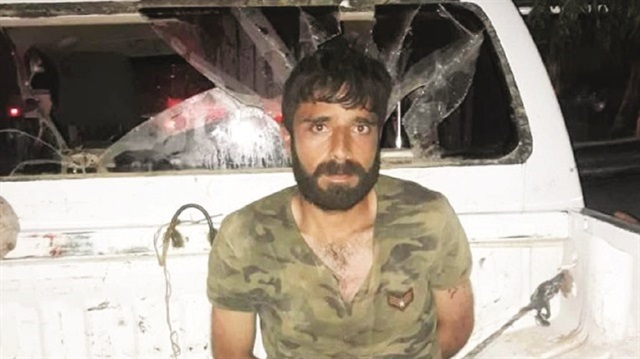
Captured terrorist Ahmad Ali Omar
As operations continue to clear opposition-controlled areas in Syria from Daesh and Kurdistan Workers’ Party (PKK) terrorists, an assassination plot in northwestern Afrin was foiled after the capture of two hitmen in Meydanki by the Turkish Armed Forces (TAF) and Free Syrian Army (FSA).
A total of 15 Daesh terrorists have been arrested in Idlib’s Saraqib in the aftermath of ongoing operations in the region.
Speaking exclusively to Yeni Şafak daily, Syrian General Abdulrazzak Arslan said that the two captured terrorists were receiving commands from the same terror cell, noting that these terror attacks aim to destabilize safe zones established by Turkey in the region.
“The U.S., Iran, Assad and EU countries have a score to settle with Turkey and the Syrian people, and they carry it out through terror elements on the field. The captured PKK and Daesh terrorists are hired pawns that serve the strategies drawn out in dark cells.”
In talks between Russia and the U.S., the Syrian affiliate of the Kurdistan Workers’ Party (PKK), the YPG, joining the Syrian army has come to the fore.According to Syria’s semi-official newspaper al-Watan daily, so-called top PKK figures have been conducting meetings with the Assad regime in Damascus.The PKK/YPG terror organization, after its failure in the northwestern region of Afrin, is enhancing ties with Assad and is preparing to join its forces.Turkish army does 8th round of patrols in Manbij, SyriaFour PKK terrorists neutralized in SE Turkey, N. IraqMinister of petroleum to be selected from PKK terroristsTalks regarding raising the regime’s flag to the east of the Euphrates River, which is under the terror group’s control, operationalizing military service centers, and giving it political and military privileges are continuing, thus the PKK will be linked to Damascus.Under the agreement between the two;The status of the regional power force of Iraq’s Baghdad which is currently the Peshmerga, will be given to the YPG/PKK terrorist organization in eastern Syria.PKK/YPG payments will be provided by the regime and terrorists who previously fought in the PKK/YPG will be considered as having completed their military duties.The language of military trainings will be reorganized as Kurdish and Arabic in PKK/YPG-dominated regions, and the Syrian Petroleum Minister will be elected from PKK terrorists.The U.S. military presence will be maintained and western companies will have rights to operate and explore for oil around eastern territories invaded by the PKK/YPG.Russia, in addition to its military presence in Lattakia, Homs, Deir ez Zor and Tartus, will have broad authority on oil and natural gas operations.Ongoing talks in Damascus with the Assad regime have been set up by Ilham Ahmed, who is in the PKK’s Qandil cadre and a top figure of the YPG. The other prominent name of the deal is Redur Khalil, the so-called official spokesperson of the YPG, as well as Omer Osi, who is a member of the Syrian parliament.Al-Watan daily, which is owned by President Bashar al-Assad's cousin, confirmed the ongoing negotiations and stated that significant steps have been taken regarding the deal, adding that the Trump- Putin summit had a pivotal role in the PKK alliance with Assad.The PKK is listed as a terrorist organization by Turkey, the European Union and the United States.
PKK terror group seeks to join Assad
A base used by modern Turkey’s founder Mustafa Kemal Atatürk in World War I was found by the Turkish Armed forces (TAF) in Rajo, a town in Syria’s Afrin region.Rajo was recently cleared of terror elements as part of Operation Olive Branch, which was launched on Jan. 20 to clear YPG/PKK-Daesh terrorists from Afrin.Dr. Süleyman Hatipoğlu, a professor at Turkey’s Hatay Mustafa Kemal University, said that Atatürk, who served as the 7th Army Commander in Palestine in 1918, first went to Aleppo in October and then to Afrin in October the same year. Atatürk and his troops were positioned at the Qatma train station in Rajo.Atatürk who gathered together a network of resistance consisting of Kurds and Arabs, established a militia force to support military units. He secured the logistics line by remaining in close contact with units in Turkey’s Kilis.Triumph over BritishThe front that extended from Iskenderun, Reyhanlı, Kırıkhan, Belen, Der al Jamal and Tell Rifaat were protected by Atatürk. The British army, heading south from Afrin, faced the 7th Army in Qatma on Oct. 26, 1918.The Ottoman army under the command of Atatürk, joined by the locals, triumphed over the British in Qatma. According to Kurdish president of the local assembly, Ibrahim Halil Ali, the stone home of Hanıf Ağa was turned into a base while Atatürk remained in the district. The home is located in the most central point of the Haji Halil village, which is in Afrin’s center.The base is now in ruins due to lack of care.“We have not forgotten this region’s history. The Ottoman army was stationed here. Our meaningful history must not be forgotten. We hope the home can be repaired to its former glory,” said Halil Ali. Atatürk’s distinguished military career included repelling the Allied invasion of the Gallipoli peninsula in 1915 and then rallying Turkey to withstand the Allies’ attempt to carve up Turkey after World War I in the War of Independence.As Turkey’s first president, Atatürk transformed the country through a wide-ranging series of modernizing reforms.
Military base of modern Turkey’s founder found located in Syria’s Afrin
Leader of terror group in Ayn Issa
A Daesh terrorist codenamed “Abu Faisal,” who served as the so-called emir of Raqqa between 2015- 2016 after the terror group seized the opposition-controlled city in coordination with PKK terrorists, is responsible for running these terror cells.
The so-called Daesh emir was dispatched by the PKK to an American-French military base in Ayn Issa.
The terrorist was being held by the U.S. since November following Daesh’s withdrawal from Raqqa in 2017.
According to local sources who spoke to Yeni Şafak daily, Abu Faisal was put in charge of the sabotage unit after Syria’s Afrin was cleared from terror elements by the TAF.
A sharp increase in terror attacks in al-Bab, Jarabulus, Azaz, Idlib and Afrin is attributed to the renewed coordination between PKK and Daesh terrorists.
A total of 103 civilians were killed in Afrin after a series of terror blasts struck the city.
Two assassins in Meydanki
Two PKK assassins were captured in the aftermath of a joint operation by the TAF and FSA fighters in Afrin’s Meydanki region.
Hasan Abdi, one of the two captured terrorists, was arrested with a silencer-equipped rifle on his person.
Abdi, who is from Turkey’s southern province Şanlıurfa, confessed to infiltrating Afrin to carry out an assassination targeting prominent figures in the region.
The PKK terrorist also confessed to entering Afrin, among groups of civilians who had returned to the region, by using fake ID cards and assassination lists supplied by the terror organization.
Operation Olive Branch was launched on Jan. 20 by the TAF in Afrin to clear the northwestern Syrian region of terror elements.
The Turkish military on Wednesday completed its ninth round of patrolling in the northern Syrian city of Manbij as part of a deal with the U.S. to rid the area of the terror group YPG/PKK.In a message posted on its official Twitter account, the Turkish General Staff said that both countries' forces conducted separate coordinated patrols in the area between the Operation Euphrates Shield region and Manbij.The first patrols by both Turkish and U.S. troops in the region began on June 18.The Manbij deal between Turkey and the U.S. focuses on the withdrawal of the PKK-affiliated YPG terror group from the city in order to stabilize the region.Syrians of Manbij look to Turkey to guarantee stabilityPKK terrorists kidnap 17 Syrian families over Erdoğan pictureIn its more than 30-year terror campaign against Turkey, the PKK has taken some 40,000 lives, including those of women and children. The YPG/PKK is its Syrian branch.Should the Manbij model prove to be a success, Turkey will push for a similar arrangement in eastern Syria.Turkey has said the presence of terror forces near its border constitute a threat and has launched military operations and other efforts to rid the region of terrorists.
Turkish army conducts 9th round of patrols in Manbij
Turkish police on Tuesday detained 23 suspects, including two pharmaceutical warehouse owners, a security guard and a police officer, who have been providing the Kurdistan Workers’ Party (PKK)’s Qandil cadre with medication.The police seized medication worth approximately TL 2 million in simultaneous raids.Operation dubbed as “Stop Wayfarer!”Turkish police had been monitoring the suspects for six months and launched an operation dubbed as “Stop wayfarer,” which is related to the Battle of Çanakkale, dealing a great blow to the PKK.It was uncovered that the suspects had been using the identity information of people who are seriously ill and that pharmacy workers who are a part of the network had been adding more medication than was necessary to the patients’ e-prescription. They also prescribed medication to healthy people without their knowledge.Turkey uses a digital e-prescription system which doesn’t allow patients to see how many drugs have been prescribed. The suspects acquired the identities of patients by waiting in front of hospitals, under the pretext of helping them.The pharmaceuticals that the PKK-linked network sent to northern Iraq via the Khabur border gate were used in the treatment of wounded terrorists.Northern Iraq’s Qandil Mountains have been a haven for PKK terrorists over the past few decades. Considered as the main base of the PKK, which control checkpoints and entrances to the mountains, the structuring in the area is used for cover and concealment by terrorists.The PKK is listed as a terrorist organization by Turkey, the European Union and the United States. The PKK has been conducting armed violence in the southeastern part of Turkey since 1984. More than 40,000 people, mostly civilians, have been killed in the three-decade long conflict.Police are still searching for an additional seven suspects.
Turkish police capture 23 suspects providing PKK terrorists with medication