

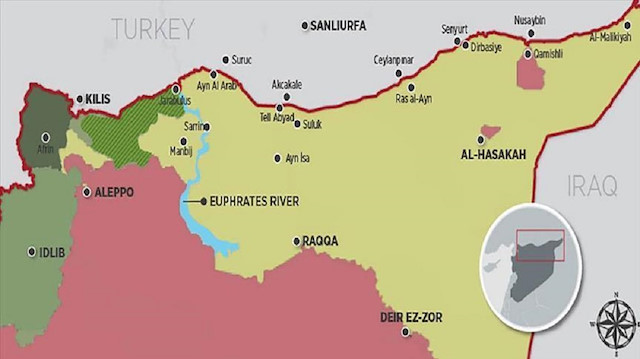
The National Liberation Front (NLF), an umbrella of anti-regime opposition groups in Syria’s northwestern city of Idlib
The National Liberation Front (NLF), an umbrella of anti-regime opposition groups in Syria’s northwestern city of Idlib, said Monday that it would support planned Turkish military operation east of the Euphrates River.
It also voiced readiness to confront the YPG/PKK terrorist group.
“By allowing sectarian militias into the country, the Assad regime has tried to alter Syria's demographic composition,” the NLF said in a statement.
"The regime has created a suitable environment for terrorist groups, including the PKK/PYD/YPG, to the detriment of the Syrian people,” the organization added.
The foreign ministers of Turkey, Russia and Iran will meet in Geneva on Tuesday as part of efforts to find a political solution to the civil war in Syria, diplomatic sources said Monday.Turkish Foreign Minister Mevlüt Çavuşoğlu will meet his Russian and Iranian counterparts at the UN office and they are expected to announce the committee which will form Syria’s new constitution, said the sources, who refused to be named due to restriction on talking to the media.UN Special Envoy for Syria Staffan de Mistura will chair the meeting.During the Syrian peace conference in late January in the Russian city of Sochi, the formation of a committee to develop recommendations to amend the Syrian constitution was agreed upon.On Friday, Russian Foreign Minister Sergey Lavrov said that Russia, Turkey and Iran will present a list of candidates for the Syrian Constitutional Committee to the UN.Syria has been locked in a vicious civil war since early 2011 when the Bashar al-Assad regime cracked down on protesters with unexpected ferocity.Since then, hundreds of thousands of people have been killed and more than 10 million others displaced, according to U.N. officials.Turkish, Syrian children build friends through footballTurkey may start new Syria operation at any moment, Erdoğan says
Turkish, Russian, Iranian FMs to meet in Geneva on Syria
A new program is aiming to use sports to build bridges between Syrian and Turkish children in the southern Hatay province.The Hatay-based Syrian Agency for Rescue (SAR) with the support of the German Society for International Cooperation (GIZ) launched "Promote dialogue and social adaptation through football" project.Within the framework of the project, 140 boys and girls between the ages of 8 and 17 were brought together in the field. Half of them are Syrian refugees in Turkey.Syrian opposition vows support for Turkish op east of EuphratesPKK/PYD terrorists in Syria will be buried in trenches they dig: ErdoğanCoaches train the teams which play football thrice a week.Mohammad Kindawi, the head of SAR, told Anadolu Agency that the project aims to improve communication between Turkish and Syrian children through football.Kindawi said they want Syrian children to adapt into Turkish culture."We are building a bridge of friendship between Turkish and Syrian children through sports," Kindawi said."At the same time, sports keeps children away from bad habits," Kindawi said, adding that the project will last three months.Both Turkish and Syrian children expressed their happiness at being able to play games and form lasting friendships in the scope of the project.US warns Syrian opposition against backing Turkish opSyrian opposition backs Turkey’s planned operation
Turkish, Syrian children build friends through football
The Assad regime, it went on to assert, “has turned Syria into a playground for rival regional powers”.
The NLF also warned that “certain parties” were actively working to derail planned Turkish military operation east of the Euphrates.
"We will support any operation aimed at ensuring regional stability, ending the terrorist presence, and allowing the return of displaced persons to their homes,” the NLF statement read.
It added: “We will not allow any group -- be it the PKK/YPG or anyone else -- to divide our country.”
In May, 11 different Syrian opposition groups joined forces in the northwestern city of Idlib under the banner of the NLF.
Turkish President Recep Tayyip Erdoğan on Monday said he told U.S. President Donald Trump that if Kurdistan Workers’ Party (PKK) terrorists are not withdrawn from the east of the Euphrates that Turkey would “remove them.”The military operation east of the Euphrates could start "at any moment," he said at a mass opening ceremony at Mevlana Square in central Konya province."We can start our operation any moment now in the Syrian territory at any place especially along the 500-kilometer border, without harming the U.S soldiers," said Erdoğan.He said the army has completed preparations for the planned operation, adding that Turkey will do "what is necessary" regarding terror corridors east of the Euphrates River.Erdogan reiterated that Turkey will not allow a terror corridor along its borders."I’m not just saying this ... Now it’s time for the area east of the Euphrates. Listen, those who are protecting terrorists in the region: You're making a mistake. Let's give up [protecting them]," the president warned.Erdogan said Turkey's fight against terrorism in Syria will continue until fresh elections are held and a comprehensive political solution is reached in the country.A possible mission east of the Euphrates, which Turkey’s leadership has been suggesting for months, would follow two successful cross-border Turkish operations into Syria since 2016 – Operation Euphrates Shield and Operation Olive Branch – both meant to eradicate the presence of YPG/PKK and Daesh terrorists near Turkey’s borders.The PKK is listed as a terrorist organization by Turkey, the European Union and the United States. The PKK has been conducting armed violence in the southeastern part of Turkey since 1984. More than 40,000 people, mostly civilians, have been killed in the three-decade long conflict.
Turkey may start new Syria operation at any moment, Erdoğan says
Syria's Assad regime and its allies have forced approximately 130,000 people to migrate -- through fierce attacks and blockades -- from cities it captured this year. On the occasion of International Migrants Day (Dec. 18), Anadolu Agency collected data from local sources that suggests that 2018 -- for Syrians -- would be remembered as a year of displacement and forced migration. Although opposition-held areas of Damascus, Homs, Daraa and Quneitra were all designated "de-escalation zones" (in line with earlier agreements signed in Astana), this did not stop the regime from attacking and blockading them, and forcing numerous residents to leave their homes. Syrian opposition vows support for Turkish op east of EuphratesPKK/PYD terrorists in Syria will be buried in trenches they dig: ErdoğanSyrians in these regions who remain opposed to the regime were relocated to refugee camps in the country’s north, where they continue to face difficult living conditions. According to data collected by the Syria Intervention Coordinators, a local NGO devoted to helping civilians, the regime and its allies have forced as many as 128,926 people to leave their homes in the period from March 14 of this year to July 31. 80,000 leave capital This year’s forced evacuations first began in the period from March 14 to May 10, when Syrians in Damascus' Eastern Ghouta, Eastern Qalamun, Qadem, Yelda, Babila, and Beit Sahm were relocated. Almost 74,000 people in Eastern Ghouta, a suburb of Damascus, and Eastern Qalamun near the Lebanese border (regarded as a symbol of anti-regime resistance) were forcibly relocated to opposition-held safe zones in Aleppo and Idlib. With another 9,250 relocated from the opposition-held Yarmouk Camp's Yelde, Yelda, Babila and Beit Sham settlements, the total number of those forced to leave opposition-held areas of Damascus this year has now reached 83,214. Car bombing kills four in Syria’s AfrinUS warns Syrian opposition against backing Turkish op35,000 leave Homs Once the forced evacuations in Damascus were completed, the Syrian regime and its allies then targeted Syria’s central city of Homs. Following a lengthy blockade, 35,648 local residents were forced to leave rural areas of northern Homs to opposition-held areas in Idlib and Aleppo in the period from May 7 to 18. The cities of Daraa and Quneitra, meanwhile, fell entirely under the regime’s control in the wake of the evacuations. Opposition groups and civilians who continued to oppose the regime in Daraa and Quneitra were also forced to relocate to northern Syria.In line with an involuntary evacuation agreement, more than 10,000 people were forced to leave their homes during the period from July 15 to 31. According to the United Nations High Commissioner for Refugees (UNHCR), the seven-year-long Syria conflict has left some 6.6 million people internally displaced and another 5.6 million seeking refugee status abroad. 'Turkey cannot tolerate state-like structures in Syria'Syrian opposition backs Turkey’s planned operationRegime stops returnees Aiming to turn the situation in its favor, the Assad regime is now trying to prevent millions of people from returning to their homes by severing their organic link with Syria. With this aim in mind, the regime has continued to confiscate -- or simply demolish -- properties left behind by those who have been forcibly relocated. In April, the regime implemented a housing law, known as “Law 10”, according to which it has the right to nationalize the property or assets of anyone who has failed to claim them within a one-year period. In mid-October, Human Rights Watch said that satellite images had shown regime forces demolishing property without giving prior notice or offering compensation. Turkey’s planned operation gives hope to SyriansYPG/PKK attacks FSA emplacements in N. Syria
Syrian regime forced 130,000 to leave homes in 2018
On Sunday, the U.S. warned opposition groups linked to the Free Syrian Army against supporting anticipated Turkish operation east of the Euphrates River.
On Monday, Turkish President Recep Tayyip Erdogan said that operation could begin "at any moment", asserting that Turkey would never allow a “terror corridor” to be set up along its border.
Syria has only just begun to emerge from a devastating conflict that began in 2011 when the Assad regime cracked down on demonstrators with unexpected ferocity.
According to UN figures, hundreds of thousands of people have been killed in the conflict to date.
The Pentagon has handed control over the observation posts established by the U.S. on Turkey’s southern borders to terrorists from the Kurdistan Workers’ Party (PKK)’s Syria affiliate, the PYD. The posts, set up in Syria’s northern border town of Tal Abyad, are the latest attempt by PKK/PYD terrorists to monitor Turkish movements across the border, using telescopes and close-up lenses. The observation posts are being protected by vehicles handed over by Washington to PKK/PYD terrorists.These points are thought to be among the first targets to be struck by the Turkish Armed Forces (TAF) when Turkey’s imminent operation east of the Euphrates River begins.President Recep Tayyip Erdoğan last week said Turkey was set to launch an operation east of the Euphrates "within a matter of days to save it from a separatist terrorist organization", referring to the terrorist PYD/PKK.Turkey says US can't hinder op east of EuphratesPKK/PYD Snipers and a large number of armored vehicles in the area are said to be pointing their barrels toward Turkey as the op looms. Tal Abyad is set to be among the most important fronts during the upcoming Turkey-led cross-border operation. Turkish units across the border in the Akçakale-Tal Abyad zone are on full alert, with howitzers and long-barreled missile launchers, which are capable of hitting targets 40 kilometers away, at the ready.The Pentagon established its first observation post in Syria’s Tal Abyad in early December about 2 kilometers away from the Turkish border on a hill, which has a clear view of Turkish soil.Syrian Turkmen, Arabs back Turkey’s planned operationOn the opposite side of the border, the Turkish Armed Forces (TAF) have an observation post in the Turkish village of Öncül, which is just 2-2.5 kilometers away from Washington’s post.U.S. Defense Secretary Jim Mattis said on Nov. 21 that the United States was setting up the posts to help keep the focus on clearing the final strongholds of Daesh terrorists in Syria and avert terror threats.“We want to be the people to call the Turks and warn them if we see something coming out of an area that we’re operating in,” Mattis said.Last week, PKK terrorists accelerated efforts to transfer weapons received from the U.S. under the pretext of fighting Daesh to Syria’s northeastern town of Tal Abyad. The shipments particularly escalated after Turkey started to shell PKK/YPG terror positions in the city and the east of the Euphrates River.The PYD and its military YPG wing are Syrian branches of the PKK, which has waged war against Turkey for more than 30 years.A possible mission east of the Euphrates, which Turkey’s leadership has been suggesting for months, would follow two successful cross-border Turkish operations into Syria since 2016 – Operation Euphrates Shield and Operation Olive Branch – both meant to eradicate the presence of YPG/PKK and Daesh terrorists near Turkey’s borders.
Pentagon hands over Syria observation posts to PKK/PYD ahead of Turkish op