

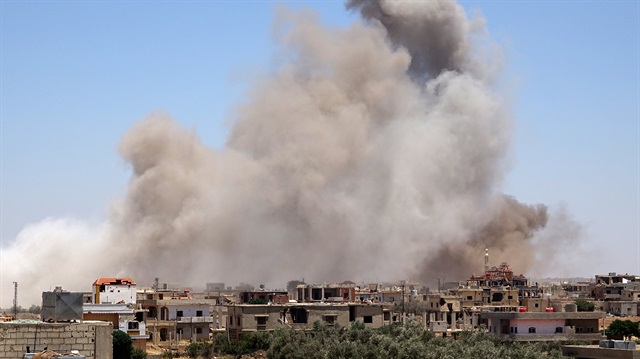
File photo
A Syrian opposition spokesman said a Russian-mediated ceasefire agreement in eastern parts of Daraa province includes a withdrawal of government militias from several towns in the south.
Ibrahim Jabawi, the spokesman, said local forces overseen by Russia would take charge of the area.
Jabawi earlier said the opposition had agreed on a phased handover of their weapons and the deployment of Russian military police in the area near the Jordanian border as part of the deal.
Jordan's army has sent reinforcements to its northern border with Syria as Syrian government forces backed by Russian air strikes appear poised to seize the main frontier crossing from rebels, officials said on Friday.The army, which had deployed more armoured vehicles in the area, has set in motion "contingency plans to face any eventuality" as the Syrian government offensive closes in on the Nasib crossing, diplomatic sources said.Reopening the crossing, a vital trade artery which has been in rebel hands since 2015, is a major objective of the Syrian government campaign that aims to recover the entire southwestern corner of Syria from rebel foes of President Bashar al-Assad.But Jordan, a staunch ally of the United States, wants first to make sure that Assad's Russian allies play a central role in stabilising southern Syria, fearing that any upheaval there will affect its own security, officials in Jordan said.Jordan has always taken a cautious approach to the Syrian conflict that spiralled out of street protests against Assad's rule in 2011.Though Jordan was an important sponsor of rebels in the south, analysts said this support was always aimed primarily at safeguarding its border from security threats such as Islamic State militants, not toppling Assad.Amman has played a leading role in getting Syrian rebels to agree to terms of surrender that include stationing of Russian military police in the south. Rebels hope the Russians will guarantee the safety of civilians from state retribution.An official said Jordan is favourable to a Russian military police presence on parts of the border to help exclude Iranian-backed militias that have been supporting Assad's forces and which are seen as a menace by Amman.Witnesses said military vehicles flying Russian flags were spotted near the Nassib crossing on Friday.REFUGEE PREDICAMENTThe Syrian government campaign has created a new problem for Jordan in the shape of tens of thousands of civilians who have fled the offensive towards the border.The United Nations has called on Jordan to open its border. Jordan, which is already hosting some 650,000 Syrian refugees, has refused so far, citing a combination of security and economic pressures.The U.N. refugee agency says around 60,000 Syrians have gathered near the Nassib crossing. The total number of displaced by the offensive now stands at over 320,000 people.Footage posted on social media of women and children pleading with King Abdullah to let them in has generated a wave of sympathy in Jordan with the plight of the newly displaced Syrians.Syrian families have set up tents near the border in the hope Jordan will let them in. Some say they cannot contemplate returning to live under Assad's rule, and that they would instead storm the frontier."There is no option for us if we see them (the regime) getting close," said Omar Abu Hamed, who fled from Russian bombing in the town of Saida, which fell to government troops on Thursday. He added that people feared persecution or worse.Another displaced Syrian, Umm Zaid, a mother of five who had lost her husband in the latest offensive, said she would break through the fence if necessary, speaking to Reuters from the border area by phone.General Mahmoud Freihat, Jordanian chief of staff, has warned the army will deter any threat to Jordanian security.But "we cannot direct our arms towards a civilian or displaced (person) and we are dealing with this matter with caution", he was quoted as saying by a state newspaper. 
Jordan beefs up border defences with Syrian army at frontier
Opposition agrees to lay down heavy weapons in S. Syria
Syria’s armed opposition has agreed with Russia to surrender its heavy weapons in the southern part of the country, an opposition spokesman said Friday.
Hussein Abu Shaimaa told Anadolu Agency that the deal also calls for the withdrawal of Bashar al-Assad regime forces from some of the towns and villages they recently captured.
The agreement further calls for Russian military police to gradually replace regime forces following the withdrawal of the latter from areas near the Jordanian border.
Under the terms of the arrangement, anyone wishing to leave the area once the deal takes effect will be granted safe exit.
Turkey’s foreign minister on Friday said Turkey and the US agree that after the northern city of Manbij, other Syrian regions will be rid of PKK/YPG terrorists.Speaking at Anadolu Agency’s Editors' Desk, Mevlüt Çavuşoğlu said: “There is a clear consensus [with the U.S.] on our roadmap that we will move on to other areas after Manbij [has been cleared of PKK/YPG terrorists].The roadmap was announced last month after a meeting in Washington between Çavuşoğlu and U.S. Secretary of State Mike Pompeo.The deal focuses on the withdrawal of the PKK-affiliated YPG terror group from Manbij and stability in the region.German intelligence calls PKK, PYD 'sister' groups"The Kurds in Kobani need not worry about the roadmap, because the YPG is persecuting them. We will analyze the demographics and if the majority is Kurdish, then this will be reflected in the administration, but the YPG/PKK will not be a part of this," Çavuşoğlu said.Speaking on the Turkish army patrols in the northern Syrian city of Manbij, Çavuşoğlu said the YPG/PKK’s withdrawal from patrol areas in Manbij does not mean they have completely withdrawn.On Wednesday, the Turkish military completed its ninth round of patrols in Manbij as part of a deal with the U.S. to rid the area of the terror group YPG/PKK.On its Twitter account, the Turkish General Staff said that both countries' forces conducted separate coordinated patrols in the area between Manbij and the area previously cleared by Turkey’s Operation Euphrates Shield.Video: Joint Turkey-US patrol forces enter Syria's ManbijThe first patrols by Turkish and U.S. troops in the region began on June 18.In its more than 30-year terror campaign against Turkey, the PKK has taken some 40,000 lives, including those of women and children. The YPG/PKK is its Syrian branch.Çavuşoğlu also stated Turkey’s resolve to continue counterterrorism operations in northern Iraq.“We will do what is necessary for the terrorist PKK to be cleared from Iraqi territories,” he said.The PKK is listed as a terrorist organization by Turkey as well as the U.S. and the EU. In its terror campaign against Turkey, which has lasted for more than three decades, over 40,000 people have been killed, including women and children.S-400 dealAbout how bilateral ties might get affected if the U.S. imposes sanctions on Turkey due to its S-400 purchase, the foreign minister said: "The U.S. administration will make the decision. The administration does not want to harm relations with Turkey."Especially, [Donald] Trump himself does not want to harm relations with Turkey. He, in real terms, respects our Mr. President.”Under an accelerated timetable for the S-400 deal, Russia's first deliveries of the advanced anti-aircraft missile system to Turkey are due in late 2019 or early 2020.The S-400 is Russia's most advanced long-range anti-aircraft missile system with a capacity of carrying three types of missiles capable of destroying targets including ballistic and cruise missiles.The system can track and engage up to 300 targets at a time and has an altitude ceiling of 27 kilometers (17 miles).Israeli forces attack peaceful protest in E. J'lem with tanks, bulldozersRelations with IsraelAbout Turkish-Israeli relations, Çavuşoğlu said Israel was maintaining an aggressive attitude towards Turkey.“Israeli should cease its wrong policies and merciless cruelty, which is incompatible with humanity, in order to normalize our relations with Israel in real terms,” Çavuşoğlu said.On Turkish national Ebru Özkan’s arrest in Tel Aviv, Çavuşoğlu said: “They [Israel] have been taking steps to deter our citizens from visiting Jerusalem. We will respond to this.”An Israeli military court on Tuesday extended the detention of Özkan, who had been under arrest since June 11 for alleged links with terrorist groups, the lawyer said.Iran nuclear dealOn U.S. withdrawal from Iran nuclear deal, Çavuşoğlu said: “We don’t find the U.S. decisions on sanctions on Iran right.”In May, Trump withdrew the U.S. from the nuclear deal, which was signed in 2015 between Iran and the P5 1 group of nations (the five permanent members of the UN Security Council plus Germany). The deal placed restrictions on Iran’s nuclear program in exchange for billions of dollars in sanctions relief.He said Iran should not be forced into a corner since it would be "dangerous and risky”.Çavuşoğlu added the U.S. decision against Iran had been taken upon Israeli demand and had no justification.Also, on Austria’s taking over of the rotating presidency of the Council of the European Union from Bulgaria on July 1, the foreign minister said: “We also do not expect Austria to take a radical decision.”Austria assumed the presidency for the third time after its terms in 1998 and 2006.Turkey issues arrest warrants for 346 FETÖ suspectsFight against FETOAbout the fight against Fetullah Terrorist Organization (FETÖ), Çavuşoğlu said: “We will see how seriously they [U.S.] will take it after everything is put on the table. The U.S. should not lose its ally like Turkey.”Urging the U.S. to give up its “wrong policies” against Ankara, he urged the Washington administration to fulfill Turkey’s demands against FETÖ.According to the Turkish government, FETÖ and its U.S.-based leader Fetullah Gulen orchestrated the defeated coup of July 15, 2016, which left 251 people martyred and nearly 2,200 injured.Ankara also accuses FETÖ of being behind a long-running campaign to overthrow the state through the infiltration of Turkish institutions, particularly the military, police and judiciary.
Turkey, US agree on clearing Syrian regions of PKK
Over 350,000 people have fled Syria’s southwestern city of Daraa to border areas near Jordan and Israel due to attacks by Syrian regime forces and their allies, according to civil defense sources on Friday.On June 12, the Syrian regime, supported by Iranian militia groups and Russian air power, launched a major operation aimed at capturing opposition-held parts of southern Syria.Civil defense sources in Daraa told Anadolu Agency that the number of people fleeing Daraa has surpassed 350,000.Mostly women and children civilians are looking for shelter near the Jordanian border.Video: Number of Syrians fleeing Daraa exceeds 350,000Galeri: Number of Syrians fleeing Daraa hits 150,000An Anadolu Agency drone has captured on film civilians from Daraa trying to live in makeshift tents.According to the U.K.-based Syrian Network for Human Rights, at least 214 civilians -- including women and children -- were killed in regime attacks in Daraa in the period from June 15 to June 30.The onslaught has reportedly forced tens of thousands of civilians to flee to areas near Syria’s border with Jordan.On Thursday, the UN called on Jordan to open its border and provide temporary shelter to tens of thousands of Syrian people fleeing airstrikes in southwestern Syria.
Number of Syrians fleeing Daraa exceeds 350,000