

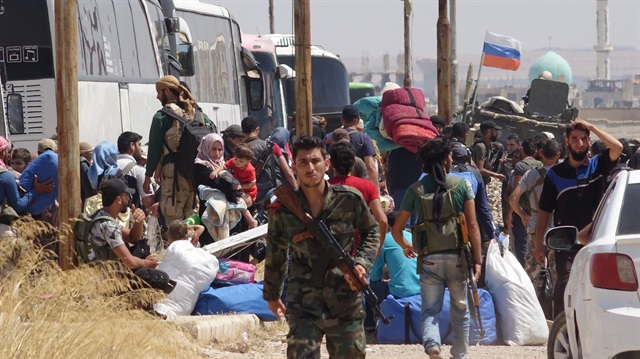
File photo: 1st convoy of regime opponents leaves Syria’s Daraa
Bashar al-Assad’s regime and opposition forces have made another deal to evacuate thousands of civilians and fighters from two besieged districts in northwest Syria, according to opposition sources on Tuesday.
The agreement hammered out between the two sides calls for the evacuation of civilians from Kefraya and Al-Fuaa districts of Idlib.
Both Kefraya and Al-Fuaa districts remain surrounded by opposition forces.
Under the new deal, a total of 6,900 people will be evacuated, while the Assad regime will release 1,500 civilians and fighters.
At least ten civilians, the majority of whom were children, were killed after a barrel bomb attack carried out by the Syrian regime and its allies targeted a school in the town of Ain Teineh, in the southwest province of Quneitra.The Syrian regime army and its allies have taken control of the strategic hill overlooking the Israeli-occupied Golan Heights as Assad pushes forward with an offensive to seize the remaining parts of the southwest from opposition fighters.The region has been heavily bombed by Russian and Syrian regime airstrikes in the past two days as the army has moved closer to the Israeli border after gaining control of most of Daraa province in a military excursion that began last June.The regime offensive has caused a major displacement crisis in Daraa, with an estimated 350,000 civilians fleeing the province in recent days towards areas near the Jordanian border.Syrian civilians approach Israeli frontier fence in Golan HeightsThe opposition-held towns of Qusaiba, Sweisa and Ain Teineh were being bombarded into submission by the Assad regime and its allies.Following peace talks held last year in Astana, Daraa and Quneitra were both designated as “de-escalation zones” in which acts of aggression are prohibited. The opposition remains in control of most of the border-adjacent Quneitra province, however, the Daesh terror group still maintains a presence in the southern border pocket of Tasil.Iranian advisors still in southern Syria: Rouhani envoy
Syrian regime barrel bomb attack on school kills 10 civilians in Quneitra
Dozens of people walked on Tuesday from Syrian refugee encampments on the Golan Heights to Israel's nearby frontier fence, where they stopped some 200 metres (yards) away and were ordered by an Israeli soldier to turn back."You are on the border of the State of Israel. Go back, we don't want to hurt you," the soldier shouted in Arabic through a loudspeaker at the crowd, live Reuters TV footage showed.The Syrian army is pressing a Russian-backed offensive against oppositions in the area."Go back before something bad happens. If you want us to be able to help you, go back," an Israeli army officer on the Israeli side of a frontier fence told the crowd in Arabic through a megaphone. "Get a move on."A witness on the Syrian side of the frontier said people were seeking shelter wherever they could as the offensive drew closer to their location.The Syrians who approached the frontier fence stopped some 200 metres (yards) away, before an Israeli soldier told them to leave.Video: Syrian civilians approach Israeli frontier fence in Golan Heights"You are on the border of the State of Israel. Go back, we don't want to hurt you," the soldier shouted in Arabic through a loudspeaker at the crowd, live Reuters TV footage showed.The crowd, which included women and children, then walked back slowly towards the refugee encampment. Some stopped mid-way and waved white cloths in the direction of the Israeli frontier.
Syrian civilians approach Israeli frontier fence in Golan Heights
Last year, many prisoners in al-Yarmouk refugee camp, Madaya and al-Zabadani, as well as in the regime’s prisons, were freed as part of a deal to evacuate the Shias in Kefraya and Al-Fuaa.
The two Shia-majority districts will be completely evacuated should new evacuation takes place.
Notably, Idlib falls within a network of de-escalation zones -- endorsed by Turkey, Russia and Iran -- in which acts of aggression are expressly prohibited.
Syria has only just begun to emerge from a devastating conflict that began in early 2011 when the Assad regime cracked down on demonstrators with unexpected ferocity.