

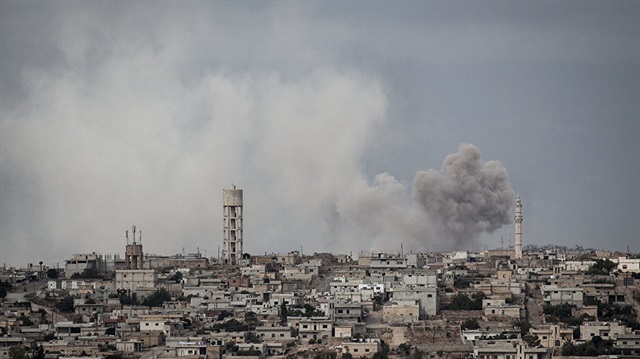
File photo
An article I wrote back in February of this year for Anadolu Agency's News Analysis Desk was titled "Control of Syrian Airspace: Flying in a Minefield" [1]. The article in question maintained that the Syrian airspace had become the most dangerous airspace in the world, predicting that major tensions could be sparked off any moment due to Russian military presence and the strengthening of the Syrian Arab Air Defense Force in the face of intensifying interventions by the Israeli Air Force. An event in Sept. 2018 confirmed the predictions of the open-source intelligence analysis in question. While the Israeli Air Force was carrying out an attack on a number of military targets in Syria, a Russian IL-20 (Ilyushin-20) electronic intelligence and reconnaissance aircraft that happened to be in the operation zone was hit by an S-200 long-range air defense system operated by the Baath regime.
The only point that the Russian and Israeli sources have agreed on is that the defense system that downed the IL-20 was an S-200 SAM (surface-to-air missile), which belonged to the Syrian Arab Air Defense Force. Apart from this important detail, widely different statements came from the two states as to what happened. However, there is a more critical aspect of the incident than the debate on which military-technical and diplomatic explanation may have been closer to the truth than others. Immediately after the incident, Moscow announced that it was delivering S-300 air defense systems to the Baath regime and that it had launched an extensive air defense modernization program. On the other hand, in addition to Israel not indicating that it would stop its activities in the Syrian airspace, news articles appeared in the international press saying that the primary goal of the U.S. administration in Syria was to put an end to Iran's forward-deployed military bases. Apparently, given the current circumstances, we will now have to use more dire terms than "minefield" to talk about the Syrian airspace. While many evaluations coming from international strategy circles are exclusively focused on the critical M4 and M5 highways, the Euphrates, and a number of tactically significant residential areas, there is something that is partly overlooked and partly covered-up: it is the fact that the Syrian airspace is the primary factor in determining the course of the war, and particularly in its tendency to erupt into a regional conflict. In the last three years, the most critical and sensational conflicts in which state-level actors directly targeted each other have occurred in the air.
The USS Ross, a U.S. Navy guided-missile destroyer, docked in Israel’s southern Port of Ashdod on Monday.According to Israeli news website Ashdod.net, the USS Ross -- which last visited the port in 1999 -- “is famous for firing Tomahawk missiles at the Daesh terrorist group’s bases in Syria”.During their stay, crewmembers will visit several local sites in Ashdod and participate in activities with local residents, the website reported.And on Thursday, it added, the U.S. embassy in Israel (recently relocated to Jerusalem) will hold a “special ceremony” marking the 234th anniversary of the U.S. Navy’s establishment.Israel preparing for offensive against Gaza: NetanyahuThe website went on to quote Port Director Orna Bikhor as saying: "Washington and Israel have common interests in the region, so we expect to see more [U.S.] ships dock in Ashdod.”"The return of American naval vessels to Ashdod reflects the depth of Israeli-U.S. relations," she asserted.According to Israel’s Channel 10, the Arleigh Burke-class destroyer carries a crew of 400 naval personnel.
US naval destroyer docks in Israel's Ashdod Port
What does the delivery of S-300s to Syria mean?
The S-200 SAM system is essentially a Cold War legacy. Designated by the NATO as SA-5 Gammon, the system was designed in the 1960s for strategic air defense. The available information in the literature show that Syria had in its possession an export version of this system as early as the 1980s. The S-200 systems in the Syrian inventory, which, until recently, remained highly insignificant because of their static structure and obsolete technology, were silent, for instance, in the face of the Israeli intervention against the al-Kibar nuclear facility in 2007. There have been reports, however, stating that these systems were endowed with more reliable capabilities through Moscow's modernization efforts that began after 2016. In fact, in Feb. 2018, the S-200s shot down an F-16I of the Israeli Air Force.
Technically speaking, we know that the S-300 SAM family (or more precisely, the S-300 SAM families, which include the V and P series) are mobile systems, unlike the S-200, which is a second-generation Soviet SAM system, which means that it operates on the design philosophy of static air defense configurations. Therefore, in the event of a war, the S-300s have a much greater chance of survival than the S-200s. Additionally, the S-300 systems have a clear advantage over the S-200s in terms of the number of targets they can concurrently engage and their network-centric capabilities.
Compared to the S-400s, however, the S-300s are more vulnerable to electronic warfare measures and their capabilities against stealth aircraft, such as the F-35, are rather limited. The Russian Federation has already deployed S-400s in Syria.
The Syrian opposition and other anti-regime forces on Monday completed the withdrawal of all their heavy weapons from Idlib frontlines in northwestern Syria.Meanwhile, Russian Deputy Foreign Minister Sergey Vershinin told Sputnik news that Ankara and Moscow had agreed on the borders of Idlib’s demilitarized zone."The borders of the demilitarized zone have been already determined. Very good contacts, cooperation, ties have been established between the military of Turkey and Russia," Vershinin said.Video: Opposition heavy weapons removed from IdlibFollowing a meeting in Sochi last month between Turkish President Recep Tayyip Erdogan and his Russian counterpart Vladimir Putin, the two countries agreed to establish a demilitarized zone in Idlib, Syria’s last opposition stronghold.Ankara and Moscow also signed a memorandum of understanding calling for the "stabilization" of Idlib's de-escalation zone, in which acts of aggression are expressly prohibited.Under the deal, opposition groups in Idlib will remain in areas in which they are already present, while Russia and Turkey will conduct joint patrols in the area with a view to preventing renewed fighting.PKK is hiding behind US flags in Manbij: Syrian Turkmen Council headMostly controlled by the Free Syrian Army, Idlib is located just across the border from Turkey’s southern province of Hatay.Syria has been locked in a vicious civil war since early 2011 when the Assad regime cracked down on pro-democracy protests with unexpected ferocity.Since then, hundreds of thousands of people have been killed and more than 10 million others were displaced, according to UN officials.Galeri: Withdrawal process of heavy weapons in Idlib
Syrian opposition completes withdrawal of heavy weapons from Idlib frontline
In sum, having the S-300s, for the Syrian Baath regime, is a defense acquisition that must be seen as a great leap forward in terms of its own inventory and particularly given that it had been seeking to obtain these systems for many years. Yet, this development, on its own, will not cause a serious jolt in the military strategic balance between Syria and Israel. The most important issue, however, is that Moscow has been imposing a political will to have the Syrian airspace closed to third parties. Russian military strategy circles have been known to have this tendency for a long time. And with the downing of the IL-20 fighter jet, the Kremlin seems to have got closer to making this tendency a reality.
Of course, Moscow's program of boosting its air defense capabilities in Syria is not limited to the S-300s. It was previously known, for example, that numerous low-to-mid-altitude Pantsyr S-1 air defense systems were delivered to the regime forces. In addition to the S-300s, these deliveries might be followed by the introduction of new measures in Syria, such as a more intensive deployment of advanced electronic warfare capabilities, the strengthening of the radar network, and the boosting of the inventory of low- and medium-altitude SAMs. Of course, one must understand that Israel will be taking measures too. Even if the Syrian airspace proves too risky, the Israeli military elite have options, such as tactical ballistic missiles and long-range guided rocket strikes.
Syrian Turkmen Council head Dr. Muhammed Vecih Cuma stated that the locals of Syria’s Manbij, which is currently occupied by Kurdistan Workers’ Party (PKK) terrorists, were reaching breaking point.“Through successful diplomacy, Turkey saved the lives of people in Idlib. It is doing the same in Manbij. That is why it is showing such great patience. If there is an operation, Manbij locals will stand among the ranks of Turkish troops and the Free Syrian Army (FSA),” Cuma said in an exclusive interview with Yeni Şafak daily.Terror group hides behind U.S. flags“The U.S. is trying to preoccupy Turkey with the terrorists’ trenches. The PKK is hiding behind U.S. flags in Manbij. If Americans weren’t there, and if they didn’t have arms or political support, the locals would have cleared the area of those terrorists. Turkey is showing this much patience to ensure a non-military political solution in which civilians are not harmed. That is why it is using a diplomatic path,” he added.The U.S. has established 13 operational military bases in the YPG/PKK controlled territories including Hasakah, Raqqa, Manbij, Kobani and Tal-Abyad in Syria.US trained PKK terrorists behind bombing that martyred eight Turkish soldiersAfter Turkey and the U.S. agreed this June to a roadmap agreement for removal of the YPG/PKK terror organization from Manbij, the terror group has, to the contrary, stepped up its presence and activities in the area.Turkish President Recep Tayyip Erdoğan’s spokesman İbrahim Kalın on Oct. 3 said Washington was stalling over the establishment of joint patrols with Turkey in the northern Syrian town of Manbij which the two countries agreed upon, and Ankara sees the delay as a growing problem.Afrin tactics being used in Manbij“The Americans are not fulfilling the agreement they signed. There were things they had to do, and none of it has been done. On the contrary, trenches are being dug in Manbij by the terrorists. Even though promises were made that the terror group would leave Manbij, the PKK is using the same methods used in Afrin to dig trenches that are 30 kilometers long around the city,” Cuma said.'Turkey to never stop fight against terror'Qandil cadre running Manbij“Nothing has changed for Manbij locals. They are being oppressed. The so-called 25-year-old administrators from Qandil are running Manbij. There is no justice or democracy there, only oppression and pressure. We found out that some locals have started to rally because they are sick of the oppression. I think that in the coming days, community mobilization will increase,” he added.Northern Iraq’s Qandil Mountains are considered as the main base of the PKK.Terror group utilizing trench warfare tacticsThe terrorist group has completed the construction of trenches and embankments in areas surrounding the Manbij city center. The PKK has formed embankments at various depths in front of trenches to make up a series of lines stretching nearly 30 kilometers (18.06 miles). The YPG/PKK terrorists also built tunnels linking trenches to use during possible combat.The PYD and its military YPG wing are Syrian branches of the PKK, which has waged war against Turkey for more than 30 years.“The trenches the terror group has dug will be futile. When the operation is launched, the terrorists will lose. They are digging trenches and preparing, but really, they are hiding behind the U.S. flag. The terrorists there are in control of everything and they gain this power from the U.S.’s weapons and planes. The U.S. has given the terrorists more than 19,000 trucks worth of arms and these are being used against the locals,” Cuma said.Video: YPG/PKK dig ditches around Manbij in fear of Turkish forcesYPG/PKK terror group digging in around Manbij, Syria
PKK is hiding behind US flags in Manbij: Syrian Turkmen Council head
Geopolitical focal point: Iran-Israel struggle escalating in Syria
In the political-military focal point of the S-300 crisis in Syria, there remain the Israeli Air Force, the forward-deployed elements of the Russian Federation's Aerospace Forces as well as the Syrian Arab Air Defense Forces. However, if this issue is seen from a wider perspective, one can realize that the actual geopolitical center of gravity of these events is the Iranian presence in Syria, which is becoming more and more permanent and taking on an increasingly strategic nature, coupled with the game-changing arms deliveries to the Lebanese Hezbollah. Being aware of this nuance can help one understand critical developments.
The military alliance between Syria and Iran that developed in the early 2000s amidst the Bush administration's threats of large-scale military interventions is at a completely different point today. Although the Syrian-Iranian military agreement, which was forged in 2005-2006 and which has so far regulated the relations between the two countries in the area in question, did facilitate, in some ways, the Damascus administration's defense acquisitions, it had two major shortcomings. This agreement did not give Tehran the right to have permanent bases in Syria, nor did it include a clear casus foederis, similar to NATO's Article 5, which declares that an attack against any one of the parties will be considered as it was directed against the entire pact. Today, however, beyond the military presence of the Revolutionary Guards' Quds Forces and the proxy armed groups, there are Iranian missile and rocket production facilities identified by open-source satellite imagery intelligence. Moreover, during Iranian Defense Minister Amir Khatami's visit to Damascus in August 2018, Tehran's presence in Syria gained a new international context and a permanent Iranian military presence in the Syrian territory was given emphasis at the highest level. As long as this situation persists, it is inevitable that Israel will intensify its military interventions. And these interventions will put Israel on a collision course with Russia in an increasing manner.
The Syrian airspace and future of the conflict
In Syria, the equation being overlooked but one with the highest risk of triggering a regional conflict is the airspace. Interestingly enough, from the outset of the war, control maps for Syria, including most of those published by the Turkish press as well as think tanks, dealt with the war from a one-dimensional perspective, with the aim of gaining control of the land. For instance, most of the analyses that explain that the regime forces controlled 25 percent of Syria until a few years ago and has now taken more than 70 percent of it under control are simply references to terra firma. But the truth is otherwise. Full dominance over a country can only be achieved when there is a collective control over its land, airspace and territorial waters. Even though the Syrian Baath regime seems to have gained a significant amount of control over its territory, the situation in the airspace is very different.
Finally, let us wrap up with a brief evaluation for the benefit of Turkish decision-makers and defense industry, noting that the military lessons drawn from the ongoing war in Syria are of vital importance to Ankara. There are two trends that need to be monitored carefully: first, the air defense capabilities around Turkey are becoming increasingly more advanced, and, more importantly, air defense systems more effective than the Soviet-legacy weaponry of the Cold War have been introduced, especially in the Middle East. A natural consequence of these developments is that the regional operational capabilities of the Turkish Air Force are being increasingly surrounded by A2/AD (anti-access / area denial) nodes and contested airspaces. Therefore, we need to emphasize that, in the years ahead, the ability of stealth platforms to perform network-centric operations in the depths of the battlefield (e.g. the capabilities to be provided by the F-35 Joint Strike Fighter), long-range offensive opportunities enabled by stand-off smart munitions (e.g. the SOM-J air-to-ground cruise missile), and the anti-radiation capabilities (ideally anti-radiation UAV systems) will be of great importance.
[1] https://www.aa.com.tr/tr/anali...
Translator: Omer Colakoglu
By Can Kasapoglu, a defense analyst at the Center for Economics and Foreign Policy Research (EDAM), an Istanbul-based think tank.