

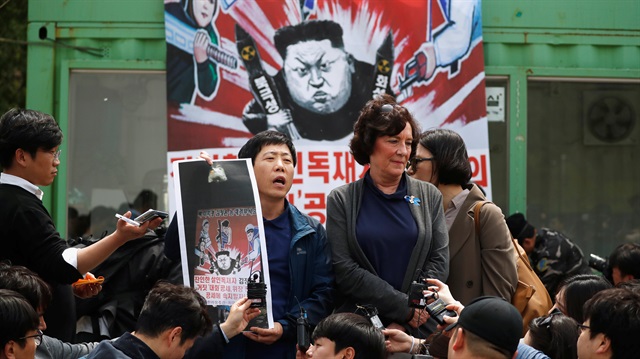
Park Sang-hak, a North Korean defector and leader of an anti-North Korea civic group, speaks as he prepares to release balloons containing leaflets denouncing North Korean leader Kim Jong Un, near the demilitarized zone in Paju, South Korea.
A South Korean government spokesman insisted Wednesday that a dozen North Korean restaurant employees who defected to the South in 2016 did so "of their own free will".
The case drew global attention at the time because North Korea accused Seoul of abducting the group, who are known to have left their posting in China in April 2016.
South Korea has officially welcomed thousands of defectors seeking to escape Pyongyang's authoritarian regime, but the restaurant staff were supposedly loyal citizens who had been allowed to work overseas.
There is "very clear evidence of humanitarian need" in North Korea, the top U.N. aid official has said during the first visit of its kind to the isolated country since 2011.U.N. Humanitarian Chief Mark Lowcock arrived in the North Korean capital of Pyongyang on Monday, and posted a video online late on Tuesday outlining his observations after travelling to several areas in the southwest of the country."One of the things we've seen is very clear evidence of humanitarian need here," he said in the video, posted to his official Twitter account and the U.N. website."More than half the children in rural areas, including the places we've been, have no clean water, contaminated water sources."Cyprus is our national cause: ErdoğanAlthough humanitarian supplies or operations are exempt under U.N. Security Council resolutions, U.N. officials have warned that international sanctions over North Korea's nuclear weapons and ballistic missile programmes are exacerbating humanitarian problems by slowing aid deliveries.About 20 percent of children in North Korea suffer from malnutrition, highlighting the need for more funding for humanitarian aid, Lowcock said.Access for humanitarian workers was improving, he said without elaborating, but he noted that funding was falling short.The United Nations says it had to stop nutrition support for kindergartens in North Korea in November because of a lack of funds, and its "2018 Needs and Priorities Plan" for North Korea is 90 percent underfunded.While visiting a hospital that is not supported by the United Nations, Lowcock said there were 140 tuberculosis patients but only enough drugs to treat 40 of them.More than 10 million people, some 40 percent of the population of North Korea, need humanitarian assistance, the United Nations said in a statement.Lowcock was due to meet government officials, humanitarian agency representatives and people receiving assistance to get a better understanding of the humanitarian situation, the United Nations said.
UN aid chief says 'clear evidence of humanitarian need' in North Korea
"I understand that the workers came to the South of their own free will," Unification Ministry spokesman Baik Tae-hyun told reporters according to Yonhap News Agency. "I have nothing more to say about that."
A day earlier, the UN special rapporteur on human rights in North Korea asked for an independent investigation, having spoken to some of the defectors in question.
"It is clear that there were some shortcomings in regards to how they were brought to South Korea," Tomas Ojea Quintana was quoted as saying by Yonhap.
"From the information I received from some of them, they were taken to [South Korea] without knowing they were coming here," he added.
Moreover, the defectors' former restaurant manager implicated Seoul's intelligence agency when he told a local broadcaster in May that he had deceived his staff members when bringing them to the South.
South Korean prosecutors are looking into the case, which has been shrouded in secrecy to protect the identities of the defectors, given that North Korea has regularly been accused of persecuting the relatives of citizens who willingly escape the country.