

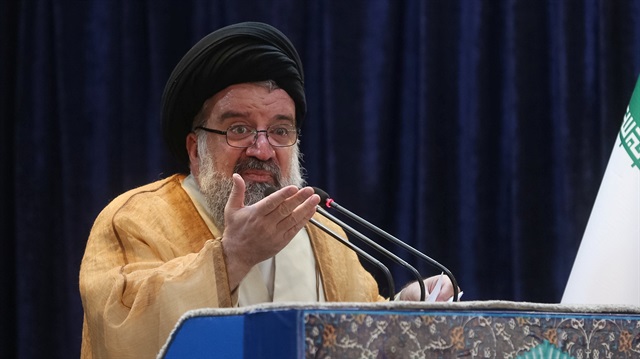
Iranian cleric Ayatollah Seyed Ahmad Khatami
A senior Iranian cleric warned Washington on Wednesday that if it attacked Iran, the United States and allied Israel would be targeted, as a war of words escalated after the reimposition of the U.S. sanctions on Iran.
Ahmad Khatami also told worshippers attending Eid prayers in Tehran that President Donald Trump’s offer of talks with Iranian leaders was unacceptable, as the U.S. leader wanted Tehran to concede on its missile programme and regional influence.
"Americans say you should accept what we say in the talks. So this is not negotiation, but dictatorship. The Islamic Republic and the Iranian nation would stand up against dictatorship," Khatami was quoted as saying by Mizan news agency.
"The price of a war with Iran is very high for America. They know if they harm this country and this state in the slightest way, the United States and its main ally in the region, the Zionist regime (of Israel) would be targeted," Khatami said.
Khatami did not elaborate which forces would carry out such attacks, but Iran has said it could target Israeli cities with its missiles if it is threatened. Iran also has proxies in the region, including Lebanon's Hezbollah group.
Iranian President Hassan Rouhani said on Tuesday that the Islamic Republic's military prowess was what deterred Washington from attacking it, and vowed to boost Iran's military might.
The Trump administration slapped sanctions back on Iran this month after withdrawing from the 2015 international nuclear deal with Iran, saying it was too soft on Tehran and would not stop it developing a nuclear bomb.
Washington imposed new sanctions in August, targeting Iran's car industry, trade in gold and other precious metals, and purchases of U.S. dollars. Trump has said the United States will issue another round of tougher sanctions in November that will target Iran's oil sales and banking sector.
Trump's national security adviser told Reuters on Wednesday that the U.S. president wanted maximum pressure on Iran.
"There should not be any doubt that the United States wants this resolved peacefully, but we are fully prepared for any contingency that Iran creates,” John Bolton said.
Iran’s Supreme Leader Ayatollah Ali Khamenei has rejected Trump's offer of unconditional talks on a new nuclear deal, prompting Trump to tell Reuters in an interview on Monday: "If they want to meet, that's fine, and if they don't want to meet, I couldn't care less."
Iranian President Hassan Rouhani said on Tuesday that the United States does not dare to attack Iran as it is aware of the Islamic Republic's military power and the high price of conflict."Why the United States does not attack us? Because of our power, because it knows ...its consequences," Rouhani said in a speech broadcast live on state television.Rouhani said the country had to develop its military forces to prevent other states taking over its territory and resources."We should make ourselves ready to fight against the military powers who want to take over our territory and our resources," Rouhani said in a speech broadcast live on state television on National Defence Industry Day.
Rouhani says US doesn't dare to attack Iran
Cooperation between Turkey and Iran will continue in the upcoming period as it has in the past, Iran’s Foreign Ministry said Monday.“Cooperation between our two countries has been very positive,” ministry spokesman Bahram Qasimi said at a news conference in Tehran.“This is set to continue in the upcoming period,” he added.Regarding recently-imposed U.S. import tariffs on certain Turkish goods, Qasimi said: “I’m confident that the Turkish people will overcome the problems they face.”As for an upcoming trilateral summit between Turkey, Russia and Iran, the spokesman confirmed that the event -- at which participants will discuss the future of Syria -- would be held early next month in Tehran.On Aug. 7, the U.S. re-imposed a first round of economic sanctions on Iran, which mainly target the country’s banking sector.The sanctions are intended to hinder Tehran's acquisition of U.S. currency; its precious metals trade; bank transactions denominated in Iranian currency; activities related to Iran's sovereign debt; and the country’s automotive sector.Earlier this month, Turkish Energy and Natural Resources Minister Fatih Donmez said that trade between Turkey and Iran would continue as part of a long-term bilateral contract that will remain in effect until 2026.
Iran to continue cooperating with Turkey: FM spokesman
Iran's oil minister said on Monday that France's Total has officially left Iran after the United States threatened to impose sanctions on companies that do business in the country, Iranian state TV reported."Total has officially has left the contract to develop the South Pars Gas project's phase 11 ... the process to replace with another company is underway," Bijan Namdar Zanganeh was quoted as saying by TV. 
Iran says France's Total has officially left South Pars deal