

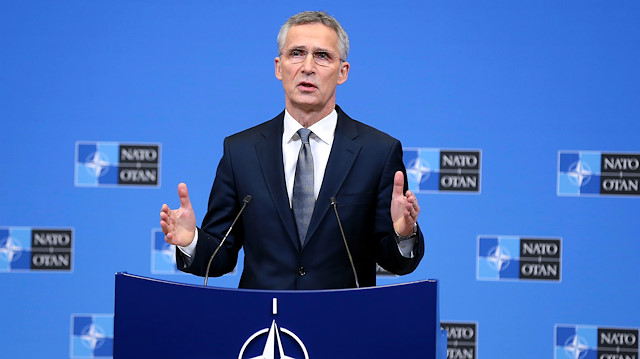
NATO Secretary General Jens Stoltenberg
NATO foreign ministers will discuss security challenges this week, the head of the organization said on Monday.
"NATO Foreign Ministers are meeting this week to address a wide range of security challenges, including Russia’s destabilising behaviour, violent extremism in the Middle East and North Africa and continuing instability in Afghanistan," NATO Secretary General Jens Stoltenberg said in a statement.
Stoltenberg's remarks came ahead of a two-day meeting due to start on Tuesday in Brussels.
He said the allies will meet on Tuesday with NATO's partners, Georgia and Ukraine, adding: "They both face serious security challenges from Russia, and we will continue to give both countries practical and political support."
Stoltenberg said the ministers will also exchange views on the Intermediate-Range Nuclear Forces (INF) Treaty that was signed in 1987 between the U.S. and the then Soviet Union.
"This Treaty eliminated an entire category of weapons, but it has been put in jeopardy by Russia," he added.
On Oct. 21, U.S. President Donald Trump announced his intention to withdraw from the treaty.
According to the statement, Stoltenberg said Russia has developed, produced and deployed a new missile, which “could reach European cities with little or no warning."
The secretary added Washington is in full compliance with the INF Treaty, saying: "There are no new US missiles in Europe, but there are new Russian missiles."
Russia's intelligence services were behind cyber attacks targeting the Czech foreign ministry last year, the Czech security service said on Monday in its annual report.The BIS counter-intelligence service has long warned against Russian activity in the Czech Republic, a member of NATO since 1999 and of the European Union since 2004. Many other Western countries have issued similar warnings.In its report, BIS said two separate attacks on the Czech foreign ministry were partly the work of the APT28 hacking group, which is linked to the Russian government and has been blamed for past attacks in Germany and the United States."All the findings make clear that it was the Turla cyberespionage campaign, originating from the FSB, a Russian intelligence service, and APT28/Sofacy, which is credited to the Russian military intelligence, the GRU," the annual report said.In a hack of the ministry's information system, it said, attackers accessed more than 150 staff mailboxes, copying emails and attachments. "They thus obtained data that may be used for future attacks, as well as a list of potential targets in virtually all the important state institutions," it said.The Czech foreign ministry said at the time it believed a foreign state was behind the cyber attacks on it but said no confidential material was compromised.As in previous years, the report warned of Russia's continued use of undeclared intelligence officers acting under diplomatic cover as part of a general hybrid strategy against member states of the European Union and NATO.The Russian government was not immediately available on Monday to comment on the BIS accusations.BIS also reported increased activity by Chinese intelligence officers and a growing worry of espionage in the economic, scientific and technical domains.Czech President Milos Zeman has vigorously promoted political and business ties with both China and Russia.BIS said it had also detected several attacks against Czech military targets, with the most serious compromising several private email accounts of people linked to the Defence Ministry and army and also compromising an IP address by malware know as X-Agent.
Czech security service says Russia behind cyber attacks on ministry
Middle East and North Africa
Stoltenberg said the ministers will also discuss the challenges coming from the Middle East and North Africa.
"We will discuss Iraq, where we are helping train local forces, and our experts are helping set up defense education facilities," he said.
He added the ministers on Wednesday will hold a meeting on the Western Balkans, joined by EU High Representative Federica Mogherini.
"They will discuss Skopje’s progress towards NATO membership and the next steps in developing the Alliance’s relationship with Bosnia and Herzegovina," according to the statement.
The NATO chief also said the ministers will endorse the organization’s readiness to accept Bosnia’s first annual national program. "This is an important tool, which can help the country implement political, economic and defense reforms," he added.
He said a meeting of all nations contributing to the Resolute Support training mission in Afghanistan will conclude Wednesday's session.
"We must continue to ensure that the country never again becomes a safe haven for international terrorists," Stoltenberg said.
Turkish Foreign Minister Mevlut Cavusoglu will attend the meeting. He is expected to have bilateral meetings with his counterparts.
Turkey’s Foreign Minister Mevlüt Çavuşoğlu will attend a NATO Foreign Ministers’ Meeting in Brussels on Dec. 4 and 5.In a statement, the ministry said on Monday: “Foreign Ministers will discuss the latest international security issues and review the implementation of the decisions taken at the NATO Brussels Summit held on 11-12 July 2018.”“Minister Çavuşoğlu will hold bilateral meetings with his counterparts,” the statement added.
Turkish FM to attend NATO meeting in Brussels