

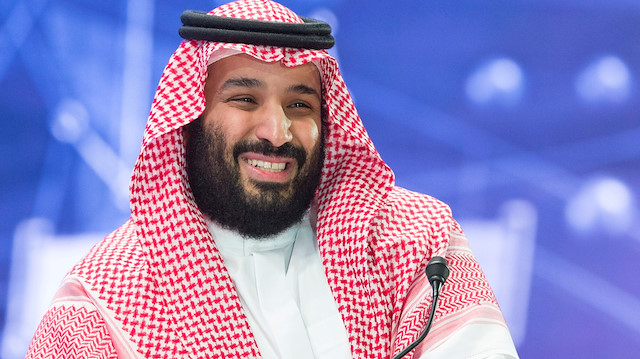
Saudi Crown Prince Mohammed bin Salman
Saudi Arabia's crown prince set in motion seven major energy projects, one of which is to build the kingdom’s first nuclear research reactor, according to the Saudi Press Agency’s report late Monday.
During his visit to King Abdulaziz City for Science and Technology, Saudi Crown Prince Mohammed bin Salman launched key projects for atomic energy, renewable energy, water desalination, genetic medicine and aircraft manufacturing.
Among the launched projects is a nuclear reactor described as a "low-energy research reactor," a solar energy-powered desalination plant in Khafji with a capacity of 60 thousand cubic meters of water per day, and a desalination plant in Yanbu with a capacity for 5.2 thousand cubic meters per day.
Israeli Prime Minister Benjamin Netanyahu's visit to Oman, which Tel Aviv does not have diplomatic relations with, reignited the debate about the future of ties between Gulf states and Israel, and thereby the impact this would have on the Palestinian issue. Previously, Yıtzhak Rabin and Shimon Peres, also former leaders of Israel, visited Oman in 1994 and 1996, but Netanyahu's visit in late October drew far more attention.Reshaping the Middle EastThroughout history, the Middle East has never before been through such a tumultuous period. The current Middle East is essentially trying to be reshaped today. That is why the relationship developed between actors is now more important than ever. That is why, during U.S. President Donald Trump’s first trip to the Middle East after his election, he stated that it was time for new alliances. The countries and actors that formed a rapport and those that drifted apart must therefore be evaluated carefully.Iran and Palestine are principal mattersThere are two matters that have dominated the international agenda of the Middle East for the past two years. These issues have been held under the spotlight more than the civil war that has ravaged Syria for more than seven years. The first is whether Iran is a threat, and the second is how the lack of a solution in the Palestine-Israel conflict will shape the future. These matters are so deep that even Jamal Khashoggi, who was slain in Istanbul, is not free from these discussions. Because just before his murder, Khashoggi stated that viewing Iran as the main source of the conflicts in the Middle East caused a serious problem and that the pains experienced today were caused by this. According to Khashoggi, the basis of many of the arguments in the Middle East were based on the Israel-Palestine matter.Israel arrests 19 Palestinians in West Bank raidsIs Oman a mediator?There is a rapprochement between Arab countries and Israel that is growing each day in the reshaping Middle East. Saudi Arabia opened its airspace to Israeli airplanes, Arab leaders held secret meetings with Netanyahu on the sidelines of the UN General Assembly, and finally the Sultan of Oman hosted Netanyahu despite lack of diplomatic relations between the two countries. Another issue that needs to be noted is that Netanyahu’s visit came just days after Palestinian President Mahmoud Abbas paid a three-day visit to Oman. This situation indicates that Oman is taking on the mediator role. However, this situation should not be explained through mediation alone. It is necessary to recognize that this rapprochement means that the statements which Israel has made over the years regarding improving ties with Arab countries have now been actualized, more than ever before. Israel is legitimizing these moves made based on the common enemy, Iran. In a period where especially the U.S. has demonized Iran, Israel seeks to expand the rift between Muslims by expending chaos in the region.Israel benefitsMuslim communities of the Middle East are entrenched in serious chaos and conflict. Many Muslim countries like Libya, Yemen and Syria are ravaged by war. Despite conducting elections nearly a year ago, Iraq and Lebanon have not been able to form a strong government. Many Muslim countries, such as Saudi Arabia, the United Arab Emirates, Iran, and Egypt, have drawn themselves into a number of problems by becoming directly or indirectly involved in the civil wars of their neighbors. In addition to all this chaos, countries have engaged in an arms race by establishing coalitions against each other. When a common enemy is formed, Israel enters these alliances and makes serious gains. While Middle Eastern countries are polarizing among each other in order to overcome the chaos they live in, Israel emerges victorious.Israeli army wounds iconic Palestinian protesterArab nations silencedIsrael opted to maximize its own interests in the region after the Trump administration stepped in. Netanyahu’s Oman visit must be evaluated in this light. With the U.S. withdrawal from the nuclear agreement signed in the Obama period, Iran once again became the enemy and began to be perceived as a threat by Middle Eastern states. The fact that Iran is seen as a threat does not only distance the Palestinian issue from the global agenda but also strengthens the position of Israel in this conflict. Washington’s recognition of Jerusalem as Israel’s capital and opening the rights and earnings of refugees to debate can be counted as great victories for Israel during its conflict with Palestine. To pull the U.S. to its side and spread fear among Arab countries by declaring Iran as the common enemy are perhaps the clearest gains of Israel in terms of silencing criticism of its own invasion policies. However, Israel is not just content with these gains, but is also making investments for the future. Oman is one of these investments.Israel is trying to influence OmanOman’s distance from many clashes, especially in the Middle East, makes it a frontrunner for the role of mediator. Oman played a key role in the nuclear treaty with Iran and made a significant contribution to the deal. From this perspective, Oman is expected to become a mediator as the U.S. has lost this role. Israel is trying to direct Oman, which is likely to assume the role of mediator in the Palestinian-Israeli negotiations, by keeping a grip on it.Iran accuses Israel of failed cyber attackSowing the seeds of harmony or chaos?Netanyahu’s visit was widely covered by Gulf media outlets, and it was evaluated as being significant in terms of Middle Eastern peace. On the contrary, Iranian media, which has good ties with Oman, portrayed the trip as a new seed of chaos. Iranian media stated that this visit would spark conflict and corruption among Muslim countries, and underlined that the Palestinian issue would be overshadowed by these visits and relations. Rather than evaluating this visit as part of an alliance against Iran or as part of such an effort, the Iranian press interpreted it more in the light of the Palestinian issue.Diplomatic success for IsraelIsraeli press evaluated the visit as a strategic move. During the same week, three visits made to Gulf countries at ministerial and prime ministerial levels were highlighted as a diplomatic success. In particular, the symbolic meaning of the recitation of the Israeli national anthem during sporting activities in the United Arab Emirates was noted. Netanyahu's visit to an Iranian friend - Oman - was dubbed as another step in the isolation of Iran and also labeled as important for the continuation of peace and stability in the Middle East.Israel razes Bedouin structures in West Bank
Israel’s new favorite: Oman
The nuclear reactor is likely to draw international attention as the kingdom selects bidders for its first nuclear plant.
According to the World Nuclear Association, Saudi Arabia plans to build two large nuclear power reactors to diversify its energy supply, at a cost of more than $80 billion.
In April 2013, the King Abdullah City for Atomic and Renewable Energy (KA-CARE) aimed to have 17 gigawatts (GWe) of nuclear capacity by 2032 out of a total of 123 GWe. In January 2015, the nuclear target date was moved to 2040 and KA-CARE announced that it was soliciting proposals for 2.9 GWe of nuclear capacity from South Korea, China, Russia and Japan.
With the realization of the nuclear project, the kingdom is set to become the second Gulf Arab state to launch a nuclear power project after the U.A.E.
Qatar's ruler said on Tuesday that a political and economic boycott of his country by larger neighbours had weakened a Gulf Arab bloc at a time of regional instability, but he voiced hope the crisis would pass.Emir Sheikh Tamim bin Hamad al-Thani outlined Qatar's economic achievements over the past year despite sanctions imposed by Saudi Arabia and four Arab states since June 2017, saying the tiny but wealthy country would preserve its status as the world's top liquefied natural gas exporter.Saudi Arabia, the United Arab Emirates, Bahrain and Egypt cut transport and trade ties with Qatar, accusing it of supporting terrorism and their foe Iran. Doha denies the charges and says the boycott aims to impinge on its sovereignty.Qatar reshuffles cabinet, boards of Qatar Petroleum and Qatar Investment Authority"History teaches us that crises pass, but if they are handled badly then this may leave traces which last for a long time," Sheikh Tamim said in a speech to the country's consultative Shoura council."It is very regrettable that the continuation of the Gulf crisis exposed the failure of the Gulf Cooperation Council (GCC)...which has weakened its ability to face challenges and threats and marginalised its role in the region," he said.The United States, an ally of the six-nation GCC, has tried to mediate in the dispute which it sees as a risk to efforts to contain Iran. Qatar is home to a U.S. air base. Saudi Arabia and the UAE had repeatedly said that resolving the row was not a top priority for them.Qatar calls for release of four citizens detained in Saudi Arabia
'Gulf crises will pass, but economy is stronger'