

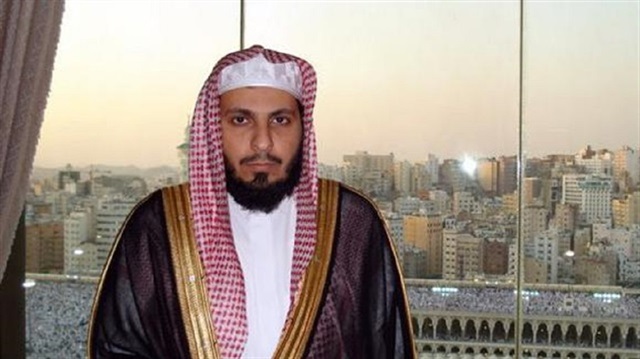
Sheikh Saleh al-Talib
Saudi Arabia has detained Sheikh Saleh al-Talib, a prominent imam at the Grand Mosque of Mecca, after he delivered a sermon saying that it was a duty in Islam to speak out against evils in public.
Al-Talib, who additionally serves as a judge in Mecca, also criticized gender mixing, particularly at concerts.
He was arrested despite not criticizing the royal family directly as Saudi Arabia has eased laws on female attendance at public events after Saudi Crown Prince Muhammad Bin Salman said he will lead his country back to “moderate Islam.”
Saudi Arabia has eased laws on female attendance at public events after Saudi Crown Prince Muhammad Bin Salman said he will lead his country back to “moderate Islam.”
Bin Salman additionally carried out a purge targeting businessmen in Saudi Arabia on “corruption charges” and never shied away from taking radical decisions.
He has also detained dozens of imams, women’s right activists and members of the ruling royal family.
Both of al-Talib’s English and Arabic Twitter accounts were deleted just hours after he was arrested, and the Kingdom is yet to make a statement on his detention.
Saudi’s diplomatic row with Canada
Ties between Saudi Arabia and Canada have soured after Ottawa criticized the arrest of human-right activists, Samar Badawi and her brother Raif Badawi.
Khalid bin Faisal Al Saud, the emir of Mecca, announced the “successful” completion of this year’s Hajj pilgrimage season on Friday.One day earlier, some 1.6 million pilgrims concluded the Hajj while another 750,000 remained in the tent city of Mina near Mecca to perform the “Great Jamra” ritual, in which Muslims hurl stones at a symbolic representation of the devil.According to the Saudi authorities, more than 2.37 million pilgrims took part in this year’s Hajj, some 1.75 million of whom came from overseas.The annual Hajj pilgrimage to Saudi Arabia is a religious obligation for Muslims, who must make the journey -- if financially feasible -- at least once in their lives.Considered the fifth “pillar” of Islam, the Hajj is intended to demonstrate the solidarity of the Muslim people and their submission to Allah.While the Hajj is generally associated with Islam’s final prophet, Muhammad, who lived in the seventh century, Muslims believe that the pilgrimage to Mecca dates back thousands of years to pre-Islamic times.The pilgrimage takes place every year from the 8th to 12th day of Dhu al-Hijjah, the 12th and final month of the Islamic calendar.On these five days, pilgrims converge on Mecca, where they circumambulate the Kaaba seven times; run between the hills of Al-Safa and Al-Marwah; drink water from the sacred Well of Zamzam; stand vigil on the plains of Mount Arafat; and, lastly, pelt the “devil” with stones.Pilgrims then cut their hair and sacrifice an animal -- meat from which is traditionally distributed to the poor -- before celebrating the Eid al-Adha, or the “Feast of the Sacrifice”.Because the Islamic calendar is based on the lunar cycle, the date of the Hajj changes each year on western calendars.
Mecca emir hails success of this year’s Hajj pilgrimage
As U.S. President Donald Trump searches for new schemes to reduce the country’s foreign trade deficit and national debt by waging an economic war on countries by imposing unfair tariffs under the pretext of his “America First” campaign, reports have surfaced that his next target is the funds of Arab countries.Arab countries, primarily Saudi Arabia, the United Arab Emirates (UAE), Kuwait and Bahrain, currently have $4 trillion in U.S. and U.K. banks.A large amount of these funds belongs to Saudi and the UAE, with the revenues of petrol and natural gas directly transferring into U.S. banks.Specialists evaluated the situation and stated that Trump, who has waged an economic war against many countries, including China, Turkey and Iran, is now planning to seize the petrodollars of Gulf countries.Deposits not questionedSpeaking to Yeni Safak daily, Cevahir Holding Chairman of the Board of Directors Yusuf Cevahir stressed, “The U.S. does not question the source of the money that comes from Gulf countries deposited into U.S. banks. However, when companies in Gulf countries want to withdraw money from U.S. banks, they are immediately faced with the questions regarding the "money source." This situation has been like this since the September 11 attacks. As long as oil revenues stay in the U.S., there is no problem. They only allow cash flow in the case of purchases of supplies and equipment from the U.S. Many Saudi companies have had mortgages currently because the U.S. does not allow cash withdrawals. Therefore, many projects in Saudi Arabia have come to a standstill because of the troubles these companies face. He also stressed that the companies in Saudi’s $500 billion mega-city NEOM project face the same difficulties.“This situation shows that countries such as Saudi Arabia, UAE, Kuwait and Bahrain work together with the U.S. in a chain of command.”Trump could declare seizure at any momentDirector of Istanbul University’s Banking Research Center Kadir Tuna in his turn stated that the possibility of seizing Arab funds has never been so strong.“Economic ties between the U.S. and Saudi Arabia and the UAE is far beyond than a usual investor and banker relationship. In terms of international banking, the fact that such large amounts of money are being held in U.S. banks for years is an unusual situation.“This situation cannot be defined with international law. Saudi Arabia has an extraordinary tie to the U.S. Trump, at any moment, can officially declare that he has seized the money,” he said.9/11 compensationAccording to reports, a number of Saudi assets and foundations will face large compensation lawsuits by the insurance companies of the families of victims of the 9/11 attacks under the pretext of supporting al-Qaeda.Washington is said to be leveraging the 9/11 court decision in an attempt to seize Saudi assets in the U.S. which will put the oil-rich kingdom’s investments there at risk.Aramco public offering ‘called off’ Saudi Arabia also called off plans for the domestic and international listing of state oil giant Aramco, billed as the biggest stock flotation in history, four senior industry sources said on Wednesday, according to Reuters. This was interpreted as a bid to protect Saudi stocks from being seized by the U.S. However, the Saudi government early Thursday issued a statement denying the reports. “The government remains committed to the initial public offering of Saudi Aramco, in accordance with the appropriate circumstances and appropriate time chosen by the Government,” Energy Minister Khalid al-Falih said in a statement released on Saudi Press Agency.Trump says the Gulf has nothing but moneyTrump had planned to target Arab funds since before his election. In a speech in Florida during his election campaign in 2016, he stated that the Gulf “has nothing but money.”“We want to do safe zones in Syria. I will get the Gulf states, who are not doing much, believe me. The Gulf states have nothing but money. I’m going to get them to pay. We owe 19 trillion, we’re not paying for it. Don’t forget, without us, the Gulf states won’t exist,” he said.
'Trump could seize Arab funds at any moment'
Saudi air defenses on Thursday intercepted a missile fired by Yemen’s Houthi rebel group into the kingdomn, according to a Saudi media reports.The missile was fired toward Saudi Arabia’s southwestern Jizan province, the Saudi television news channel Al-Ekhbariya reported.The broadcaster did not provide further details.It was the second Houthi missile to be intercepted over the last week.Yemen has been wracked by conflict since 2014, when Shia Houthi rebels overran much of the country.The conflict escalated one year later when Saudi Arabia and its allies launched a wide-ranging military campaign aimed at rolling back Houthi gains in Yemen.Riyadh accuses the rebel group of serving as a proxy force for Shia Iran, Saudi Arabia’s arch-foe in the region.Qatar accuses Saudis of barring hajj pilgrims, Riyadh says untrueYemeni government, Houthi movement invited to Sept 6 peace talks
Saudi Arabia intercepts Houthi missile from Yemen
In a statement released through the Saudi Press Agency in early August, Saudi Arabia gave the Canadian ambassador 24 hours to leave the kingdom, declaring him as a “persona non grata,” and froze all new trade deals with Ottawa. Saudi authorities also recalled its own ambassador to Canada, Nayif bin Bender es-Sedir, on the same day.
These statements came after Canada's Foreign Ministry criticized human rights violations in Saudi Arabia and urged Riyadh to “immediately release” detained activists.