

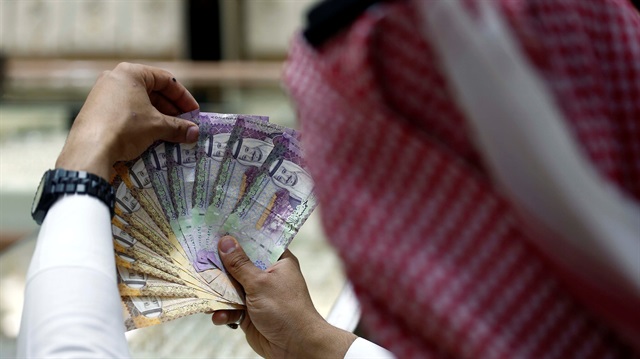
Saudi Riyal banknotes
Saudi Arabia's currency fell to its lowest level in two years and its international bond prices slipped on Monday over fears that foreign investment inflows could shrink as Riyadh faces pressure over the disappearance of journalist Jamal Khashoggi.
Trade in the forward currency market, used by banks to hedge investments, suggested some institutions were protecting themselves against the risk of capital outflows or U.S. sanctions on Riyadh after the disappearance of Khashoggi, a prominent critic of Saudi authorities, in Istanbul.
But the market moves were smaller than some bouts of instability in the last several years, indicating investors were not as panicked by the Khashoggi case as they were by a plunge of oil prices that began in 2014.
U.S. President Donald Trump threatened "severe punishment" for Riyadh if it turned out that Khashoggi was killed in the Saudi consulate in Instanbul, as Turkish officials allege. Saudi Arabia has denied this and on Sunday warned it would counter any sanctions with greater ones of its own.
Oil prices moved only slightly on Monday as analysts said they doubted Saudi Arabia, the word's biggest exporter of crude, would risk international isolation and damage its own finances by cutting back exports at a time when it is pushing through reforms designed to create jobs and diversify its economy.
But Krisjanis Krustins, director in the Middle East and Africa team at credit ratings agency Fitch, said the affair could hurt some parts of the reform programme.
"If there is any lasting change in investor willingness to engage with Saudi Arabia, it could lead to slower and less complete implementation of some Vision 2030 initiatives, and greater need for Saudi Arabia to use debt and internal resources to finance them," he said.
Saudi Arabia's stock market plunged on Sunday as investors worried about deteriorating relations with the international community after the disappearance of Saudi journalist Jamal Khashoggi.After nearly two hours of trade the index was down 7.0 percent, its biggest drop since December 2014, when oil prices were crashing. Shares in the region's biggest petrochemical producer, Saudi Basic Industries, tumbled 7.9 percent."It’s the political environment. The market is reacting negatively to sentiment around the Khashoggi case and the political noise around it," said Salah Shamma, head of investment for the region at Franklin Templeton Emerging Markets Equity, a big global fund manager.Shamma noted the fundamental situation of the Saudi economy had not so far been affected.But regional traders said speculation the Khashoggi case might deter some inflows of foreign investment - and that a backlash in the U.S. Congress could lead to U.S. sanctions against some Saudi individuals - had triggered panic selling of stocks by some local investors."It seems that international accounts are punishing the Saudi exchange," a regional broker added.Turkey expects Saudi cooperation on case of missing journalist: FMKhashoggi, a prominent critic of Riyadh and a U.S. resident, disappeared on Oct. 2 after visiting the Saudi consulate in Istanbul. Turkey believes he was deliberately killed inside the building and his body removed. Riyadh has dismissed the claims.U.S. President Donald Trump said on Saturday there would be "severe punishment" for Saudi Arabia if it turned out that Khashoggi was killed in the consulate.Media companies and some technology executives have pulled out of a major Saudi investment conference scheduled for next week in Riyadh because of growing outrage over the disappearance.Other stock markets in the Gulf opened higher on Sunday but began falling as Riyadh plunged, with the Dubai index sinking 1.4 percent.Trump says US would be 'punishing itself' if it halts Saudi arms sales
Saudi stocks plunge 7 pct on Khashoggi fallout; biggest drop since 2014
U.S. President Donald Trump said on Saturday that the United States would be "punishing itself" if it halts military sales to Saudi Arabia, even if it is proven that Saudi journalist Jamal Khashoggi was killed inside the country's consulate in Istanbul.Khashoggi, a prominent critic of Riyadh and a U.S. resident, disappeared on Oct. 2 after visiting the consulate. Turkey's government believes he was deliberately killed inside the building and his body removed.Trump has forged closer ties with Saudi Arabia and is under international and domestic pressure to help determine what happened to Khashoggi and punish Saudi Arabia if investigations show its government had him killed.Some U.S. lawmakers have said Washington should block military sales to Riyadh if the allegations are proven. But Trump is opposed."I actually think we’d be punishing ourselves if we did that," Trump told reporters at the White House on Saturday."There are other things we can do that are very, very powerful, very strong and we’ll do them," he added, without saying what those measures might be.Trump says Saudi Arabia faces 'severe punishment' if Khashoggi was killedDisappearance of Khashoggi cannot be covered up: AK Party spoxUS congressmen seek support for Khashoggi intel release
Trump says US would be 'punishing itself' if it halts Saudi arms sales
Saudi Arabia must cooperate with the investigation into the disappearance of Saudi journalist Jamal Khashoggi and allow Turkish officials to enter its Istanbul consulate, Foreign Minister Mevlüt Çavuşoğlu said on Saturday.Çavuşoğlu was speaking to reporters during a visit to London, after a delegation from Saudi Arabia arrived in Turkey for a joint investigation into Khashoggi's disappearance."There is consensus on forming a joint working group with Saudi Arabia over missing journalist Khashoggi," Çavuşoğlu said.Trump says Saudi Arabia faces 'severe punishment' if Khashoggi was killed"It is natural for everyone to show awareness of the case and want it to be clarified," he added.On the same day that the Saudi journalist arrived at the consulate, 15 other Saudis, including several officials, arrived in Istanbul on two planes and visited the building while Khashoggi was also inside, police sources said. All of the identified individuals have since left Turkey.Saudi authorities have yet to give a clear explanation of Khashoggi’s fate, while several countries -- particularly Turkey, the U.S., and the U.K -- are pressing the case to be cleared up as soon as possible.Disappearance of Khashoggi cannot be covered up: AK Party spoxTurkey obtains recordings of Saudi journalist's purported killing
Turkey expects Saudi cooperation on case of missing journalist: FM
Weak Private Sector
The riyal was quoted at 3.7524 to the U.S. dollar in the spot market early on Monday, its weakest rate since September 2016, Refinitiv data showed.
The central bank maintains a peg of 3.75 riyals to the dollar, and usually the currency fluctuates in a range of about 3.7498-3.7503. In November 2015, when oil prices were plunging, the riyal dropped as low as 3.7598.
In the forwards market, the dollar rose on Monday as high as 100 points against the riyal, a nine-month high, from 54 points on Friday. In 2016, it briefly rose above 1,000 points.
Yields on Saudi Arabia's U.S. dollar bonds climbed, mostly at the long end of the curve; its notes maturing in 2046 were 15 basis points wider.
Krustins and other analysts noted that foreign investment flows into Saudi Arabia were already very low because of a weak private sector and uncertainty over regulation; this could limit the impact of any reduction of flows.
Media organisations and a growing number of executives, including JP Morgan Chase & Co chief executive Jamie Dimon, have pulled out of a major Riyadh investment conference scheduled for next week, dubbed "Davos in the Desert".
The Saudi stock market had tumbled 7.2 percent over the previous two trading days because of the Khashoggi case, but it rebounded 2.0 percent on Monday.
Traders said some institutional investors, including foreign ones, were buying stocks at the lows, believing Saudi Arabia's fundamental economic situation was unlikely to change much.
But many bankers and analysts said the Khashoggi case had fuelled perceptions of political risk in Saudi Arabia because it was the latest in a series of unexpected incidents over the past three years.
During this period Saudi Arabia has launched a war in Yemen, imposed an embargo on Qatar, arrested dozens of top officials and businessmen in a corruption purge, detained women's rights activists and seen tensions with Canada and Germany rise.
Jason Tuvey, senior emerging markets economist at London-based Capital Economics, said political developments in Saudi Arabia were becoming an increasingly important economic risk.
U.S. Treasury Secretary Steve Mnuchin is still planning to attend an upcoming summit in Saudi Arabia despite the controversy over the disappearance of Saudi journalist and political dissident Jamal Khashoggi, White House economic adviser Larry Kudlow said on ABC's "This Week.""Mr. Mnuchin will make up his mind as the week progresses and as new information surfaces," Kudlow said. His comments came shortly after Florida Senator Marco Rubio told CNN's "State of the Union" he believes Mnuchin should boycott the event.Saudi threatens to retaliate against any sanctions over Khashoggi disappearanceMoroccan press calls for probe into Khashoggi caseSaudi stocks plunge 7 pct on Khashoggi fallout; biggest drop since 2014Fiancee demands accountability if Khashoggi murdered
US Treasury Secretary Mnuchin still plans to attend upcoming Saudi summit
Saudi Arabia rejected threats to punish it over the disappearance of journalist Jamal Khashoggi in Istanbul, saying the kingdom would retaliate against any sanctions with tougher measures, the official state news agency said on Sunday.The comments came after U.S. President Donald Trump threatened "severe punishment" for Riyadh if it turned out Khashoggi, a prominent critic of Saudi authorities and a legal resident of the United States, was killed in the Saudi consulate in Istanbul."The Kingdom affirms its total rejection of any threats and attempts to undermine it, whether by threatening to impose economic sanctions, using political pressures, or repeating false accusations..." the official Saudi Press Agency quoted an unnamed government source as saying."The Kingdom also affirms that if it receives any action, it will respond with greater action, and that the Kingdom's economy has an influential and vital role in the global economy..." the source added without elaborating.The threat caused the stock market of the world's biggest oil exporter to lose as much as $33 billion of its value on Sunday in one of the first signs of the economic pain that Riyadh could suffer over the affair.The Saudi equities index plunged as much as 7 percent in its biggest drop since December 2014, when oil prices were crashing. It later recovered partially to stand 5.0 percent lower shortly before the close.Turkey believes Khashoggi was deliberately killed in the consulate and his body removed. Riyadh has rejected those claims.A senior member of Saudi Arabia's ruling family, Prince Khaled al-Faisal, has met Turkey's President Tayyip Erdogan to discuss Khashoggi's disappearance, two sources with knowledge of the matter told Reuters without providing details of the talks.On Friday, a source with links to the prince's family said Prince Khaled, who is the governor of Mecca, had been sent to Turkey in his capacity as special adviser to King Salman.INVESTMENT CONFERENCEForeign capital is key to Saudi Arabia's plans to diversify its economy beyond oil and cut a 12.9 percent jobless rate among its citizens.But in response to Khashoggi's disappearance, media firms and some technology executives have pulled out of a major Riyadh investment conference scheduled for next week."This is happening at a time when Saudi Arabia is preparing for a big investment event and they don’t need people suspending or pulling out investments," said Nadi Barghouti, head of asset management at Emirates Investment Bank in Dubai.Trump has not described what punishment Saudi Arabia might face. He has indicated Washington does not want to harm close defence ties, saying the United States would be punishing itself if it halted sales of military equipment to Riyadh.But U.S. senators have triggered a provision of the Global Magnitsky Human Rights Accountability Act requiring the president to determine whether a foreign person is responsible for a gross human rights violation. The act has in the past imposed visa bans and asset freezes on Russian officials.Also, anti-Saudi sentiment in the U.S. Congress could conceivably raise pressure to pass the so-called No Oil Producing and Exporting Cartels Act, which would end sovereign immunity shielding OPEC members from U.S. legal action.Past U.S. presidents have opposed the bill but the chances of it being passed may have increased because of Trump's frequent criticism of the Organization of the Petroleum Exporting Countries, which he accuses of driving up oil prices.Meanwhile, there is concern Khashoggi's disappearance could add to a sense that Saudi policy has become more unpredictable under Crown Prince Mohammed bin Salman, who is pushing social reforms to modernise the kingdom but has also presided over a rise in tensions between Riyadh and several other countries.A Gulf banker said the Khashoggi case, combined with other events, had become a significant factor for some potential investors in Saudi Arabia and that her bank was receiving many queries from foreign clients on how to interpret it."It’s cumulative – the Yemen war, the dispute with Qatar, the tensions with Canada and Germany, the arrests of women activists. They add up to an impression of impulsive policy-making, and that worries investors," the banker said.UK's Labour says it would stop selling arms to Saudi ArabiaSaudi stocks plunge 7 pct on Khashoggi fallout; biggest drop since 2014Trump says US would be 'punishing itself' if it halts Saudi arms salesFiancee demands accountability if Khashoggi murdered
Saudi threatens to retaliate against any sanctions over Khashoggi disappearance
Britain's main opposition Labour Party would stop selling arms to Saudi Arabia if it was in government, its foreign policy spokeswoman said on Sunday after the disappearance of Saudi journalist Jamal Khashoggi.Khashoggi entered the Saudi consulate in Istanbul on Oct. 2 to get documents for his forthcoming marriage. Saudi officials say he left shortly afterwards but Turkish officials and his fiancée, who was waiting outside, said he never came out.Turkish sources have told reporters the initial assessment of the police was that Khashoggi, an outspoken critic of the Saudi government, had been deliberately killed inside the consulate. Riyadh has dismissed the claims.Emily Thornberry, Labour's so-called shadow foreign minister, told the BBC's Andrew Marr show that "the balance of evidence" suggested Saudi Arabia had killed the journalist."We would stop selling arms to Saudi Arabia in current circumstances until they changed their ways ...We would be making it clear that we disagreed," she said."I think our country has had enough of this. I think we have to stand up to them and have to say that the current behaviour is unacceptable."Foreign minister Jeremy Hunt has called on Saudi Arabia to explain what happened to Khashoggi. Turkey expects Saudi cooperation on case of missing journalist: FMTrump says Saudi Arabia faces 'severe punishment' if Khashoggi was killedTurkey obtains recordings of Saudi journalist's purported killingIMF chief attending Saudi conference, watching for news of journalist
UK's Labour says it would stop selling arms to Saudi Arabia