

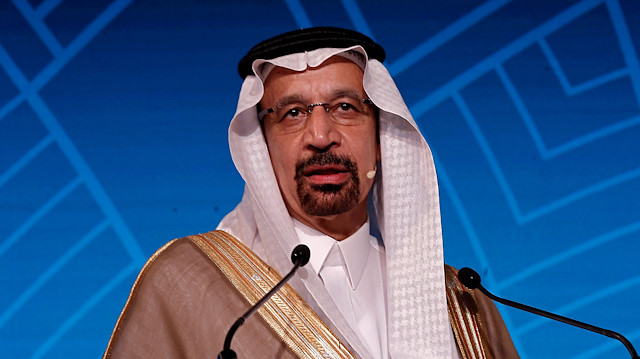
Saudi Energy Minister Khalid al-Falih
Saudi Arabia is seeking to persuade Russia on Wednesday to cut oil production substantially with OPEC next year in an attempt to arrest a decline in the price of crude and prevent another global glut.
Russian Energy Minister Alexander Novak was due later in the day to meet his Saudi counterpart Khalid al-Falih, whose country leads the Organization of the Petroleum Exporting Countries.
OPEC holds policy talks on Thursday in Vienna, followed by a gathering with allies including Russia on Friday.
Saudi Arabia has indicated it wants OPEC and its allies to cut output by at least 1.3 million barrels per day, or 1.3 percent of global production.
Morocco was not part of Saudi Crown Prince Mohammed bin Salman’s recent regional tour, a move seen by experts as reflecting a crisis in relations between Rabat and Riyadh.“Relations between Morocco and Saudi Arabia are going through a ‘silent crisis’,” Salman Bonaman, a Moroccan researcher in international relations, told reporters.“Rabat has chosen a middle way that does not pursue escalation or boycott,” he said.On Nov. 22, bin Salman started his first foreign tour since the murder of Saudi journalist Jamal Khashoggi inside the Saudi Consulate in Istanbul one month earlier.His tour included the United Arab Emirates (UAE), Bahrain, Egypt, Tunisia, Argentina, Mauritania and Algeria.Morocco, however, was not included in the tour, in a move seen as reflecting strained ties between the two countries.After saying he had left the consulate alive, Saudi Arabia admitted weeks later that Khashoggi – a columnist for The Washington Post - was killed there, blaming his death on a group of rogue Saudi operatives. A CIA assessment released in November appeared to implicate bin Salman in Khashoggi’s murder.Istanbul prosecutor seeks arrest of Saudi officials over Khashoggi killingCold tiesObservers cite several signs that show a growing gap between Riyadh and Rabat over the past year.Unlike most Arab states, Rabat did not issue any statement in support of Saudi authorities in the wake of Khashoggi’s murder.Morocco has also remained neutral regarding the Saudi-led blockade on Qatar when Saudi Arabia, Egypt, the UAE and Bahrain severed diplomatic and trade ties with Doha in 2017, accusing it of supporting terrorism, an accusation vehemently denied by Qatar.Ignoring the blockade, Rabat sent an aircraft loaded with foodstuffs to Qatar with King Mohamed VI visiting Doha for talks with Emir Tamim bin Hamad Al-Thani.In response, Saudi King Salman did not spend his annual summer vacation in the Moroccan city of Tangier as he used to and visited Neom region in northwestern Saudi Arabia instead.The oil-rich kingdom also voted in favor of the U.S.-Canada-Mexico file to host the 2026 FIFA World Cup instead of the Moroccan file."Morocco has its own vision regarding the management of Arab and Gulf relations,” Bonaman said. “This vision is based on solidarity, cooperation, common interest and respect of sovereignty without submission.”The Moroccan researcher said Rabat seeks to follow a “balanced, neutral and independent foreign policy that supports stability and security”."Morocco rejects blackmailing or guardianship by any party,” he said.ProblemsOmrani Boukhubaza, a professor of international relations at the Abdelmalek Essaadi University, believes that “ambiguity” was shrouding Saudi-Moroccan relations.“There is a state of vacuum and noticeable coldness, which was reflected in many behaviors, including the no-vote for the Moroccan file to host the 2026 World Cup,” he said.He said the cancellation of the Saudi king’s annual vacation in Tangier and exclusion of Morocco from bin Salman’s tour were also signs of poor ties between the two countries.“There are problems between the two countries that resulted from previous events," Boukhubaza said."Morocco is trying to distance itself from some issues and avoid going into them,” he said.
Experts say Morocco exclusion reflects ‘crisis’ with Saudi
Riyadh wants Moscow to contribute at least 250,000-300,000 bpd to the cut but Russia insists the amount should be only half of that, OPEC and non-OPEC sources said.
"It is not easy but we will always work together with our colleagues," United Arab Emirates Energy Minister Suhail bin Mohammed al-Mazroui told reporters when asked about Russia's position.
A source close to the Russian Energy Ministry said: "No one is eager to cut unless there is an emergency. It is the United States where we are seeing the bulk of the increase in oil output. OPEC and Russia will be very careful about voluntary 'blood letting'."
Istanbul's chief prosecutor has filed warrants for the arrest of a top aide to Saudi Arabia's de facto ruler and the deputy head of foreign intelligence on suspicion of planning the killing of Jamal Khashoggi, two Turkish officials said on Wednesday.The prosecutor's office has concluded there is "strong suspicion" that Saud al-Qahtani and General Ahmed al-Asiri, who were removed from their positions in October, were among the planners of the Oct. 2 killing at the Saudi consulate in Istanbul, the officials said."The prosecution's move to issue arrest warrants for Asiri and Qahtani reflects the view that the Saudi authorities won’t take formal action against those individuals," one of the Turkish officials said.Saudi-backed Yemeni government team heads to Sweden for peace talksBin Salman 'complicit' in Khashoggi murder: US senator
Istanbul prosecutor seeks arrest of Saudi officials over Khashoggi killing
Russia, Saudi Arabia and the United States have been vying for the position of top crude producer in recent years. The United States is not part of any output-limiting initiative due to its strict anti-trust legislation and fragmented oil industry.
Crude prices have sunk since October due to global economic weakness and fears of a glut due largely to rising U.S. production.
Russia's Ministry of Foreign Affairs said on Wednesday the United States had yet to provide any evidence Moscow was in breach of a landmark arms control treaty, but said it was ready to keep discussing the matter with Washington.The United States delivered Russia a 60-day ultimatum on Tuesday to come clean about what Washington says is a violation of a 1987 nuclear arms control treaty, saying it would be forced to start a six-month process of withdrawal if nothing changed.Maria Zakharova, a spokeswoman for Russia's foreign ministry, told a briefing that the U.S. embassy in Moscow had handed over a note on Tuesday evening saying Washington would quit the Intermediate-Range Nuclear Forces (INF) Treaty unless Russia began complying with it."These documents were received for further processing," said Zakharova. "In them once again there were groundless allegations about our alleged violation of this agreement. We have repeatedly said that this is conjecture. No proof (of our alleged violation) has been presented to us." 
Russia says US has shown no evidence it is in breach of nuclear treaty