

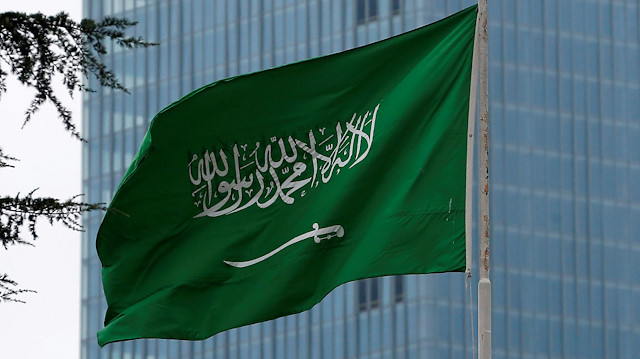
A Saudi flag flutters atop Saudi Arabia's consulate in Istanbul, Turkey.
Saudi Arabia told the United Nations on Monday it would prosecute those responsible for the killing of journalist Jamal Khashoggi at its Istanbul consulate, and defended its human rights record.
Bandar Al Aiban, the head of the Saudi government delegation at the first U.N. review of the kingdom's record in five years, heard calls from other envoys for a credible investigation into the killing and for the protection of critics of the government.
He told the hearing that King Salman had instructed the Saudi public prosecutor to "proceed with the investigation into this case according to the applicable laws and preparation to reaching all facts and bringing all the perpetrators to justice".
In the remarks, which did not appear in an advance transcript of the speech, Aiban gave no details on the status or whereabouts of the 18 Saudi nationals detained in connection with the case.
Nine days after journalist Jamal Khashoggi was killed in the Saudi consulate in Turkey’s Istanbul on Oct. 2, a chemist and toxicologist were sent to Istanbul to get rid of the body and eliminate evidence, Turkish daily Sabah reported on Monday.Chemist Ahmed Abdulaziz Aljanobi and toxicology expert Khaled Yahya Al Zahrani were part of an 11-member delegation from Saudi Arabia that that entered Turkey via Istanbul’s Sabiha Gökçen Airport on Oct. 11 as part of the joint investigation into the disappearance of Khashoggi.Saudi Arabia tells UN rights body that will prosecute Khashoggi murderSaudi squad cleaned consulate, residence for one weekAccording to intelligence information received by Sabah, Aljanobi and Zahrani visited the Saudi consulate from Oct. 12 until Oct. 17 as a part of the so-called investigation team, and also worked to eliminate evidence at the residence of the Saudi consul-general. The 11-member team left Turkey on Oct. 20.It is believed that the duo engaged first in search activities before wiping the crime scenes clean.Turkey was only granted permission to search the Saudi consulate on Oct. 15, which it carried out for two consecutive days, and the search of the residence was conducted on Oct. 17. Sabah reported that the chemist and toxicology expert carried out their work at the consulate and residence until Oct. 17.Reports Khashoggi's body dissolved in acid must beinvestigated: Turkish VPRemains possibly dissolved in acid“They [the chemist and toxicology expert] have the ability to remove any toxic or acid substances. An attempt was possibly made to render the victim unrecognizable by pouring acid onto his corpse. It may have been intended to clean the body fluids that could have splattered around. Of course, this is all hypothetical,” said Dr. Şevki Sözen, who is an academic at Istanbul University’s Faculty of Medicine.Saudis failed to eliminate all evidence“These two specialists may have come to remove the victim’s splattered tissue and blood. It appears that the Saudis sent two teams to kill Jamal Khashoggi, dismember him and then clean the crime scene. The presence of a toxicologist and chemist in the Saudi delegation is an indication that the body was dismembered. These experts entered the residence for cleaning purposes. The Saudis may have stalled crime scene investigators for this reason. According to the information we received from a reliable source, the investigation teams found a blood sample during the search. And a sample was taken from the wall. That means the Saudis couldn't completely eliminate all evidence,” said retired murder detective Savaş Kurtbaba.SoftBank's Saudi ties in focus as CEO Son makes first appearance since journalist murderKhashoggi, a Washington Post columnist and critic of Saudi Arabia's Crown Prince Mohammed bin Salman, was killed inside the Consulate of Saudi Arabia in Istanbul after he went there to obtain documents for his forthcoming marriage.The Saudi government initially insisted Khashoggi had left the consulate, later saying he died in an unplanned "rogue operation". On Oct. 25, the kingdom's public prosecutor Saud Al Mojeb said the attack was premeditated.Istanbul chief prosecutor Irfan Fidan said last week that Khashoggi was suffocated as soon as he entered the consulate, and his body then cut up and disposed of. Turkey has demanded cooperation from Saudi officials.Khashoggi's sons plead for father's body return
Saudi experts spent six days cleaning consulate after Khashoggi killing: report
Khashoggi's sons on Monday demanded the return of the body of the Washington Post columnist and critic of the Saudi government, who disappeared at the consulate on Oct. 2.
Saudi officials initially insisted Khashoggi had left the consulate, then said he died in an unplanned "rogue operation". The kingdom's public prosecutor Saud al-Mojeb later said he was killed in a premeditated attack.
Envoys from Australia, Belgium, Canada and Italy joined others at the debate calling for a credible and thorough investigation into Khashoggi's death. "Reports that the killing was pre-meditated are deeply alarming," Australian ambassador Sally Mansfield told the U.N. Human Rights Council hearing.
France's ambassador Francois Rivasseau called on Saudi Arabia to "immediate halt imprisonment and arbitrary arrests" of journalists and activists, and to guarantee freedom of religion.
Reports that the body of slain Saudi journalist Jamal Khashoggi was dissolved in acid need to be investigated, Turkey's Vice President Fuat Oktay said on Monday."The question now is who gave the orders. This is what we are seeking answers to now," Oktay said while speaking to Anadolu Agency’s Editor Desk."Another question is where the body is... There are reports of (the body) being dissolved with acid now. All of these need to be looked at."Khashoggi's sons plead for father's body returnJamal Khashoggi, a journalist critical of the Saudi state, was murdered early last month in the Saudi consulate in Istanbul. On Friday, Turkish President Recep Tayyip Erdoğan said the order to kill Khashoggi came from the "highest levels" of the Saudi government.“Turkey is approaching the Khashoggi killing with transparency and a serious manner. It has given the message that nobody will ever attempt to commit such a murder and those who do will pay the price,” Oktay added.Turkey praised for handling of Khashoggi affairU.S. sanctions on Iran“It's not meaningful and fair to expect all countries to obey sanctions upon a country's interests. We clearly expressed our stance about the U.S. sanctions. We'll see the results of a statement to be made today,” Oktay said, referring to the sanctions re-imposed by the United States on Iran’s vital energy and banking sector.The United States said on Friday it will temporarily allow eight importers to keep buying Iranian oil when it re-imposes sanctions on Monday aimed at forcing Tehran to curb its nuclear, missile and regional activities.China, India, South Korea, Japan and Turkey - all top importers of Iranian oil - are among these eight countries expected to be given temporary exemptions from the sanctions to ensure crude oil prices are not destabilized.US ratchets up pressure on Iran with resumption of sanctionsRouhani says Iran to sell oil, break US sanctionsTurkey ‘will start discussing real problems in normalization process with US’Oktay also stated Turkey would begin discussing the thawing of ties with Washington.“We will start discussing real problems in the normalization process with the U.S. rather than artificial problems, because this is what allies do,” the Turkish vice president said.“Turkey's problem in relations with the U.S. were never about pastor Brunson. We did not have such a problem nor do we still think it is one,” he added, referring to American evangelical Christian pastor Andrew Brunson, who was detained in Turkey on terrorism charges. He was released last month.Turkey neutralizes 45 terrorists over past weekTurkey to eliminate all terror threats“The U.S. promised to eliminate the PKK/YPG in Syria’s Manbij but postponed the solution. Turkey does not have the tolerance to postpone it any further,” Oktay said.The Manbij deal between Turkey and the U.S. focuses on the withdrawal of YPG/PKK terrorists from the city to stabilize the region, which is in the northeast of Syria's Aleppo province.“Turkey won't tolerate any terrorist threat on its 911-kilometer long border [with Syria],” Oktay said.Syrian tribes call for boycott of YPG/PKK in Raqqa“Our fight on our borders will continue until the moment no element threatening Turkey is left,” he added.In its more than 30-year terror campaign against Turkey, the PKK -- listed as a terrorist organization by Turkey, the U.S. and the EU -- has been responsible for the death of some 40,000 people, including those of women and children. The YPG is its Syrian branch.“Turkey will not allow any threats or any formations anywhere. Turkey has shown its determination and done what is necessary,” Oktay said.Erdoğan calls on terrorists to leave Syria's Manbij
Reports Khashoggi's body dissolved in acid must be
investigated: Turkish VP
Austria, Belgium, and Denmark raised concerns about arrests of activists including women for their rights campaigns.
Aiban, who is president of the official Human Rights Commission of Saudi Arabia, said the kingdom was constantly striving to promote and protect human rights "driven by the honourable principles and provisions of Islamic sharia and the traditional values of our society," said.
"The kingdom has spared no effort in combating and criminalising criminal conduct that could undermine, threaten or violate human rights, notably extremism, terrorism and corruption, and illustrating the contradiction between these acts and the principles of Islamic sharia," he said.
Saudi Arabia has denied any link to the death of two Saudi sisters studying the United States.Talal Farea, 16, and her sister Rotana, 22, were found dead duct-taped together in the Hudson River. U.S. media said the two sisters had applied for political asylum in the U.S.Media reports claimed that relatives of the dead girls told police that a Saudi embassy official had telephoned them on Aug. 23 ordering them to return to Saudi Arabia.But an embassy spokeswoman vehemently denied the claim."Reports we ordered anyone related to the Saudi sisters to leave the U.S. for seeking asylum are absolutely false,” Fatimah Baeshen said on Twitter on Saturday."Details are still under investigation and will be shared in due course," she added.Last week, the Saudi Consulate in New York said it has appointed a lawyer to follow up the legal process of the case, pointing out that the girls were studying in the U.S.Saudi Arabia has been facing world outcry since the murder of Saudi journalist Jamal Khashoggi in the Saudi Consulate in Istanbul.Khashoggi, a columnist for The Washington Post, disappeared on Oct. 2 after entering the Saudi Consulate in Istanbul to receive paperwork he needed to get married.Once inside, he was immediately strangled and then dismembered, according to the Istanbul Prosecutor’s office.US police said Saudi sisters didn’t want to return home
Saudi Arabia denies link to death of two sisters in US
Freedom of opinion and expression were guaranteed, but was limited by laws that protect the rights of others as well as the "prerequisites of national security and public order", he said.
Women's rights were the subject of most reforms and developments over the last five years, Aiban added. Women were allowed to vote and stand as candidates in municipal councils and driving licenses have been issued to women since June. Egypt's ambassador Alaa Youssef praised Saudi Arabia's efforts to confront terrorism and radicalism. The United States, a major ally of the kingdom, was also due to take the floor. It has observer status, having quit the 47-member forum in June accusing it of bias against Israel.
Friends and supporters gathered for a memorial service Friday in honor of slain Saudi journalist Jamal Khashoggi.The service was organized by the newly created Justice for Jamal organization, which aims to continue efforts to raise awareness of the journalist's death.Khashoggi, a Saudi national and columnist for The Washington Post, disappeared Oct. 2 after entering the Saudi Consulate in Istanbul to receive paperwork he needed to get married. Once inside, he was immediately strangled and then dismembered, according to the Istanbul Prosecutor’s office."It is really hard for me to believe that you are really gone," said Nihad Awad, head of the Coalition of Islamic American Relations (CAIR).Awad, a close friend of Khashoggi for 25 years, said the journalist’s legacy is something the world should not forget, and he planned to make sure the Saudis do not forget either.The CAIR director told Anadolu Agency he is working on a petition to change the name of the street in front of the Saudi Embassy in Washington from New Hampshire Avenue to “Jamal Khashoggi Way.”Other colleagues of the journalist discussed that his death brings to light other heinous acts against people who show any form of criticism to Saudi Arabia.“The same exact attorney general who went to Turkey to investigate the murder of Jamal Khashoggi, who was murdered for his peaceful activism and journalism, is actually seeking the death penalty against my father for similar peaceful activism,” said Abdullah Alaoudh, fellow at Georgetown University.Alaoudh’s father, Salman Alaoudh, an internationally recognized Islamic scholar, is currently imprisoned in Saudi Arabia and was charged with terrorism against the country.'Khashoggi’s body was dismembered, dissolved in acid'Arab media covers Turkey's Khashoggi statementUS urges return of Khashoggi's remains to familyHatice Cengiz, Khashoggi's fiancée, also sent a video message to the service, and called on U.S. President Donald Trump to help in obtaining his body.“I would like you to support Turkey’s legal efforts to bringing light to this situation and to discover the whereabout of his body,” she said.Following the service, experts participated in a panel discussing on the political environment in Saudi Arabia in light of Khashoggi's death.Courtney Radsch, journalist and director of the Committee to Protect Journalists, noted the Saudis use public relations firms and software to uplift their social media strategy and spy on dissidents.“The Pegasus software, which is an Israeli software that is sold by a U.S. company, which was used to spy, potentially, on Jamal Khashoggi,” she added.They also discussed how Washington-based think-tanks shy away from criticizing Saudi Arabia due to the country’s influence in the U.S.Human Rights Watch Director Tom Porteous said these think-tanks never stray far from the Washington consensus on foreign policy, in order to appear relevant.“Another important point is that they accept money from governments. They accept money from the U.S. government. They accept money from Middle Eastern governments, from Bahrain, from Saudi Arabia,” Porteous said.Norway summoned Saudi ambassador over Khashoggi murderPompeo says 'handful more weeks' before US responds to Khashoggi killingIsraeli official says Khashoggi death 'despicable', but Iran greater challenge
US mourners gather at service for Jamal Khashoggi