

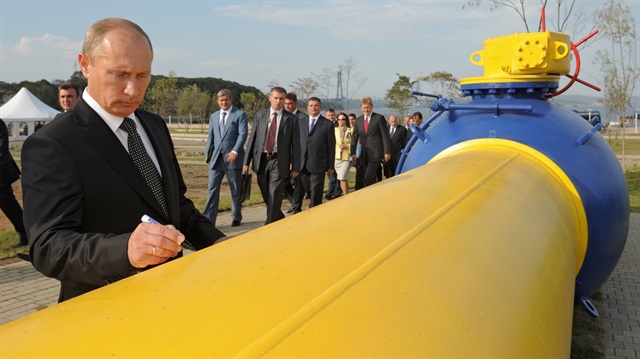
Vladimir Putin signs a natural gas pipeline in the Russian Far East city of Vladivostok on September 8, 2011.
Russia is setting records in gas pipeline exports despite U.S. pressure on Europe to reduce imports, and aims to become the world's leading liquefied gas exporter in the next decade thanks to technology it is developing at home.
Russian government officials and executives told an industry conference on Wednesday they expect Russia export a record amount of gas this year, potentially exceeding 200 billion cubic metres (bcm) and beating last year's all-time high of 194 bcm.
The development comes despite repeated calls by the United States on Europe to diversify its gas imports away from the Kremlin's pipeline monopoly Gazprom, which Washington says is using energy as a tool of intimidation.
Gazprom controls 35 percent of the gas market in Europe, larger than any other supplier, and aims to increase its share to 40 percent due to declining European production and the lower cost of extracting gas in Russia.
Figures show that Russian forces have tested several new weapon systems in Syria -- in the first direct clashes outside its borders in seven years.Russia intervened in the conflict in September 2015, backing the Bashar al-Assad regime on the pretext of fighting Daesh.The regime and its allies now control more than half of the country -- 109,136 square kilometers (42,137 square miles) of the 185,180 square kilometers (71,498 square miles) -- with two Russian military bases at the port city of Tartus and the northeastern city of Hmeimim.According to the Russian Ministry of Defense, a total of 34 warplanes and 16 helicopters at Hmeimim airbase actively took part in military operations across Syria under the service of 63,012 military personnel, of which 25,738 are officers and 434 generals.US would destroy banned Russian warheads if necessary: NATO envoyRussian jets carried out more than 39,000 airstrikes to support the regime and allies. Its warships were deployed 189 times.Russian S-300 and S-400 missile defense systems were also stationed across Syria, particularly in the vicinity of Russian bases.According to Kremlin figures, the war in Syria has cost more than $4 billion and resulted in 112 Russian casualties. Thirty-nine servicemen were killed when the An-26 transport aircraft crashed and 15 when the Il-20 warplane was downed.Russia also lost eight planes, seven helicopters and several armored vehicles.Germany to stop reconnaissance missions over Iraq, SyriaRussia tested 231 different newly-developed or modern arms systems, including the Tu-160 strategic bomber plane, the X-101 air-to-surface cruise missile, the modernized T-90 tank, the Su-57 and Su-35 fighter planes, Mi-28H helicopter, various short and intermediate range surface-to-air missiles and the Pantsir-S anti-aircraft artillery system.The Syrian war also saw the first-ever use of Russian long range naval cruise missiles, fired from warships in the Caspian Sea to targets within Syria.Russian President Vladimir Putin illustrated this point during a televised question and answer session on June 8, 2018.“The use of our armed forces in the battlefield is a unique experience, a unique tool by which to improve our armed forces. No amount of military exercises could compare with the use of force in combat conditions.”Number of US diplomats doubled in Syria: Pentagon chiefTime to clear YPG terrorists from Syria's Manbij and leave city to civilians: FM
Russian military tests arms to gain experience in Syria
"We have been hearing about the reduction in Russian supplies for many years now," Russian energy minister Alexander Novak told the conference. "But in spite of this, Europe keeps increasing Russian gas imports."
Novak said Russia could double gas exports by 2030 to meet soaring global demand.
That would require Gazprom to build new pipelines to China and Europe, adding some 163 bcm to its exports, while Russian liquefied natural gas (LNG) exports could reach 80-115 million tonnes.
That would put Russia on a par with Qatar, the world's largest LNG producer, which plans to expand its capacity to 110 million tonnes by 2024 from 77 million tonnes now.
Russia must halt its covert development of a banned cruise missile system or the United States will seek to destroy it before it becomes operational, Washington's envoy to NATO said on Tuesday.The United States believes Russia is developing a ground-launched system in breach of a Cold War treaty that could allow Russia to launch a nuclear strike on Europe at short notice, but Moscow has consistently denied any such violation.U.S. ambassador to NATO Kay Bailey Hutchison said Washington remained committed to a diplomat solution but was prepared to consider a military strike if Russian development of the medium-range system continued."At that point, we would be looking at the capability to take out a (Russian) missile that could hit any of our countries," she told a news conference. Number of US diplomats doubled in Syria: Pentagon chiefGermany to stop reconnaissance missions over Iraq, SyriaNumber of US diplomats doubled in Syria: Pentagon chief
US would destroy banned Russian warheads if necessary: NATO envoy
Russia is a fairly modest LNG producer. Its output comes from a Gazprom-led project on Sakhalin island off Russia's Pacific coast, and a project led by private producer Novatek in the Arctic Yamal peninsula.
"Despite the fact that the United States is reluctant to see Russian gas, some cargoes of LNG from Yamal have reached the United States itself this year," Novak said.
Novatek's chief executive, Leonid Mikhelson, said his company had the resources to boost output far above current targets. The company has said it could quadruple output to as much as 80 million tonnes of LNG.
"We are seeing the birth of a new industry in Russia," said Mikhelson, adding that Novatek has developed technology to liquefy gas.
Russia has up to now relied on companies such as French oil major Total to build new plants and provide technology.
U.S. and European sanctions on Moscow over its actions in Ukraine have made exports of technology to Russia and the funding of projects, such as Novatek's Yamal, challenging.
The United States also aims to become a large LNG exporter through its booming shale gas industry, but Mikhelson and Gazprom's deputy chief executive Alexander Medvedev said Russian gas would still be cheaper in Europe.
"As the Russian saying goes - they try to scare us but we are not afraid," Medvedev told the conference.
He added Europe may need as much as 100 bcm of new gas imports by 2030 because its own production is falling.