

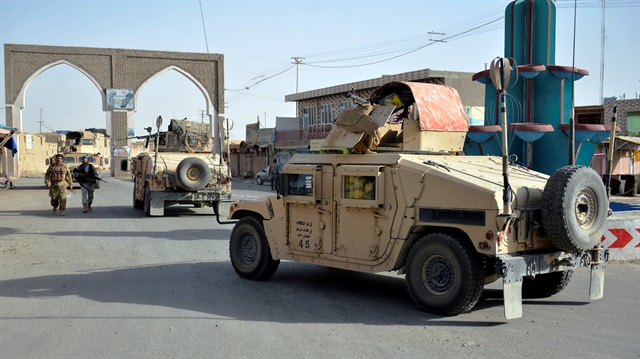
Afghan security guards walk during a Taliban attack in Ghazni city, Afghanistan August 12, 2018. Picture taken August 12, 2018.
Russia's Ministry of Foreign Affairs said on Wednesday the Taliban was prepared to attend multilateral peace talks on Afghanistan in Moscow, RIA news agency reported.
Afghanistan's deputy foreign minister is expected to visit Moscow on Thursday to discuss the dates of the talks, the Afghan embassy was cited as saying earlier.
Pakistan has seized three tons of hashish in an operation in the northern Arabian Sea, an official statement said on Wednesday.The country’s navy in collaboration with Maritime Security Agency seized a boat carrying the hashish worth "millions of dollars" as part of an anti-narcotics operation, the statement from Pakistan Navy said, without mentioning if any arrests were made.A video released by Pakistan Navy showed personnel standing behind a sack of “hashish-filled” bags recovered during the raid.The seized drugs were supposed to be smuggled into European market via sea route.This follows the recovery of 8,000 kilograms (17,637 pounds) of drugs worth over $90 million in the open market by Pakistan's coastguards in March this year from southwestern Balochistan province.According to the United Nations Office on Drugs and Crime (UNODC), Pakistan is the destination and transit country for approximately 40 percent of the opium produced in neighboring Afghanistan.Mineral-rich Balochistan province, which borders Afghanistan and Iran, is said to be a key transit point for drug trafficking between the two countries. The route is also notorious for smuggling of Iranian petroleum products.War-torn Afghanistan is the world's largest producer of illicit opium involving the country’s powerful warlords, and the militant groups, which use the drug money to arm their respective supporters despite the heavy presence of U.S.-led foreign forces for over 16 years.Scores of small mobile laboratories have reportedly been operating in lawless Pak-Afghan border for opium processing, according to the UNODC.
Pakistan seizes hashish worth millions of dollars
The UN refugee agency on Tuesday hailed the new Pakistani premier’s pledge to grant citizenship to around 1.5 million Afghan refugees and Bengalis who have lived in the country for decades. “The UNCHR welcomes the statement by Prime Minister Imran Khan on Afghan children born in Pakistan," Qaiser Afridi, spokesperson for the UNHCR Pakistan, told Anadolu Agency.The UNHCR will continue to closely work with the government of Pakistan on these issues in the coming weeks, he added.On Sunday, Khan announced that his government is considering granting nationality to Afghan refugees and Bengali children who were born in Pakistan.The announcement came a day after his Foreign Minister Shah Mehmood Qureshi returned from meeting with Afghan President Ashraf Ghani and other top officials in Kabul.According to the UN, Pakistan has around 2.4 million registered and unregistered Afghan refugees, most of whom fled Afghanistan after the 1979 Soviet invasion. As some 60 percent of the Afghan refugee population was born in Pakistan, nearly 1.5 million people could benefit from the move. - Khan consults with parliamentOn Tuesday, Khan asked parliament for feedback on his citizenship proposal."Children whose parents have lived the last 40-50 years in Pakistan have no identity,” Khan said in a nationally televised speech to parliament.“If we are still refusing to give them identity, where they will go?"They are people and now is the time to make a final decision on these stateless people, he added.Pakistan's 1951 citizenship act guarantees citizenship to anyone born in the country, excluding the children of foreign diplomats and “enemy aliens.”- Afghan refugees welcome proposalAfghan refugees living in Pakistan welcomed Khan’s proposal, calling it good news for all refugees."This is really good news and we are happy that government is finally accepting our longstanding demand," Noor Wali, 25, told Anadolu Agency.The move would also benefit the country’s economy to bring all those Afghan refugees who are running big businesses in Pakistan into the tax system, he added. Wali's parents escaped Afghanistan after the Soviet invasion and took shelter in Peshawar in northwestern Pakistan.But Wali’s father Haji Sharafat, 62, is worried about his future if the government only grants nationality to his children.“The government should also grant citizenship to all those refugees who’ve been living here since 1980,” he said, also voicing concern over how their children could live in Pakistan if the government deports their parents. - Political reactionPoliticians seems divided over Khan's proposal. Pashtun nationalist parties welcomed it, but Baloch nationalists called it disappointing."The ANP fully supports granting Pakistani citizenship to refugees from Afghanistan and Bangladesh born in Pakistan. This is very important to end discrimination against stateless people and to improve Pakistan's image the world over," the Awami National Party (ANP), a major Pashtun nationalist party, said in a statement.But Akhtar Mengal, head of the Balochistan National Party (BNP), a major Baloch nationalist party in Balochistan, struck a sour note. "The premier’s announcement is disappointing, as on one hand the Durand Line -- the border between Pakistan and Afghanistan -- is being fenced, and on the other, Afghan refugees are being provided nationality," said Mengal in a statement.Mengal may fear the government move could damage his electoral support in the Balochistan province, where the Baloch ethnicity is currently in the majority, but could become a minority if the government gives nationality to Afghan refugees.
UNHCR hails Pakistan plan to grant refugees citizenship