

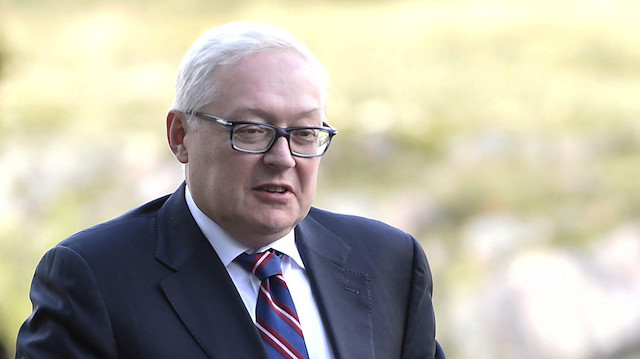
Deputy Foreign Minister of the Russian Federation Sergei Ryabkov
Russia said on Monday it was planning for a U.S. deployment of new nuclear missiles in Europe following Washington’s planned withdrawal from a landmark Cold war-era arms control treaty despite the United States denying it has such plans.
Russia is keen to dissuade U.S. President Donald Trump from carrying out a threat for Washington to quit the Intermediate-Range Nuclear Forces (INF) Treaty which eliminated both countries’ land-based short- and intermediate-range nuclear missiles from Europe.
Both countries accuse each other of violating the 1987 treaty and President Vladimir Putin and Trump are due to discuss the matter at the G20 in Argentina later this month.
Deputy Foreign Minister Sergei Ryabkov told a news conference on Monday that Moscow wanted to save the treaty and was open to talks on the issue with Washington.
But Ryabkov, who accused the United States of violating the accord with missile deployments in Poland and Romania, said he thought the chances of a change of heart were slim and said Russia's military planners were prepared for such a scenario.
Russia has stopped three Ukrainian navy vessels from entering the Sea of Azov via the Kerch Strait by placing a huge cargo ship beneath a Russian-controlled bridge, Russia's state-controlled Rossiya 24 TV channel reported on Sunday.Earlier on Sunday, Russia and Ukraine accused each other of breaking international law after Russian border guards tried and failed to stop Ukrainian ships circumnavigating Crimea en route to a Ukrainian port.A Rossiya 24 correspondent reporting from the area of the Kerch Strait bridge near Crimea said Russia's tactic had completely blocked the bridge, which connects the Black Sea and the Sea of Azov, and that Russian military helicopters were circling overhead.
Russia blocks Ukrainian navy from entering Sea of Azov
Russia on Sunday intervened as Ukrainian warships were engaged in relocation from the Port of Odesa to the Port of Mariupol in the Sea of Azov, the Ukrainian navy said.According to a statement by the Ukrainian Navy, two armored artillery vessels and a tug boat were sent after notifying transfer plans in advance, in accordance with international rules, to ensure the safety of shipping.The statement said Russian ships tried to stop the movement by “ramming” the tugboat that caused minor damages.It said all “unlawful” actions were recorded by the Ukrainian Navy Command and transferred to the international bodies.However, the Russian Federal Security Service (FSB) claimed that Ukraine violated international law by crossing the Sea of Azov, off the Crimea.Relatives of MH17 victims taking Russia to top EU courtIn a statement, the FSB said the Ukrainian warships illegally entered Russian territorial waters at 07.00 a.m. local time.The statement added that the Ukrainian ships were carrying out “dangerous maneuvers” in the Russian waters, ignoring the warnings of the border security.Ukrainian ships continued its “provocation for around five hours in the territorial waters of Russia,” the statement said, added: "The purpose of the Ukrainian ships in the region to create a conflict is obvious."Bulgaria reported as route choice for TurkStream 2 gasHead of Russian spy agency accused of British poison attack dies
Russia ‘rams’ Ukrainian tugboat off Crimea
A Sceptical Moscow
NATO’s top official said in October he did not believe there would be new deployments of U.S. missiles in Europe and U.S. National Security Advisor John Bolton said Washington was a long way from taking decisions about deploying missiles in Europe.
Ryabkov said Moscow was sceptical about assertions from U.S. and NATO officials that no such new missiles would be deployed.
"We hear (the denials) but nothing more," said Ryabkov. "Plans have been changed many times before. We don't want to be disappointed in our (U.S.) colleagues again and therefore we are assuming the worst case scenario in our military planning."
Russia and Ukraine accused each other of breaking international law on Sunday after Russian border guards tried and failed to stop two Ukrainian armoured artillery vessels circumnavigating Crimea en route to a Ukrainian port.The incident in the Black Sea reflects rising tensions between Moscow and Kiev around the Sea of Azov which both countries have the right to use.Russia and Ukraine, whose relations remain acutely strained after Moscow's 2014 annexation of Crimea and its backing for a pro-Russian insurgency in eastern Ukraine, have accused each other of harassing each other's shipping in the area.On Sunday, the Ukrainian Navy said it had sent two small armoured artillery vessels and a tug boat from the port of Odessa to Mariupol, a journey that requires them to pass from the Black Sea via the Kerch Strait into the Sea of Azov.It said in a statement that Russian border guard vessels had tried to stop the small flotilla by ramming the tug boat, causing minor damage to it in an incident it said showed Russia was behaving aggressively and illegally.Russian news agencies reported that Russia's FSB security service had accused Ukraine of not informing it in advance of the journey, something Kiev denied, and had said the Ukrainian ships had been manoeuvring dangerously with the aim of stirring up tensions.The Ukrainian navy said the flotilla was continuing its journey regardless.
Russia and Ukraine involved in Black Sea naval standoff
Russia would be ready to host a meeting between Palestinians and Israel and to act as a mediator, Foreign Minister Sergei Lavrov said on Friday.Lavrov was speaking to reporters during a two-day trip to Rome. Israeli navy detains Palestine fishermen off Gaza coastHamas seeks Palestinian unity not division: Leader
Russia ready to mediate between Palestinians and Israel: Lavrov
Ryabkov said he believed the United States would be able to deploy intermediate-range nuclear missiles in Europe "within years," something he said would fuel a dangerous arms race.
"We can't ignore the potential deployment of new American missiles on territory from where they will be a threat to Russia and its allies," the TASS news agency cited him as saying.
"In the event of such a deployment the Americans would gain significant extra capabilities, allowing them to strike at targets deep inside Russia."
Putin has previously said that Russia would be forced to target any European countries that agreed to host U.S. nuclear missiles.
Ryabkov said it was too early to speak about specific military retaliatory steps, but said Moscow's response would be "effective" and "relatively inexpensive."
Russia has drawn up draft legislation aimed at stopping leaks of personal information from state agencies, a step that follows publication of details of Russians allegedly involved in clandestine intelligence operations abroad.The bill, produced by Russia's communications ministry, bars unauthorised people from creating and publishing databases of personal data drawn from official sources, and fines anyone violating that rule.It also requires that state agencies setting up systems for handling personal data consult with the Federal Security Service, Russia's main domestic intelligence agency.The communications ministry did not respond to a request for comment from Reuters.'Turkish-Russian cooperation reshaping world'The bill, published late on Thursday, says it is in response to a 2017 instruction from President Vladimir Putin and makes no mention of the spate of leaks.However, Russian authorities have been embarrassed by leaks about two men Britain alleges were Russian intelligence agents who used a nerve agent to poison former spy Sergei Skripal and his daughter. Russia denies involvement.The two men told Russian television they were innocent tourists who went to the English city of Salisbury, where Skripal was living, to view its cathedral.But the Bellingcat investigative journalism website, drawing on leaked passport information, identified the two as officers with Russia's GRU military intelligence agency.Russian tourists to Turkey hit record high: envoyIn a separate case, a Russian accused in a U.S. indictment of conducting cyber attacks around the world was traced, via leaked official databases, to an address in Moscow that Washington says is a base for Russian military intelligence.The legislation, comprising two draft laws and a draft government resolution, has been published for a 30-day period of public consultation, after which it will be submitted to parliament and the government for approval.Russia has an active black market in illegal databases compiled using confidential information stolen from state-run registries. The data includes passport details, addresses, car registrations, flight manifests and even tax returns.Releasing personal data in this way is already illegal under existing legislation, but Russian authorities have struggled to stamp out the practice. Many of the databases are openly available on the Internet. Russia: US uses base in Syria for militant training
Russia, stung by intelligence leaks, plans to tighten data protection