

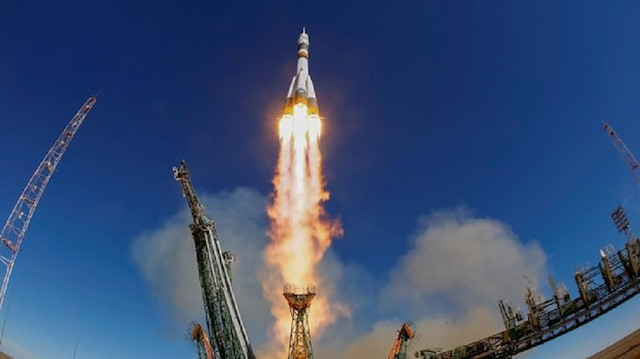
File photo
A Russian-made Soyuz rocket blasted a three-man crew into orbit on Monday, beginning the first manned voyage to the International Space Station since a mission in October was aborted in midair because of a rocket malfunction.
The Soyuz lifted off at 1131 GMT from Baikonur cosmodrome in Kazakhstan, carrying Russian cosmonaut Oleg Kononenko, NASA astronaut Anne McClain and the Canadian Space Agency's David Saint-Jacques.
"We have confirmation of the spacecraft separation; Soyuz capsule and crew safely in orbit," NASA TV said online in its blow-by-blow commentary of the take-off.
The launch was closely scrutinised because of the abortive mission to the ISS on Oct. 11, which ended two minutes after take-off when a rocket failure forced its two-man crew to perform an emergency landing.
Three spaceflyers launched on Monday (December 3) to the International Space Station (ISS) abort a Russian Soyuz rocket. NASA astronaut Anne McClain, Canadian astronaut David Saint-Jacques and Russian cosmonaut Oleg Kononenko took off from the Baikonur Cosmodrome in Kazakhstan.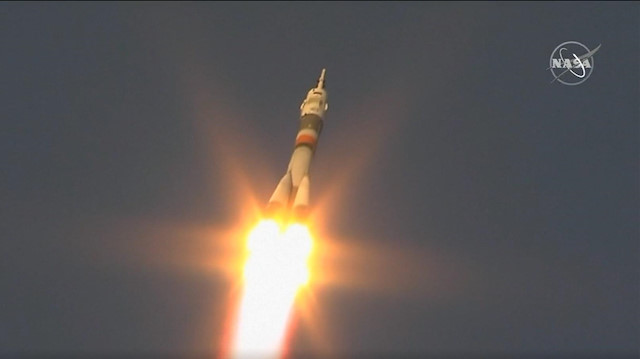
American and Canadian astronauts and Russian cosmonaut launch to the International Space Station
Russian investigators blamed that malfunction, which occurred as the first and second stages of a booster rocket separated, on a damaged sensor.
The three-man crew appeared briefly before relatives and reporters on Monday morning, waving and blowing kisses as they left a hotel to board a bus on their way to prepare for the flight.
The crew repeatedly denied being nervous about flying and insisted the fact that the two-man crew had safely returned to Earth despite the dramatic mishap had demonstrated the reliability of the rocket's safety mechanisms.
Before take-off, an Orthodox priest at the launchpad on Sunday gave his blessing to the flight, splashing holy water from a brush and holding up a cross.
The spacecraft is due to dock at the ISS at 1736 GMT on Monday.
The new arrivals to the ISS will join the European Space Agency's Alexander Gerst, NASA's Serena Auñón-Chancellor and Russia's Sergey Prokopyev, who have been in orbit since June but are due to fly back to Earth on Dec. 20.
The chief of Britain's foreign intelligence service warned the Kremlin on Monday not to underestimate the West after a brazen nerve agent attack on a retired double agent in England stoked fears about Russian covert activity abroad.In his second major speech since being named in 2014 to head the Secret Intelligence Service, or MI6, Alex Younger said Russia has a stance of "perpetual confrontation" with the West.After the attack on Sergei Skripal, a former Russian military intelligence officer who betrayed dozens of agents to MI6, Britain's allies in Europe and the United States took its side and ordered the biggest expulsion of Russian diplomats since the height of the Cold War.Britain identified the nerve agent deployed in the English town of Salisbury as Novichok, a highly potent group of nerve agents developed by the Soviet military in the 1970s and 1980s.Kremlin calls absurd accusation it has designs on Ukrainian sea ports"The Russian state used a military-grade chemical weapon on UK soil," Younger told students at the University of St Andrews in Scotland where he once studied economics and computer science before joining the British army."Our intention is for the Russian state to conclude that, whatever the benefits it thinks it is accruing from this activity, they are not worth the risk," he said.Moscow has repeatedly denied involvement and accused British intelligence agencies of staging the attack to stoke anti-Russian hysteria."I should emphasise that even as the Russian state seeks to destabilise us, we do not seek to destabilise Russia. We do not seek escalation," Younger said.Younger, 55, said that Britain's spies have thwarted multiple Daesh plots originating overseas.Less than four months before the United Kingdom is due to leave the European Union on March 29, Younger said MI6 continues to work with partner agencies to strengthen "indispensable security ties" in Europe.He said the United Kingdom had helped France and Germany prevent terrorist attacks.MI6, the home of fictional spies such as John le Carré’s George Smiley and Ian Fleming’s James Bond, has the job of defending Britain, and its interests, abroad.A career spy who joined MI6 as the Soviet Union was crumbling, Younger stressed the need for espionage to embrace the new."The era of the fourth industrial revolution calls for a fourth-generation espionage: fusing our traditional human skills with accelerated innovation, new partnerships and a mindset that mobilises diversity and empowers the young," he said.In a recruitment pitch, Younger gave some details of his own life, including drinking obscure homemade alcohol in an attempt to penetrate an organisation intent on genocide in the Western Balkans in 1990s."If you want to make a difference and you think you might have what it takes, then the chances are that you do have what it takes, and we hope you will step forward."
Britain's MI6 spymaster cautions Russia: Do not meddle in the West