

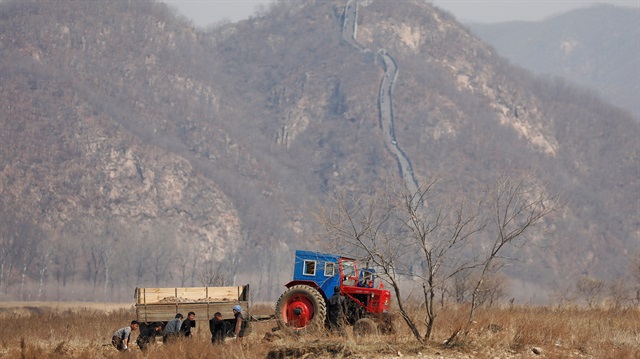
File Photo: North Korean farmers work in a field as a section of the Great Wall is seen on the Chinese side of the Yalu River, north of the town of Sinuiju in North Korea and Dandong in China's Liaoning province.
A heat wave in North Korea has led to rice, maize and other crops withering in the fields, "with potentially catastrophic effects", the International Federation of Red Cross and Red Crescent Societies said on Friday.
The world's largest disaster relief network warned of a risk of a "full-blown food security crisis" in the isolated country, saying that the worrying situation had been exacerbated by international sanctions imposed due to North Korea's nuclear and missile programmes.
The South and North Korean leaders will hold high-level talks on Monday to review the decisions taken during a meeting on April 27, according to local news agency Yonhap.The summit between officials from South and North Korea will take place in the Joint Security Area of Panmunjom in the South, also known as the truce village, where the 1953 Korean Armistice Agreement that paused the Korean War was signed.North Korea urges US to relent on peace treaty stanceThe South Korean Unification Minister Cho Myoung-Gyon said the preparations for a new summit between South and North Korean leaders will also be discussed during the meeting.On April 27, the leaders of North and South Korea agreed to a “complete denuclearization” and lasting peace on the Korean Peninsula.The deal followed a historic bilateral summit between South Korean President Moon Jae-in and North Korean leader Kim Jong-un in Panmunjom.
Koreas to hold high-level talks on Monday
There had been no rainfall since early July as temperatures soared to an average 39 Celsius (102 Fahrenheit) across the country, whose official name is the Democratic People's Republic of Korea (DPRK), and the next rain was expected in mid-August, it said.
The population of 25 million is already stressed and vulnerable with malnutrition among children that could worsen, it said in a statement issued in Geneva.
"This is not yet classified as a drought, but rice, maize and other crops are already withering in the fields, with potentially catastrophic effects for the people of DPRK," said Joseph Muyamboit, its programme manager in Pyongyang.
Iranian President Hassan Rouhani told North Korea's foreign minister that the United States cannot be trusted, Tehran's state media said, as the United States seeks a deal to rein in the North's nuclear and missile programmes.Iran dismissed a last-minute offer from Washington for talks this week, saying it could not negotiate after the Trump administration reneged on a 2015 deal to lift sanctions in return for curbs on Iran's own nuclear programme.North Korea's top diplomat, Ri Yong Ho, visited Iran as the United States reintroduced sanctions against the Islamic Republic."The U.S. administration performance in these years has led the country to be considered untrustworthy and unreliable around the world which does not meet any of its obligations," Rouhani was quoted by the Islamic Republic News Agency (IRNA) as telling Ri on Wednesday.Iran's minister of labour sacked by parliament"In the current situation, friendly countries should develop their relations and cooperation in (the) international community," he said, adding Iran and North Korea have "always had close views" on many issues.Ri travelled to Tehran after attending a security forum in Singapore, where he and U.S. Secretary of State Mike Pompeo sparred over an agreement made at June's landmark summit between Trump and North Korean leader Kim Jong Un.US seeks to trigger chaos in Iran by reinstating sanctionsThe two sides vowed to work towards North Korea's denuclearisation at the summit, but have since struggled to reach a deal to meet that goal. North Korea has been pursuing its weapons programmes in defiance of U.N. Security Council resolutions and sanctions.Ri told Rouhani that Washington's pullout from the 2015 pact and restoration of sanctions was an "action against international rules and regulations", IRNA said."North Korea's strategic policy is to deepen relations with the Islamic Republic of Iran and confront unilateralism," he said.North Korea's top envoy visits IranTrump decided to restore sanctions against Iran despite pleas from other world powers that had co-sponsored the deal, including Washington's main European allies, Britain, France and Germany, as well as Russia and China.The sanctions have already led banks and many companies around the world to scale back dealings with Iran. Companies doing business with Iran will be barred from the United States, Trump said on Tuesday.Supreme Leader Ayatollah Ali Khamenei, the highest authority in Iran, said the country had nothing to be concerned about, his official website said on Wednesday."With regard to our situation do not be worried at all. Nobody can do anything," Khamenei said, the website reported."They can be sure. There is no doubt about this." 
US can't be trusted, Iran's Rouhani tells North Korea
"We cannot and must not let this situation become a full-blown food security crisis. We know that previous serious dry spells have disrupted the food supply to a point where it has caused serious health problems and malnutrition across the country," he said.
The Federation was helping the national Red Cross to support 13,700 of the most vulnerable people at risk. It had deployed emergency response teams and 20 water pumps to irrigate fields in the hardest-hit areas, it said.
North Korea's state-run media insisted Thursday that officially ending the 1950-53 Korean War is the "first process" if the peninsula is going to achieve peace.The North's Rodong Sinmun newspaper described the need for a formal peace treaty as "the demand of our time" while also lamenting the "abnormal" lack of trust between Washington and Pyongyang.The United States has repeatedly made clear its view that the Korean War should only be closed once North Korea denuclearizes, although the latter sees an official state of peace as a security guarantee from Washington.North Korea's top envoy visits IranTo further complicate the standoff, South Korea already agreed with the North that they will seek to end the war by the end of this year following decades of tensions since an armistice was signed by American, North Korean and Chinese officials in 1953.South Korean lawmaker raises alarm on North’s coalSeoul's presidential office added further pressure Monday when spokesman Kim Eui-kyeom told reporters that South Korea is asking the North to "speed up its denuclearization process" and the U.S. to "show sincere efforts about corresponding measures that North Korea is demanding".Pyongyang has accused Washington of being too focused on sanctions and making "gangster-like demands" since the unprecedented summit between Chairman Kim Jong-un and President Donald Trump on June 12.
North Korea urges US to relent on peace treaty stance
David Beasley, the head of the U.N.'s World Food Programme (WFP), visited North Korea in May to look into boosting food distributions to hungry women and children, in the latest sign of an opening.
About 70 percent of North Koreans are "food insecure", meaning they struggle to avoid hunger, and one in four children under five is stunted from chronic malnutrition, the WFP said at the time. A 2015 drought worsened the situation, it said.
North Korea suffered famine in the mid-1990s that killed up to three million people.
When South Korean businessman Kim Yong-tae worked with North Koreans at the Kaesong Industrial Complex before it was closed in 2016, one of the biggest challenges was communicating in what is ostensibly a shared language."There were confounding moments because there were terms I never heard of while working and living just in South Korea," he said, describing blank looks from some North Korean workers when he used the word "container," which is pronounced similar to its English term in South Korea.Between the South's increasing adoption of international terms and the North's political sensitivity to some words, the growing language divide is complicating cooperation on a range of joint cultural and economic exchanges as ties between the neighbours improve.To counter the confusion and promote a feeling of unity, the South Korean government is working to restart an obscure academic project aimed at developing a common Korean language dictionary with the North.North and South Korea speak the same language based on the Hangeul alphabet, but after decades of division, only about 70 percent of words are mutually understood, according to some experts.GROWING APARTThe two Koreas officially maintain the goal of reunification, but as each side has developed in strikingly different ways, that dream has faded.North Korea's government has maintained - at least officially - a tight grip on its economy, meaning many North Koreans are unfamiliar with some economic and business terms common in the South's more capitalist system."Homelessness, yearly rent, monthly rent: The North Koreans have no such terms since everything is owned by the state which gives out housing," said Kim Wanseo, a South Korean lexicographer on the committee working to compile the dictionary.After she defected to the South in 2002, Kim Young-hee said she had to learn a number of financial terms that didn't exist in the North, including the words for stocks and shares."When it comes to general terms, I would say seven out of 10 words can be mutually understood by people from each side," said Kim, the lexicographer. "However, when it comes to jargon and technical words there is a big, big difference between the two now."The North's cultural and political isolation has also meant North Koreans have adopted fewer English words.This became obvious when the players from North and South Korea combined for a joint ice hockey team during the Olympics."The only two words we shared were 'skates' and 'puck'," said Kim Jung-min, spokesman for the Korea Ice Hockey Association. "We had to coordinate before all training started, and we printed out the list of different terms between the two and stuck them on the athletes’ lockers."COMPILING A DICTIONARYIn the wake of April’s summit between North Korean leader Kim Jong Un and South Korean President Moon Jae-in, the two counties have embarked on a number of cooperation projects designed to avoid running afoul of sanctions.Besides the dictionary, began in 2006 but halted in 2015 due to political tensions, projects being discussed include the archaeological excavation of a palace in North Korea, performances by a North Korean art troupe in South Korea, pest control projects in the North, and a number of sporting events.And in a gesture of unity, North Korea changed its time zone by half an hour to realign with the South.The South's Unification Ministry says preserving and unifying the language is needed to prepare for eventual unification.Politics is never far away, however, and past dictionary discussions with the North Koreans often involved sensitive terms.For example, the dictionary's authors had to avoid one term for "him," which was typically used only to apply to North Korean leaders, and the United States could not be mentioned in examples, said Kim, the lexicographer.The sides debated the definition of the word "dong-mu," which means childhood friend in the South, but has come to mean comrades who experienced the communist revolution together in the North."We had to negotiate what an impartial definition is – and ended up defining it as ‘someone who strives together for a single goal,’ Kim said.Other debates were less serious.In South Korea, the verb "sal-ji-da" is used to say "hey, you’ve gained some weight.""It’s insulting in some contexts here too, but it’s a very insulting word to the North Koreans - to a whole new level," Kim said. "They only use this verb for farm animals."
Language hurdles plague two Koreas after years of division