

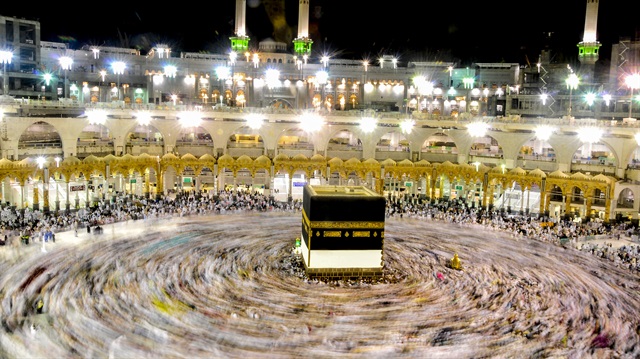
Muslim Hajj pilgrims at Masjid al-Haram in Mecca
Qatar has accused Saudi Arabia of barring its citizens from this year's hajj, something Riyadh denies, saying a diplomatic dispute is not stopping Qataris from making the pilgrimage to Mecca.
Although 1,200 Qataris are eligible to perform the hajj under a quota system, Qatar says it has become impossible to get permits, blaming the campaign by Saudi Arabia, the United Arab Emirates, Bahrain and Egypt to cut trade and diplomatic ties with the country.
Abdullah Al-Kaabi of the state-run Qatar National Human Rights Committee said Saudi Arabia had shut down an electronic system used by travel agencies to obtain permits for pilgrims from Qatar.
Saudi Arabia is currently hosting more than 800 foreign media personnel to cover this year’s Hajj pilgrimage, according to Saudi Information Minister Awad bin Saleh al-Awwad.This year’s pilgrimage season is officially set to begin on Sunday evening.Al-Awwad made the assertion while inspecting a series of information centers set up for pilgrims in the areas of Arafat, Muzdalifah and Mina.According to the minister, preparations for this year’s pilgrimage are being covered by 151 media outlets from around the world in a multiplicity of languages.At least 16 direct digital channels, he said, are also covering the preparations in six different languages around the clock.Al-Awwad went on to note that his ministry had set up a number of media centers in Mecca -- and at other holy sites -- to facilitate coverage of pilgrimage-related activities.Media personnel, he added, were being provided with all the technical services they require.Last year, roughly 1.75 million Muslims visited Saudi Arabia to perform the Hajj, while another 6.53 million came for the Umrah, the non-mandatory lesser pilgrimage.The Hajj pilgrimage to Mecca is considered a religious obligation for Muslims, who are expected to make the journey -- if financially feasible -- at least once in their lives.Unlike the Hajj pilgrimage, which this year will take place from Aug. 19 to 24, Muslims can perform the Umrah at any time.Turkish religious head visits sick patients in Mecca1.4mn Muslims arrive in Saudi for Hajj pilgrimageHoly sites for worship, not politics: Saudi Arabia
800 journos in Saudi to cover Hajj pilgrimage: Minister
"There is no chance this year for Qatari citizens and residents to travel for hajj," he told Reuters. "Registration of pilgrims from the State of Qatar remains closed, and residents of Qatar cannot be granted visas as there are no diplomatic missions."
A Saudi official said Qatar had blocked several registration links set up for its pilgrims.
An official at Saudi Arabia's hajj ministry said a group of Qataris had arrived for the pilgrimage which runs from Sunday to Aug. 24, but he did not say how many there were or whether they had travelled directly from Qatar. Last year, 1,624 Qatari pilgrims attended, he said.
The head of Turkey's top religious authority on Thursday visited patients being treated at a hospital founded by the authority in Saudi Arabia.Ali Erbas, the head of Turkey's Religious Affairs Directorate (Diyanet), made inspections at the Diyanet Health Center, which was specifically founded to treat Turkish pilgrims visiting the holy city of Mecca during the Hajj.The hospital provides treatment with its staff of 550 in Mecca and Medina, and has so far examined over 70,000 patients, according to the head of the directorate’s health team.
Turkish religious head visits sick patients in Mecca
'LOST MONEY'
Saudi Arabia says the Qatari government is using the issue for political ends and it "rejects any effort to politicise the hajj or drag political differences" into the pilgrimage, the official said, speaking on condition of anonymity.
Saudi Arabia, and the three other Arab countries, closed land, air and sea links with Qatar in June last year, accusing it of funding terrorism, something Doha denies.
Saudi Arabia has said Qatari pilgrims can arrive on any airline other than Qatar Airways.
But three travel agencies in Doha told Reuters they had stopped trying to sell hajj packages, which can cost up to 120,000 riyals ($33,000).
The number of pilgrims who have come to Saudi Arabia from overseas to take part in this year’s Hajj pilgrimage now stands at some 1.39 million, the Saudi authorities said Monday.According to the Saudi General Directorate for Passports, the new arrivals cover the period from July 14 to Aug. 11.On July 1, the Saudi Ministry for Hajj and Umrah Affairs said that arrangements had been made to accommodate as many as two million expected pilgrims.Video: Muslim pilgrims visit Hira Cave in MeccaLast year, roughly 1.75 million Muslims visited Saudi Arabia to perform the Hajj, while another 6.53 million came for the Umrah, the non-mandatory lesser pilgrimage.The Hajj pilgrimage to Mecca is considered a religious obligation for Muslims, who are expected to make the journey -- if financially feasible -- at least once in their lives.Unlike the Hajj pilgrimage, which this year will take place from Aug. 19 to 24, Muslims can perform the Umrah at any time of the year.
1.4mn Muslims arrive in Saudi for Hajj pilgrimage
"Last year we lost a lot of money as the crisis started after we had booked everything in Mecca and Medina and we had to pay people back," said a manager of one travel agency in Doha, declining to be named due to the sensitivity of the matter.
"This year, nobody is really trying as people have understood there is no way to go there in these circumstances."
Riyadh temporarily opened the land border for the hajj last year, but not this time. A travel agency catering to migrant labourers in Doha said that had hit business.
"We sell hajj journeys by bus with accommodation for around 12,000 riyals," its manager said. "But as nobody can get visas and land borders are closed, it is zero bookings this year."
The diplomatic crisis has defied mediation efforts by the United States, which has strong alliances with both sides and fears the split among its Sunni Muslim allies could benefit Shi'ite Iran.
Saudi Arabia and Iran are involved in proxy wars, including in Yemen and Syria, and tensions between the two have spilled over into the hajj in the past.
In 2016, Iran boycotted the hajj over security concerns after hundreds of people were killed in a crush there. Iranian pilgrims returned in 2017.