

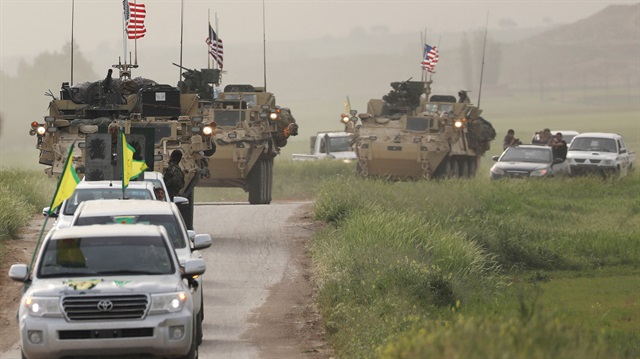
The YPG headd a convoy of U.S military vehicles in the town of Darbasiya next to the Turkish border, Syria April 28, 2017.
Clashes between Israeli and Iranian forces in Syria could lead to a new conflict, Richard C. Baffa, a senior international/defense researcher at the RAND Corporation and Nathan Vest, a research assistant and Middle East specialist also at RAND Corporation warned.
Israeli Defense Minister Avigdor Lieberman on Monday hinted that Israel could strike Iranian targets outside Syria. The Israeli Broadcasting Authority quoted Lieberman as saying: “We aren’t limiting ourselves to Syrian territory. That should be clear. We will fight against all of Iran’s threats, regardless of where it comes from.”
Signs of war
Israeli Prime Minister Benjamin Netanyahu has previously emphasized that Tel Aviv was against any Iranian presence in Syria. Tehran’s goal to build a lasting military presence in the country has been rejected time and time again by Tel Aviv, which has gone so far as to launch attacks to deter Iran, although these have proven fruitless.
U.S. President Donald Trump on Monday warned Syrian leader Bashar al-Assad not to “recklessly attack” Idlib province amid reports of a potential military offensive by regime forces.“President Bashar al-Assad of Syria must not recklessly attack Idlib Province. The Russians and Iranians would be making a grave humanitarian mistake to take part in this potential human tragedy,” Trump posted on Twitter.“Hundreds of thousands of people could be killed. Don’t let that happen!” he added.Located near the Turkish border, Idlib is home to more than 3 million Syrians, many of whom fled from other cities that were attacked by the Assad regime’s forces.In May, Idlib was designated a “de-escalation zone” -- in which acts of aggression are expressly forbidden -- as part of ongoing peace talks in the Kazakh capital, Astana.Earlier Monday, Germany and France expressed concern about a possible major offensive in the region.Meanwhile, Iranian Foreign Minister Javad Zarif, who arrived in Damascus Monday for talks ahead of a planned trilateral summit on war-torn Syria, said the Al-Nusra and Hayat Tahrir al-Sham terrorist groups “must be cleaned out of Idlib”.
Trump warns Assad against ‘recklessly attacking’ Idlib
“Past Israeli conflicts, such as the 2006 Hezbollah War, reveal common signposts on Israel's 'road to war,' in which a series of provocations prompted large-scale Israeli operations. Today, Israel's threat perception is much higher, as Tehran seems intent on pressing its perceived advantage in Syria and bolstering Lebanese Hezbollah’s (LH) precision strike capability with advanced weapons and an indigenous production capability,” Baffa and Vest wrote in an article published in late August.
Iran and Hezbollah are strong allies of Syria’s Bashar al-Assad regime, the forces of which have been fighting opposition groups in a deadly civil war since 2011.
Since then, hundreds of thousands of people are believed to have been killed and millions more displaced by the conflict.
Turkey deployed more military vehicles to its southeastern province of Kilis near the Syrian border early Tuesday. A total of eight trucks loaded with tanks and howitzers passed through Kilis and in the direction of Elbeyli district on the Syrian border, according to an Anadolu Agency correspondent in the field.Video: Turkish military reinforcements dispatched to Syria borderThe military vehicles were transferred under security measures to troops on the Syrian side of the border, according to a source who spoke on condition of anonymity due to restrictions on speaking with the media. 
Turkey deploys more military vehicles to Syrian border
New conflict would be more destructive than previous clashes
“A new war between Israel and LH that directly involves Iranian forces would potentially be far larger in scope and more destructive than the 2006 [Hezbollah] conflict. LH has a more-capable military, battle-hardened from years in Syria, and a rocket and missile force that can strike deep into Israeli territory,” they added.
RAND backs US presence in Syria
Baffa and Vest stated that it was in Washington’s best interest to maintain its presence in Syria. This comes as no surprise, as RAND Corporation is known for its links to the U.S. intelligence services.
“Continuing to entertain the possibility of exchanging a withdrawal of U.S. forces for a near-term peace deal and a tentative agreement to limit the Iranian presence in Syria could be a mistake. The United States would be better off reaffirming its presence in Syria and maintaining its hard and soft power efforts to constrain Iran and reduce the risk of another large-scale and disastrous war in the Middle East,” the article concluded.
As Syrian President Bashar al-Assad prepares for an offensive against the last opposition-held stronghold of Syria’s Idlib, diplomatic efforts are increasing to prevent a “disaster.”The State Department said the new U.S. special representative for Syria and also former U.S. ambassador to Ankara, James Jeffrey, will travel to Israel, Jordan, and Turkey with his delegation alongside from Saturday to Tuesday on his first official trip abroad.“In Turkey, the Ambassador and DAS Rayburn will meet with Turkish leaders and other senior officials to reiterate the U.S. position that a military offensive in Idlib will escalate the crisis in Syria and the region, risk the lives of humanitarians and Syrian civilians, and destroy civilian infrastructure. They will also commend Turkish leadership on their continued compassion for those affected by the Syrian conflict,” a statement read.The United Nations on Thursday called on Russia, Iran and Turkey to forestall a battle in Idlib which would affect millions of civilians.Located near the Turkish border, Idlib has been designated as a de-escalation zone endorsed by Turkey, Russia and Iran where acts of aggression are expressly forbidden as part of the ongoing Astana process.Idlib must be ‘cleaned out of terrorists’: Iran FMIsrael may strike Iran targets outside Syria: Lieberman
US special representative heads to Turkey to discuss Syria
Israeli Defense Minister Avigdor Lieberman on Monday hinted that Israel could strike Iranian targets outside Syria.The Israeli Broadcasting Authority quoted Lieberman as saying: “We aren’t limiting ourselves to Syria. That should be clear.”Speaking at a conference in Jerusalem, the hardline defense minister did not elaborate on the nature of the Iranian targets that Israel might attack.In recent months, Israel has admitted to striking a number of Iranian targets inside Syrian territory.‘US is preparing to strike over 20 regime positions in Syria’UNRWA chief defends refugee criteria for millions of PalestiniansIsrael signals it could target Iranian military assets in IraqWorld-famous artists boycott Israeli music festivalIsraeli navy injures Palestinian during boat protest
Israel may strike Iran targets outside Syria: Lieberman
Syrian President Bashar al-Assad’s army is on high alert in anticipation of a potential U.S. attack.The U.S. is reportedly in preparation to launch strikes against more than 20 positions of Assad regime forces.On the other hand, Israel conducted a string of missile attacks against five of Assad’s military bases, including Mezzeh Military Airport, and the Syrian army’s 4th, 10th and 66th division early on Sunday morning. The strikes were fired from Israeli military aircrafts in Golan Heights.According to reports, Bashar al-Assad’s brother Maher Assad was wounded during the raids, and 25 Syrian army troops and 45 Shia militias were killed, including Iranian Revolutionary Guards General Marasad al-Mizani.US will first target major air basesSpeaking to Yeni Safak daily, Syrian army Colonel Abu Firas stated that the U.S. would first hit Assad’s eight major air bases, notably Tifur and Homs airport, in case of any possible Idlib attack.“Israel’s bombings were signal flares. The U.S. in waiting in ambush for a more comprehensive attack. The Syrian army is on offensive mode against a possible U.S. attack, and the joint air defense system of Russia-Syria is on red alert,” he said, adding that the U.S. was planning to strike over 20 points of the regime in Syria.Damascus has said that the U.S. is preparing to falsify a chemical attack to justify a military operation in Syria.U.S., British and French forces launched air strikes on Syria in response to a suspected poison gas attack that killed dozens of people in April.Idlib and areas surrounding it are the last major enclave held by groups opposed to Syrian President Bashar al-Assad, who is is preparing a phased offensive to regain the province.Syrian forces hide among civiliansHe said that following Russia’s intelligence warning, Syrian troops positioned in strategic bases in Homs, Damascus and Quneitra were being evacuated.Stressing that Assad’s forces disguise themselves as civilians, “They stay among civilians in the evenings and come back to their bases in the mornings,” said Firas.Constant vigilance at Iranian bases Forces were placed on high alert at nine large bases belonging to Iranian Shia militias and the Revolutionary Guards at Quneitra, Deir ez-Zor, Aleppo, Damascus and Homs.“Mezzeh was one of the most important points where the Iranian-developed Fajr missiles were positioned. Missile platforms and some Fajr rockets were destroyed on Sunday night. The Mezzeh base is being used as headquarters of Shia militias. Additionally, Fajr-3 and Fajr-5 missile platforms were deployed at the Mezzeh Airport.”“The Fajr-3 missiles have a range of 50 kilometers and Fajr-5 missile’s estimated range is 80 kilometers. Hence, these missiles have the capability to strike northern Israel. There are also huge underground tunnels between Mezzeh and the Presidential Palace. They were hiding a vast amount of ammunition and weapons there, but a great deal of the missiles and artillery have been destroyed during Israel’s attack.”Syria has been locked in a vicious civil war since early 2011 when the Assad regime cracked down on pro-democracy protests with unexpected ferocity.
‘US is preparing to strike over 20 regime positions in Syria’