

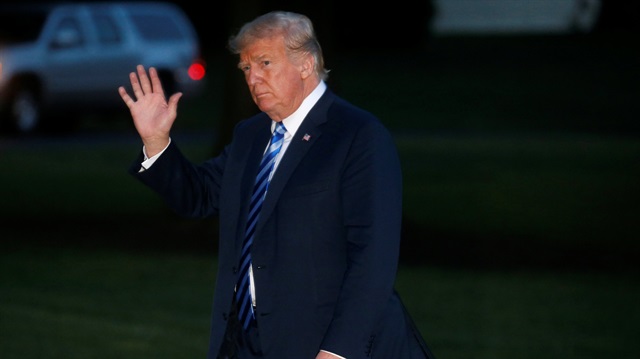
U.S. President Donald Trump
An overwhelming majority of American voters, 59 percent, do not like President Donald Trump, according to a new poll.
In the Quinnipiac University poll, just 31 percent of voters said they had a favorable opinion about the president, and do not like him as a person.
"For President Trump, another Groundhog Day. His job approval gets another cool reception in midst of the sweltering summer. What does it mean? Simple: The base is hanging in and the rest aren't buying in," said Tim Malloy, assistant director of the survey.
Fifty-four percent of voters said Trump has "emboldened people who hold racist beliefs to express those beliefs publicly."
President Donald Trump took steps on Wednesday to loosen limits on when the U.S. government can deploy cyber weapons against adversaries, reversing Obama-era guidelines, the Wall Street Journal reported on Wednesday.Trump signed an order reversing Presidential Policy Directive 20 that had mapped out an elaborate interagency process before the United States engaged in cyberattacks.The White House did not immediately respond to a Reuters request for comment.Although the policy directive signed by former President Barack Obama was classified, its contents were made public when it was leaked in 2013 by former intelligence contractor Edward Snowden.It was not clear what rules the Trump administration was adopting to replace the Obama-era policy, the Journal said. It said while a number of current U.S. officials confirmed the directive had been reversed, they declined to comment further, citing the classified nature of the process.One administration official briefed on the decision described it as an "offensive step forward" intended to help support military operations, deter foreign election influence and thwart intellectual property theft by meeting such threats with a more forceful response, the Journal said.National security adviser John Bolton began the effort to remove the directive after he took up his position in April.Critics of the Obama-era policy have seen it as preventing a quick and forceful response to cyberattacks by involving too many federal agencies in the planning.US is trying to make Iran 'surrender' through sanctionsTrump’s global policy a string of abandoned commitmentsTrump calls former Apprentice star turned White House aide 'a dog'
Trump loosens limits on when US can deploy cyber weapons
This is not the only poll that has shown Trump's disapproval by the American public. As of Sunday, the president's approval rating is at 39 percent, according to Gallup.
In a survey conducted by Pew Research Center at the beginning of July, Americans expressed concern that Trump's tax policies would have a negative effect on the U.S., with 49 percent of respondents saying increases in tariffs would be bad for the country and its trading partners.
The telephone poll, which was conducted Aug. 9 - 13, surveyed 1,175 voters and has a margin of error of plus or minus 3.4 percent.
President Donald Trump's trade dispute with Turkey increased downward pressure on U.S. stocks as indexes posted major losses Wednesday.The Dow Jones fell 260 points, or 1 percent, at 3 p.m. EST (1900GMT) to reach its lowest level since last Monday.The SP was down 26 percent with a 0.9 percent decline and the Nasdaq shaved 103 points, or 1.3 percent. Both indexes reached their lowest points since Aug. 2.Video: Turkish businessmen convert $3mln into Turkish lira after Erdoğan callThe three indexes posted losses for three trading days since Friday.The trade dispute between Turkey and the U.S., which are close allies for more than 60 years and NATO members, has intensified worries for investors who took a selling position in the market, according to analysts.President Donald Trump announced Friday that he ordered to double tariffs on steel and aluminum imports from Turkey.In return, Turkey has increased tariffs on several U.S. products, including alcohol, tobacco and cars, according to a new presidential decree published Wednesday in the official gazette.
Trade dispute with Turkey puts pressure on US stocks
The White House on Wednesday said U.S. tariffs on aluminum and steel imports from Turkey are "specific to national security".Speaking at a news conference, White House spokeswoman Sarah Sanders said tariffs on Turkey would not be removed even if detained American Pastor Andrew Brunson, who is facing terrorism charges in Turkey, is released.“The tariffs that are in place on steel would not be removed with the release of pastor Brunson. The tariffs are specific to national security," she said.The U.S will consider the removal of the sanctions that have been placed on Turkey and are "specific to pastor Brunson and others" when the aforesaid people are released, Sanders added.Turkey and the U.S. are currently experiencing rocky relations following Washington’s imposition of sanctions on two government ministers for not releasing American pastor Andrew Brunson, who faces terrorism-related charges in Turkey.Last Friday President Donald Trump ramped up his attack on Turkey by doubling U.S. tariffs on Turkish aluminum and steel imports.Turning to U.S. reaction against Turkey's increasing tariffs on American products, Sanders said, “the tariffs from Turkey are certainly regrettable, and a step in the wrong direction."The tariffs that the United States placed on Turkey were out of national security interest. Theirs are out of retaliation," she added.Turkey has increased tariffs on several U.S. products, including alcohol, tobacco and cars, according to a new presidential decree published Wednesday in the official gazette.*Michael Hernandez in Washington contributed to this story
US tariffs to remain even if pastor freed: WH
A former French diplomat has slammed U.S. President Donald Trump for his remarks targeting Turkey’s economy, saying he cannot apply unilateral measures, pressure and sanctions against a key NATO ally.Marc Finaud, Senior Program Advisor at the Geneva Centre for Security Policy, made the remarks Wednesday while speaking to an Anadolu Agency correspondent in Geneva."It's a quite unfortunate decision that increases tensions in the region, which doesn't need this kind of escalation. And if there are trade problems, which are sometimes legitimate, then they could be settled in a multilateral context within a world trade organization, but not by unilateral measures, pressure and sanctions against a very key, important ally," said Finaud about Trump's Twitter posts last week.Finaud also slammed Trump's steel and aluminum tariffs against Turkey as Trump's approach in this field is based on unilateralism, the use of force, pressure and sanctions instead of working together to find solutions.On Aug. 10, Trump ramped up his attack on Turkey by doubling U.S. tariffs on Turkish aluminum and steel imports to 20 percent and 50 percent, respectively.Finaud emphasized that Turkey, Russia, China and key actors in Europe should act together against the Trump administration."Work together as united as possible among the Europeans with Turkey, Russia, China and all key actors to convince the Trump administration that it is not even in the U.S.’ interest to act the way it does," he added.Separately, Finaud said Trump's unilateral sanctions against Iran will harm especially the U.S. and European economies.He said Russian and Chinese firms may benefit from European firms' withdrawal from Iran."The Iran sanctions have officially been cast. These are the most biting sanctions ever imposed, and in November they ratchet up to yet another level. Anyone doing business with Iran will not be doing business with the United States. I am asking for world peace, nothing less!" Trump tweeted on Aug. 7.In addition, Finaud said there can be no military solution to the Syrian conflict and the problem there had become international as he called on the international community to support the UN's efforts to find a peaceful and political solution. Syria has been locked in a vicious civil war since early 2011, when the Bashar al-Assad regime cracked down on pro-democracy protests with unexpected ferocity. This led to a military conflict between Syrian opposition groups and the regime over the war-torn country’s territory. Iran has been supporting the Assad regime during the war while Russia intervened in September 2015. Peace talks were launched in Geneva in 2012 aimed at finding a political solution to the conflict while talks in the Kazakh capital Astana began in 2017 to discuss a cease-fire that has been fragile so far. Hundreds of thousands of civilians have been killed in the conflict mainly by regime airstrikes targeting opposition-held areas while millions more have been displaced. During the conflict, the Assad regime has been accused many times by international actors of targeting Syrian civilians with chemical weapons.
Ex-French diplomat slams Trump's Turkey policy