

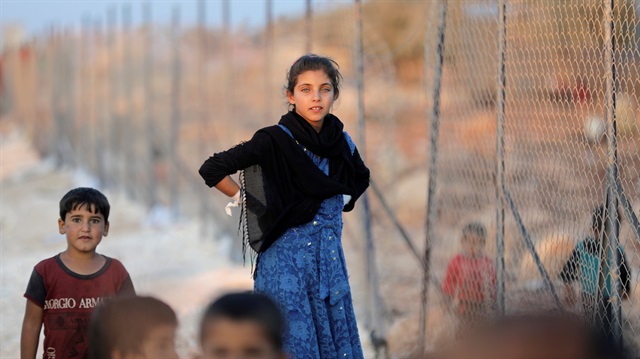
Newly displaced Syrian children arrive to a refugee camp in Atimah village, Idlib province, Syria September 11, 2018.
Civilians displaced from their homes in Syria's northwestern Idlib province during the country’s protracted conflict say their “last resort” is to migrate to Europe.
Some 40,000 people have fled towards the north of the province over the past 10 days in fear of the Bashar al-Assad regime and Russian-backed airstrikes.
The regime and its allies’ airstrikes started in northern Hama, southern and southwestern Idlib on Sept. 4, while the intensity of the attacks have decreased over the past three days.
In the past 11 days, some 8,000 families have migrated to refugee camps near the Turkish border and different areas north of the country, according to an NGO in Syria.
Germany said on Friday it expects Russia to use its influence on the Syrian regime to prevent a large-scale military offensive in the last opposition stronghold of Idlib.Ahead of a meeting with Russian Foreign Minister Sergey Lavrov in Berlin, German Foreign Minister Heiko Maas told German press agency DPA that recent developments in Syria will be one of the main topics of discussion at their meeting.“We would convey to the Russian side our expectations that there should be no large-scale military offensive on Idlib, that there should be a political process in Syria and guarantees should be given to those people who fled from Syria but would like to return to the country,” he said.Putin discusses Syria's Idlib with Russia's security councilMaas underlined that Russia has a key role to play in averting the regime’s military offensive on Idlib, which is home to more than 3 million civilians.“It’s about avoiding the worst case scenario, namely another a humanitarian catastrophe,” he said.Germany’s top diplomat reaffirmed his country’s strong support to UN-led efforts for a political solution, but underlined that Berlin’s support to a reconstruction program in Syria would be conditional.Pro-Assad forces flee in panic of Turkey’s military deployments at the border“If there would be a political solution in Syria, which would lead to free elections, then we would be ready to take responsibility for the reconstruction. It is in our interest to have Syria as a stable country,” he added.Maas was skeptical of Russia’s recent proposals for the return of refugees to their home in Syria.“This will not work, when people do not want to use such an opportunity, as they face persecution, imprisonment and expropriation risks,” he said.Maas also questioned a possible role for Syrian regime leader Bashar al-Assad in the future.“We cannot think of a durable solution with Assad,” he said, adding that Syrian people will decide on the political future of their country.Turkey's Erdoğan, Russia's Putin to meet in Sochi on MondayTurkey is working to reach ceasefire in Syria's Idlib: FM
Germany wants Russia to avert Idlib offensive
Some civilians took refuge near the observation points of the Turkish Armed Forces, as they think they are more secure.
Ahmed Semmu, who is only one of the thousands of displaced residents due to the airstrikes, told Anadolu Agency of his near-death experience.
“Last week, the regime barbarically targeted the whole region by warplanes and artillery fires. We’ve narrowly escaped death,” Semmu said.
“Those who fled their homes are now staying under olive trees and or in tents,” he added.
Speaking exclusively to Yeni Şafak daily, Syrian General Fouad Suad, who also serves as an Idlib provincial security official, evaluated the recent developments in Syria and divulged details about the growing atmosphere of panic among militias and troops who support Syrian President Bashar al-Assad, who is preparing to launch a major military offensive in the last opposition-held stronghold of Idlib.General Suad said over 800 militias and troops affiliated with Assad’s forces had fled from the frontlines following Turkey’s strategic military moves in the region.“The Turkish army and Turkish politics were successful regarding the Idlib issue. Ongoing military reinforcements and intensive operations at the border put the Syrian regime in a state of fear. This fear spread to the fronts. We can also observe this panic atmosphere from the radio and telephone communications we listen to,” Suad said.On the other hand Abdurrahman Rafi, a pro-Assad journalist who works in the region, wrote that the morale of troops on the frontlines is low, many militias and soldiers are seeking an opportunity to escape and most of the troops on the frontlines are not ready for battle. He reported that most of the military bases are filled with militias who want to loot the fronts after air and land operations, rather than fighting.Turkey has been reinforcing its military presence on the border with Syria and instructed over 50,000 Free Syrian Army (FSA) fighters stationed in Afrin, Azaz, Jarabulus, al-Bab and al-Rai to “be ready for military deployment.”The number of Turkish soldiers dispatched to northern Syria exceeded 30,000 in the areas within the scope of the Euphrates Shield and Olive Branch operations and Idlib. The Turkish army also doubled its armored vehicles and tanks deployed at the Syrian border and dispatched missile platforms, artillery batteries to strategic points.Assad’s seeks to ignite a war between brothersAbu Tawfik, a colonel on the Syrian regime’s Homs front, confessed in a WhatsApp conversation with a lieutenant from the same front that they would fail in a ground operation. He also recommended to use those who came from Daraa and Ghouta as pawns by positioning them on the frontlines.Tawfik also stated that Assad’s main plan was to pit “brother against brother." The Syrian regime forced people to leave Daraa and Ghouta, and many of those Syrians fled to Idlib. Now, Assad seeks to force that are also relatives to fight with each other. Assad has been conducting this same tactic to remain its presence since 1969.Fear over confession of the Reyhanlı plotterSuad said that Assad was concerned about the confession of the Reyhanlı massacre plotter, which also affects Idlib conflict.“In parallel to Turkey’s diplomacy regarding the Idlib issue and the international community’s support of these efforts, bringing the Reyhanlı attack plotter from the Syrian port city of Latakia to Turkey put Damascus into a difficult situation.”The Turkish National Intelligence Organization (MIT) detained Yusuf Nazik, a vital suspect of the 2013 Reyhanlı attack who confessed that he was acting on orders from Syrian intelligence units, adding: "I was not able to escape from the Turkish state" on Sept. 12.Video: Turkey deploys more military vehicles to Syrian borderTurkey captures key plotter of Reyhanlı attack in Syria's LatakiaTurkey deploys armored vehicles to Syrian border
Pro-Assad forces flee in panic of Turkey’s military deployments at the border
‘We are here as long as Turks are’
Stressing that the areas where the Turkish Armed Forces set up their observation points are not targeted by the airstrikes, Semmu said: “We do not want to leave our soils. As long as Turks are here, we will be here as well.”
Zeanif Hacci, another resident of Idlib, said: “We do not want food or beverages. We want this issue to be resolved.”
“If the strikes do not stop, we will have to migrate to Turkey and then to European countries,” he added.
Halit Sayel, who lives in Idlib’s Tal Dam village, complained about the airstrikes, saying the majority of his village was destroyed and had become uninhabitable.
Turkish President Recep Tayyip Erdoğan will meet with his Russian counterpart Vladimir Putin in the Russian city of Sochi on Monday, sources said.Turkish Foreign Minister Mevlüt Çavuşoğlu said earlier that Erdoğan and Putin would hold talks on the crisis in Syria on Monday, but had not elaborated.Erdoğan met with the leaders of Iran and Russia last week in Tehran to discuss Syria, but the summit did not delivera ceasefire pledge for the opposition-held enclave of Idlib.Turkey is working to reach ceasefire in Syria's Idlib: FMUS should reconsider its alliances in Syria: Turkish FM
Turkey's Erdoğan, Russia's Putin to meet in Sochi on Monday
“Our villages are under bombardment. We’ve fled to areas close to a TSK [Turkish Armed Forces] observation point on Sirman hill because we know they [observation points] are not hit [by airstrikes]," Sayel said.
He went on to say that they would certainly return to their village if the bombardment stops, but will have to migrate if it does not.
Since the beginning of September, at least 30 civilians have been killed in Idlib and Hama, and dozens injured, by airstrikes and attacks by the regime and Russian warplanes, according to the White Helmets civil defense agency.
The Syrian regime has recently announced plans to launch a major military offensive to the area, long controlled by various armed opposition groups.
The UN warns that such an offensive would lead to the "worst humanitarian catastrophe in the 21st century"
The locals of Syria's Idlib have started to flee as fears of a looming offensive by the Assad regime and his allies grip the province.
Idlib locals flee to Turkish-controlled areas for safety
Turkey is working to achieve a ceasefire in Syria's opposition-held northwest and is ready for cooperation to fight terrorist groups in the Idlib area, Turkish Foreign Minister Mevlüt Çavuşoğlu said on Friday.Speaking at a joint news conference with his Pakistani counterpart, Çavuşoğlu said Turkish President Recep Tayyip Erdoğan will speak with Russian President Vladimir Putin on the topic of Syria on Monday."Turkey is open to cooperation with everyone regarding efforts to fight terror groups in Syria," said Çavuşoğlu at a joint news conference in Islamabad with Pakistani Foreign Minister Shah Mehmood Qureshi.Video: Idlib locals flee to Turkish-controlled areas for safetyRecalling Turkey's efforts to find a political solution to the ongoing Syrian crisis, he said the efforts to reach a cease-fire in Idlib continue."We will continue our efforts with Iran and Russia... We will continue our efforts in international platforms as well. We have received tremendous support from many countries as well as United Nations and other organizations. Therefore, we should continue our efforts to bring peace and stability to the region," he added.Çavuşoğlu arrived in Islamabad on Thursday on an official visit upon the invitation of the Pakistani foreign minister.He was received by Pakistani President Arif Alvi, and Prime Minister Imran Khan.UN chief says US power in decline, world 'in pieces'The Turkish minister praised "strong" bilateral relations between Turkey and Pakistan, expressing willingness to further enhance cooperation in all areas. "We will devote more efforts to further enhance our solidarity, brotherhood, relations, and cooperation with Pakistan," he said.TradeThe two countries agreed to convene the 6th high level joint working group meeting soon in Islamabad and restart negotiations on a free trade agreement (FTA) between the two countries.Qureshi said the two sides have decided to enhance bilateral and economic relations."Our relations are very strong which are based on a strong historic, cultural and regional background and now we would strengthen these relations further," Qureshi said.Video: Turkish, Pakistani Foreign Minister meet in IslamabadBoth side also discussed the current trade volume and termed it unsatisfactory. The trade volume between Turkey and Pakistan was around $650 million by the end of 2017."The current trade volume is not satisfactory and we have decided to remove all hurdles in way of enhancing the trade between both countries," Qureshi said.He thanked Turkey for supporting his country on different international forums especially at the Financial Action Task Force (FATF) meeting in February this year in Paris, where the U.S. and the U.K. moved to put Pakistan back on a list of countries which have failed to stem terror financing."Today I have an opportunity to say: 'thank you very much,' to my Turkish counterpart who helped and support us in the FATF meeting," Qureshi said.During the delegation level meeting, Qureshi also briefed Çavuşoğlu about his upcoming visit to Afghanistan."I have briefed the Turkish foreign minister regarding my expected visit to Kabul and we agreed to play our role to bring peace in Afghanistan," he said.US should reconsider its alliances in Syria: Turkish FM
Turkey is working to reach ceasefire in Syria's Idlib: FM