

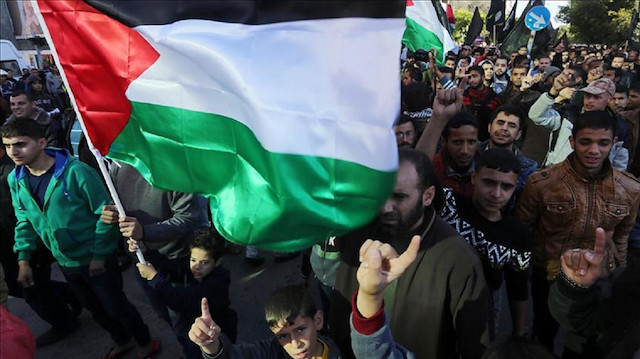
File photo
Palestinian resistance factions Hamas and Islamic Jihad have both vowed to continue organizing daily demonstrations along the Gaza-Israel buffer zone until the rallies “achieve their objectives”.
Following a late Thursday meeting between their leaders, the two groups released a joint statement emphasizing that “the rallies will continue, and their peaceful character will be maintained, until their objectives are met”.
Since March 30, Gaza-based political factions -- especially Hamas and Islamic Jihad -- have organized almost daily demonstrations along the buffer zone.
Palestinian resistance movement Hamas has called on Brazilian President-elect Jair Bolsonaro to revoke his decision to relocate the Brazilian embassy in Israel to Jerusalem.“We reject the Brazilian president-elect’s decision to relocate the embassy from Tel Aviv to Jerusalem,” leading Hamas member Sami Abu Zuhri tweeted Friday.He went on to describe the Brazilian leader’s decision as “an affront to the Palestinian people and the Arab and Muslim nation”.Bolsonaro on Thursday announced his intention to relocate his country’s embassy from Tel Aviv to Jerusalem once he formally assumes the presidency.Israeli police arrest 13 ultra-Orthodox JewsU.S. President Donald Trump sparked a world outcry last December after announcing plans to move the U.S. embassy in Israel to Jerusalem and recognize the city as Israel’s capital (which he did earlier this year).Ever since, the Palestinian leadership in Ramallah has rejected any U.S. role in the moribund Middle East peace process.Jerusalem remains at the heart of the Middle East conflict, with Palestinians hoping that East Jerusalem -- occupied by Israel since 1967 -- might eventually serve as the capital of an independent Palestinian state.Palestine’s Abbas, Egypt’s Sisi to hold talks Saturday
Palestine's Hamas urges Brazil to revoke Jerusalem decision
Protesters demand the right to return to their homes and villages in historical Palestine, from which they were driven in 1948 to make way for the new state of Israel.
They also demand an end to Israel’s 12-year blockade of the Gaza Strip, which has gutted the coastal enclave’s economy and deprived its two million inhabitants of many basic commodities, including food, fuel and medicine.
Since the rallies began some seven months ago, more than 200 Palestinians have been killed -- and thousands more injured -- by Israeli troops deployed along the other side of the buffer zone.
An Israeli official on Friday called the killing of journalist Jamal Khashoggi in Saudi Arabia's consulate in Istanbul "despicable" but said that cementing ties with Gulf states in the struggle against Iran was Israel's overriding concern.In his remarks to radio station 102 FM, Energy Minister Yuval Steinitz did not explicitly say whether his views were those of Prime Minister Benjamin Netanyahu's government, which has been reticent in commenting on the case.Asked about Khashoggi's death, Steinitz said: "It was a despicable action. It's worthy of all reproach. This was a civilian, a journalist, not a terrorist."He went on to say, however, that Israel's struggle against Iran was more pressing."We have a threat that can become an existential threat - the threat of a nuclear Iran, the threat of terror, the threat of spreading through Syria and Lebanon. And Arab states, including Saudi Arabia, are our allies in recent years against the spread of Iran and against the Iranian nuclear threat," he said. 'Khashoggi’s body was dismembered, dissolved in acid'Saudi prince disparaged Khashoggi in US calls: reportGermany hardening line on Saudi Arabia and KhashoggiArab media covers Turkey's Khashoggi statement
Israeli official says Khashoggi death 'despicable', but Iran greater challenge
Truce talks
Hamas and Islamic Jihad have also welcomed recent efforts by Egypt, Qatar and the UN ostensibly aimed at ending the suffering of the Palestinian people in the occupied West Bank and in blockaded Gaza.
An informed Palestinian source told Anadolu Agency that Egypt’s intelligence agency, which is currently leading mediation efforts between the Palestinian factions and Israel, had made "significant progress" in truce negotiations.
According to leaked information, the proposed agreement calls for easing Israel’s 12-year blockade of the Gaza Strip in exchange for a halt to the ongoing protests along the buffer zone.
Egyptian President Abdel-Fattah al-Sisi and Palestinian counterpart Mahmoud Abbas will meet in the Egyptian city of Sharm El Sheikh this weekend to discuss recent developments pertaining to Palestine.According to a source close to Abbas, speaking anonymously due to the issue’s sensitivity, the two leaders will meet on the sidelines of an upcoming World Youth Forum slated to kick off Saturday in Sharm El Sheikh.On Thursday, Palestinian Ambassador to Egypt Diab al-Louh said Abbas would arrive in Cairo on Friday afternoon -- at the head of a high-level delegation -- before meeting al-Sisi the following day in Sharm El Sheikh.Abbas’s visit to Cairo will come only days after the Palestinian president visited to Muscat, where he held talks with Omani Sultan Qaboos bin Said.At their meeting in Muscat, the two leaders discussed the Palestine-Israel peace process and the recent U.S. decision to recognize Jerusalem as Israel’s capital.Palestine-Israel talks broke down in 2014, due largely to Israel’s refusal to stop building Jewish-only settlement units on confiscated Palestinian land.In September, Abbas had expressed his readiness to resume peace talks with Israel, either behind closed doors or in public.On Tuesday, however, PLO Secretary-General Saeb Erekat said the Ramallah-based Palestinian Authority planned to cut relations with Israel in line with an earlier decision by the Palestinian Central Council.Gaza Strip holds drills to prepare for potential crisesIsraeli army rounds up 17 Palestinians in W. Bank raids
Palestine’s Abbas, Egypt’s Sisi to hold talks Saturday
For the last two weeks, delegations of Egyptian security officials have engaged in intense shuttle diplomacy between Gaza, the West Bank and Israel, where they have met with Hamas, Fatah and Israeli officials respectively.
Last month, Israeli daily Haaretz reported that Qatar had agreed to finance the purchase of fuel needed to operate Gaza’s only functioning power plant.