

File Photo
Hassan Shukah, a Palestinian prisoner in solitary confinement in Israel’s Ramleh Prison, entered his 67th day on hunger strike on Friday.
According to the Palestinian Prisoners Society, Shukah -- who is waging a hunger strike to protest his ongoing placement in what Israel calls “administrative detention” -- was recently taken to Israel’s Kapalan medical center following an abrupt deterioration of his health.
Shukah, 30, was first placed in administrative detention in 2017. After waging a 35-day hunger strike, he reached an agreement with the Israeli authorities to be released in June of this year.
However, after being placed in administrative detention again following the expiry of his prison term, he launched a second hunger strike, which remains ongoing until now.
Israel’s longstanding policy of administrative detention allows it to jail suspects -- without trial or charge -- for renewable periods of up to three months.
According to Palestinian figures, over 6,400 Palestinians are currently in Israeli custody, some 550 of whom have been placed in administrative detention.
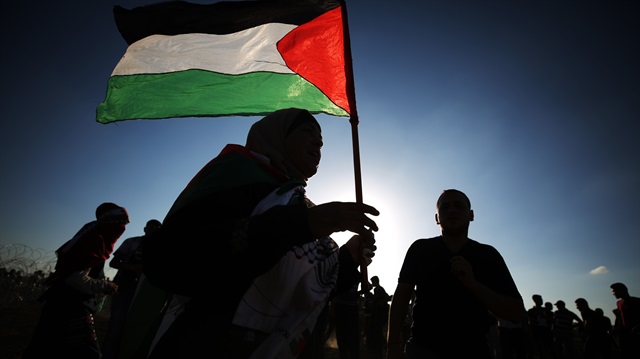
A total of 155 people have been martyred by Israeli forces since Palestinians in the blockaded Gaza Strip began holding regular demonstrations along the Gaza-Israel buffer zone on Mar. 30, according to Gaza’s Health Ministry.In a Thursday statement, ministry spokesman Ashraf al-Qidra said that 23 children, three women and at least two medics had been among those killed.UN peacekeepers back on Golan HeightsAnother 17,000 Palestinians were injured over the same period -- more than 400 seriously -- by rubber bullets, heavy ammunition and bullet shrapnel, he added.According to al-Qidra, injuries included 3,279 children and 1,553 women, some of whom have had limbs amputated as a result of their wounds.Russia to deploy military police on Golan Heights between Syria, IsraelThe Israeli army faces mounting international criticism for its continued use of disproportionate force against unarmed Palestinian demonstrators.Protesters demand the “right of return” to their homes and villages in historical Palestine, from which they were driven in 1948 to make way for the new state of Israel. Israel marks launch of Jewish center in JerusalemThey also demand an end to Israel’s 11-year blockade of the Gaza Strip, which has gutted the coastal enclave’s economy and deprived its two million inhabitants of basic commodities.Video: 246 Palestinians injured in ongoing rallies in Gaza Strip
155 Palestine protesters killed by Israel since Mar. 30
A bill winding its way through Congress could have significant blowback for the U.S. should it become law, a western diplomat has warned.The proposed legislation introduced by Republican Representative Doug Lamborn seeks to limit U.S. funding for the United Nations Relief and Works Agency for Palestine Refugees (UNRWA) to solely fund the resettlement of refugees from the 1948 Arab-Israeli war.The conflict created over 700,000 Palestinian refugees who fled or were forced from their homes.Israel marks launch of Jewish center in JerusalemIt is unclear how many original Palestinian refugees are still alive from the conflict, and how many have not yet been resettled.Additional waves of refugees have been created by subsequent conflicts, including the 1967 war, and UNRWA has been providing services to them and their descendants who in many cases live in legal limbo in camps throughout the region.Should it become law, the legislation would halt Washington’s funding for the bulk of UNRWA’s activities, which include schooling, food, health services and microfinance for the 5.3 million refugees and internally displaced people it aids.Israeli PM warns Iran over attempt to close key straitThe bill, which is currently being considered by the House Foreign Affairs Committee, alleges UNRWA has artificially inflated the number of Palestinian refugees and “provides aid to those they define as Palestinian refugees until there is a solution they deem acceptable to the Israeli-Palestinian conflict.”UNRWA spokesman Chris Gunness declined to comment on internal American legislation when contacted by Anadolu Agency, as did the State Department.The Palestinian Ma'an News Agency reported that the bill is a U.S. attempt to recognize only 40,000 Palestinian refugees.This is not the first time Congress sought to discount the agency's count of Palestinian refugees. A previous attempt in 2012 to limit the U.S.'s recognition of refugees to those who fled in 1948 and 1967 was met with fierce resistance by the State Department.- 'Shifting responsilities'The effort, former Deputy Secretary of State for Management and Resources Thomas Nides said in a since leaked letter to Congress "would put at risk the humanitarian needs of this large, poor and vulnerable refugee group."United States policy has been consistent for decades, in both Republican and Democratic administrations — final status issues can and must only be resolved between Israelis and Palestinians in direct negotiations. The Department of State cannot support legislation which would force the United States to make a public judgment on the number and status of Palestinian refugees," Nides wrote.Under international law the children of refugees, whether or not the parents are stateless or lacking citizenship in another country, should also be considered refugees.A western diplomat who spoke on condition of anonymity because he was not authorized to discuss the matter publicly maintained “there is nothing special” about the way in which UNRWA conducts its refugee tally, and warned that shifting UNRWA’s responsibilities to the UN’s main refugee agency, UNHCR, could actually result in inflating the figure.UNHCR registers “children through both the male and the female line. UNRWA only registers refugees through the male line,” the diplomat told Anadolu Agency. “So if you were to have this population all administered through UNHCR the number of Palestine refugees would actually increase significantly.”In general refugees typically have three choices they can pursue for resettlement: integration in a country that is hosting them, resettlement in a third country, or repatriation back to their home country, commonly referred to as the right of return.Resettlement in a host country has been a challenging prospect for many Palestinians who remain in the Middle East, particularly those in Lebanon with its delicate sectarian balances.And Israel and its allies in Congress have steadfastly ruled out the right of return for fear of the demographic repercussions it would carry for Israeli society.“Be very careful what you wish for, because for UNHCR the preferred priority or choice would be for refugees to go back home, which is not something I suppose these American congresspeople would want,” the diplomat said.- UNHCR’s record on resettlementUNRWA has consistently declined to take a position on how refugees should be resettled, insisting the matter should be determined by the parties as a matter of peace talks in line with international law.The diplomat warned that the number of refugees UNHCR has been able to resettle “is very, very small.“This idea that you can just give the refugees to UNHCR, and they’ll magically resettle them … UNHCR’s record on that does not bear this out,” he said.The bill claims “the number of refugees from other conflicts has diminished dramatically through UNHCR.”But by UNHCR’s own count there were 17.2 million refugees in 2016, and less than 1 percent were resettled that year in part because only a small number of countries take part in its resettlement program.Amid the push to wind down U.S. funding for UNRWA, the UN’s Palestine refugee agency is facing a funding shortfall prompted by the Trump administration’s decision in January to abruptly halt over half of a $125 million funding installment.The U.S. has long been by far UNRWA’s largest funder, most recently allocating roughly $365 million for the agency annually.Following the U.S. decision to freeze a large portion of its funding UNRWA has grappled with a budget crisis that could upend its operations, including the schooling it provides for roughly half a million Palestinians.“The name of the game now is to save our schools,” Gunness, the UN spokesman said. “At the moment we don’t have enough money to open our schools at the beginning of the school year at the end of August. That’s the big priority for us, to save the school year.”
US Palestine refugee bill could backfire: diplomat
Over 3,900 Jewish settlers forced their way into East Jerusalem's flashpoint Al-Aqsa Mosque compound last month alone, a Palestinian official said Wednesday.“The highest number of incursions [by settlers] was recorded in July,” Firas al-Dibs, a spokesman for Jerusalem’s Jordan-run Religious Endowment Authority, said in a statement.He said around 3908 settlers and Israeli soldiers stormed the flashpoint site last month.Israel arrests Palestinian youth over Al-Aqsa clashes“This is a clear indication of the increasing violations by settlers in the holy site,” al-Dibs said.Israel occupied East Jerusalem and the West Bank during the 1967 Middle East War. It later annexed the holy city in 1980, in a move never recognized by the international community. Sacred to both Muslims and Jews, Jerusalem is home to the Al-Aqsa Mosque, which for Muslims represents the world's third holiest site. Jews refer to the area as the "Temple Mount," claiming it was the site of two prominent Jewish temples in ancient times.International law views the West Bank and East Jerusalem as "occupied territories," considering all Jewish settlement building on the land illegal.Video: Israeli forces storm J'lem's Aqsa, injuring worshipersUS support for Israel hurts Middle East peace prospects291 Palestinian children being held in Israeli prisonsJordan calls on Israel to halt 'violations' at Al-AqsaIsraeli forces storm J'lem's Aqsa, injuring worshipersIsrael wages ‘systematic religious war’ against Palestine
Over 3,900 settlers stormed Al-Aqsa complex in July