

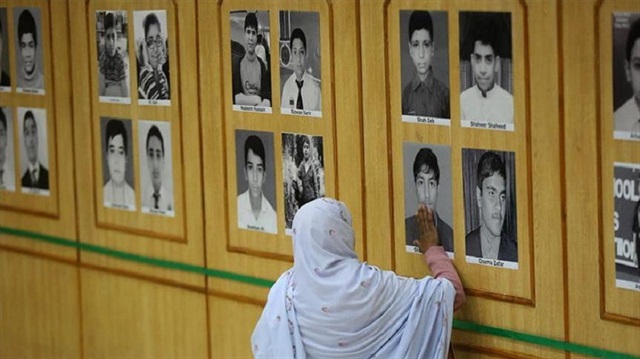
FILE PHOTO - Army Public School killed by Taliban militants, in a gallery dedicated by the provincial government for the victims of the school attack on the first anniversary of school attack, in Peshawar, Pakistan, on 16 December 2015.
Pakistan’s top court on Friday ordered a probe into the 2014 deadly school attack that claimed lives of over 140 people, mostly schoolchildren, local media reported.
A three-member bench of the Supreme Court headed by Chief Justice Mian Saqib Nisar ordered the formation of a commission to probe the attack on Army Public School in Peshawar city, said Geo News, a local broadcaster.
The commission will be headed by a senior judge of the high court and will submit its report to the apex court within six weeks.
Pakistani opposition leader Shehbaz Sharif was arrested on Friday in a longstanding corruption case, the country's anti-graft agency said.His brother, ousted Prime Minister Nawaz Sharif, was sentenced earlier this year to 10 years in prison by an anti-corruption agency after the Supreme Court removed him from power.The arrest, by agents of the National Accountability Bureau (NAB) in Lahore, involved a case of alleged corruption in the development of a water purification plant called Saaf Pani (Clean Water) when Shehbaz Sharif was chief minister of Punjab province."NAB Lahore has arrested Shehbaz Sharif, former CM of Punjab, in the Saaf Pani case," the agency's spokesman said in a text message.Pakistani court orders release of former premier SharifPakistan's ex-PM Sharif, daughter released for his wife's funeralPakistan's former first lady passes away in London
Pakistan anti-graft agents arrest opposition leader Shehbaz Sharif
On Dec. 16, 2014, six Taliban militants stormed Army Public School located in Cantt area of Peshawar city and killed 140 people, including 122 schoolchildren and their teachers.
Outlawed Tehrik-e-Taliban Pakistan (TTP) had claimed responsibility for the attack.
The families and parents of victims had been demanding the formation of a judicial commission.
Pakistan's key religious leaders have assured an Afghan government-sponsored peace council that they will do their part to help end Afghanistan’s decades-long conflict."We assured the Afghan delegation that we are ready to play a role in bringing peace to Afghanistan," Maulana Sami-ul-Haq, head of Jamiat Ulema-e-Islam, told Anadolu Agency by phone Thursday.A seven-member delegation of the Afghan High Peace Council headed by Maulvi Attaullah Lodin met with Maulana Sami-ul-Haq in Islamabad and sought his help in restoring peace to the country.Haq suggested that the Afghan delegation sit with the Taliban and pave the way for removing mistrust and holding direct peace talks. But the Afghan delegation asked Haq to play a role and convince the Taliban to hold direct talks with the Afghan government.Haq is also head of “Darul Uloom Haqqania”, a religious seminary in the town of Akora Khattak in northwestern Khyber Pakhtunkhwa province, and is believed to have influence on the Afghan Taliban as many of their key leaders have studied there."I offered my madrassa Haqqania [as a venue] so the Afghan peace council delegation could sit down with the Taliban for face-to-face talks," said Haq, adding he will extend the same offer to the Taliban.Delegation meets with JI chiefThe Afghan delegation also met with Siraj ul Haq, the head of the country's mainstream religious-political party Jamaat-e-Islami (JI), and sought his support in restoring peace in Afghanistan. "We believe that peace in Afghanistan is essential for the peace of the whole region and we always stand with our Afghan brothers and support the sovereignty, stability, peace and progress of Afghanistan," Siraj ul Haq told Anadolu Agency.He urged all Afghan groups to work together to bring peace to their country and compel foreign forces to leave.Taliban reactionTaliban spokesman Zabihullah Mujahid declined to comment on the Afghan peace council delegation’s meetings with Pakistani religious leaders.However, in a statement issued on Sept. 29, Mujahid asked Afghan and Pakistani religious scholars to refrain from participating in conferences on the war in Afghanistan in Islamabad and Kabul."We call on all sincere scholars to boycott these conferences and not become victims of American strategies and intelligence plots," he said in the statement.On Sept. 15, during Pakistani Foreign Minister Shah Mehmood Qureshi’s visit to Kabul, the two countries agreed to hold conferences of religious scholars in Islamabad and Kabul to bring the Taliban to the negotiating table.Pakistan had brokered the first round of direct talks between the fragile Afghan government and Taliban in Islamabad in July 2015. The process broke down when the Taliban announced the death of their long-time leader Mullah Omar, triggering a bitter power struggle within the group.Chances for a resumption of the stalled process dimmed further after Mullah Omar’s successor, Mullah Mansour, was killed in a U.S. drone strike in 2016 in Pakistan near the Afghan border.Since then, several attempts have been made with little success to resume the stalled peace process by a four-nation group comprising Pakistan, Afghanistan, the U.S. and China.
Pakistani religious leaders to work for Afghan peace
Karachi’s glistening beaches attract thousands of picnickers daily because of their shallow waters and sandy nature but they are also home to rare green turtles -- once the prime candidate for extinction.Increasing water pollution and garbage scattered across the beach, decreasing natural habitats, and illegal trade have led to the dwindling number of the large salt-water species in recent decades. But, the latest studies show that the number of green turtles are actually on the rise in Pakistan.Thanks to the combined efforts of the government agencies, and the wildlife non-governmental organizations (NGOs), which have brought 10 to 20 percent increase in the green turtles’ population in the last one decade.“Our (latest) five-year study shows that the population of endangered green turtles is in fact increasing. There is no evidence to support a general perception regarding a decline in their population,” Muhammad Moazzam Khan, the technical adviser (marine fisheries) at the Karachi office of the World Wide Fund for Nature (WWF), told Anadolu Agency.The WWF’s five-year study, according to Khan, puts the estimated offshore numbers of green turtles at around 8,000, which is considered a “healthy population” and 5 to 10 percent more than the previous figures.Also, he added, the offshore population of Olive Ridley -- another species of marine turtles belonging to same group -- is also on the rise. The current estimated population of these turtles is nearly 28,000.Fahmida Firdous, a Karachi-based wildlife expert, and a founding member of a government-sponsored project for conservation and protection of green turtles launched in 1980s, shares a similar view.“The situation vis-à-vis population growth of green turtles is much better compared to the year when we launched the project”, Firdous, who did her doctorate on protection and conservation of marine turtles, told Anadolu Agency.According to Firdous, a former conservator of the wildlife department of southern Sindh province, of which Karachi is the capital, there is an overall 20 percent increase in the large sea reptile’s population compared to their figures in 1980s.Rasheed Agha, head of a Sindh government-owned center for conservation and protection of green turtles, said the center yearly released 900 green turtle hatchling into the Arabian Sea.The female turtles lay their eggs on the beach between the months of October and February, which take 40 to 50 days to hatch, Agha added.Khan gives an equal credit to the community, mainly fishermen for protection of the reptile.- Still endangeredWeighing between 60 and 90 kilograms, green turtles use the Karachi’s famous Sandspit, and Hawksbay beaches as nesting grounds because of their sandy nature.They are also found at some beaches of southwestern Balochistan province.Despite a hopeful scenario in terms of population growth, experts see an increasing human activities on the beaches as a potential threat to the reptile -- the largest of the hard-shelled sea turtles.“The danger is not over yet. It requires more attention and awareness regarding protection of this sea beauty,” Firdous warned, referring to growing water pollution, encroachment, concrete constructions, and trash, especially plastic bags left by picnickers.“Plastic bags are killer for the reptile as if consumed it causes asphyxiation and eventually kill the reptile,” she observed.“They (plastic bags) also hurdle the female turtles to dig pits for laying eggs,” she said.She dubbed the protected species as a “gift from nature” as it massively adds to the protection of marine life by feeding on harmful algae.“Green turtles are the beauty of our seas. If they disappear, there will be an unimaginable growth of algae, which will destroy the marine life,” she added.Khan agrees with Firdous.“The species is still considered endangered because it is slaughtered for meat and skin in several countries. But not in Pakistan,” he observed.Rising sea levels due to climate change, Khan opined, was another threat because it was occupying the breeding grounds for the reptile.- Illegal tradeEven as the large sea specie reptile has a status of an endangered species in accordance with the country’s wildlife laws, its trade and export are continuing unabated.According to International Union for Conservation of Nature (IUCN), not only in Pakistan but the export of green turtles or its eggs is strictly prohibited worldwide due to endangered species status.But, in Pakistan, one can not only buy the protected species or its eggs from the open market but online as well. Several websites offer deals on purchase of baby turtles.Also, they are hunted for their meat, eggs, shells and skin.A large number of turtles get entrapped in fishing nets in the offshore waters, which are later sold out in the local market or online.
Pakistan: Population of endangered green turtle on rise
Pakistan has ordered several international charity and aid organizations to shut down and leave the country within 60 days, one of the organizations said Friday. ActionAid, a South Africa-based charity that focuses on education, poverty alleviation and human rights, has confirmed that Pakistan’s Ministry of Interior has asked them to shut down their operations and leave the country."The government continues to suppress civic engagement by attacking NGOs. The most recent example is ActionAid, and several other NGOs were de-registered by the government of Pakistan," Adriano Campolina, chief executive of ActionAid International, said in a statement.“The immediate victims will be the thousands of ordinary Pakistani families who ActionAid has been supporting to claim their rights and build a better life,” the statement said, adding Pakistan's hard-won democracy itself will be the ultimate victim.Around 17 international NGOs have been shut down and ordered to leave, an officer at the Ministry of Interior told Anadolu Agency on condition of anonymity, as he was not authorized to speak to the media.In December last year, Pakistan closed down 20 international NGOs and ordered them to wrap up their operations, but 17 of the organizations filed appeals with the Interior Ministry for re-consideration of its decision.The ministry rejected the appeals but said they could re-apply for registration after six months, the Interior Ministry official added.Pakistani FM hopeful on rebuilding ties with USTurkey's aid agency sets up robotics lab in PakistanIn 2012, Pakistan closed down the operations of U.S.-based aid group Save the Children over its alleged link to efforts by the CIA to locate Al-Qaeda chief Osama Bin Laden, who was killed by U.S. Navy Seals in a secret operation in 2011 in the town of Abbottabad in northwestern Pakistan.Save the Children denied having any links to the U.S. intelligence agency.Pakistan later revised its registration policy with the aim of more closely monitoring the activities of all international NGOs working in the country. Only 66 international NGOs have been allowed to work so far while 213 are still awaiting registration.Pakistan tells 18 international NGOs to leavePakistani agency gives 130,000 bread loaves to Syrians daily
Pakistan expelling 17 foreign aid groups