

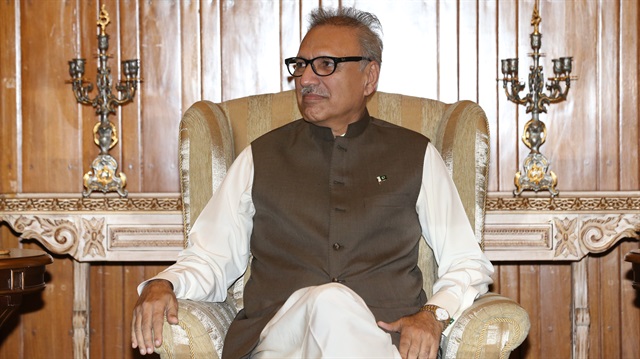
President of Pakistan Alvi
Pakistani President on Monday termed country’s relations with Turkey as vital for regional peace and development.
In his maiden address to the joint parliamentary session, the newly-elected Arif Alvi said the historical relations between the two Islamic countries are based on culture, religion and heritage.
"Our relations with Turkey are very important because these relations would help to bring development and peace in the whole region," Alvi said.
He vowed that the new government would boost the bilateral relations.
Prime Minister Imran Khan on Sunday announced to grant nationality to hundreds of thousands of Afghans and Bengalis born in Pakistan -- a move likely to invite ire from nationalists.Khan made the announcement at a ceremony in southern port city of Karachi, which has the largest population of Afghan refugees and illegal Bengali immigrants."Many Afghans and Bengalis have been living here for last 40-50 years. Their children were born here. We will Insha Allah (God willing) issue national identification cards and passports," Khan said addressing a fund raising dinner for construction of dams at governor house Sindh, for which Karachi is the capital.The first-time premier attached the grant of nationality to law and order in the province, mainly Karachi, the country's commercial capital."An entire generation (of Afghans and Bengalis) was born and raised here. But they do not have national ID cards and passports, therefore they cannot get jobs. This ultimately push them to criminal activities and street crimes" Khan observed.Home to over 15 million people, Karachi is the country's most populated city, and has earned notoriety for political and criminal violence, particularly street crimes in recent decades.The metropolis is also home to over 2 million Afghan refugees and illegal Bengali immigrants.Pakistan hosts 1.6 million registered and over a million illegal Afghan refugees.Khan's announcement is to benefit a large number of Afghans and Bengalis, particularly Beharis -- the people who had first migrated to Bangladesh (then East Pakistan) in 1947 following the creation of Pakistan, and then to Pakistan (then West Pakistan) in 1971 following the creation of Bangladesh.However, the move is very much likely to draw opposition from Sindhi nationalists who already see the presence of refugees and immigrants as a "burden on local resources."They fear that the growing number of immigrants in Sindh, the country's second largest province, will disbalance the population equilibrium in the province.Sindh, especially Karachi, has long been witnessing ethnic tensions between the local Sindhis and Mohajirs -- the Urdu speaking people who migrated from India in 1947 following the creation of Pakistan.
Pakistan PM announces nationality for Bengalis, Afghans
Alvi also underlined the role of official visits in strengthening ties with countries, referring to the recent visits by Turkey, China, U.S. and Iranian foreign ministers.
The president reiterated Pakistan’s desire to establish good relations with all countries, particularly with China, Russia, Afghanistan and Iran.
China-Pakistan Economic Corridor
On the reports of Pakistan’s concern for China Pakistan Economic Corridor (CPEC), Alvi rejected the speculations, assuring Chinese government for cooperation.
“CPEC is very important for the socio-economic development of Pakistan and it would continue to be the government's top priorities," Alvi said.
On Sept. 9, the Financial Times reported the new Pakistani government is concerned that the $64-billion CPEC project unfairly benefits Beijing.
CPEC, a mega project, signed in 2015, during the jailed former premier Nawaz Sharif government, aims to connect China's strategically important northwestern Xinxiang province to Pakistan’s strategic Gwadar port through a network of roads, railways, and pipelines to transport cargo, oil, and gas.
The economic corridor will not only provide China cheaper access to Africa and the Middle East but will also earn Pakistan billions of dollars for providing transit facilities to the world’s second-largest economy.
On the relations with long-time arch rival India, Alvi said Pakistan desires peaceful relations with India.
The new government would continue its effort for the peaceful solution of Kashmir issue, he added.
In Pakistan, the president is a symbol of federation, the head of state, and commander-in-chief of the armed forces; however, exercises powers upon the recommendations by the prime minister.
According to the country's constitution, the president addresses the joint session of the parliament, the Senate, and National Assembly at the beginning of every parliamentary year to give a direction for national policies to the government.