

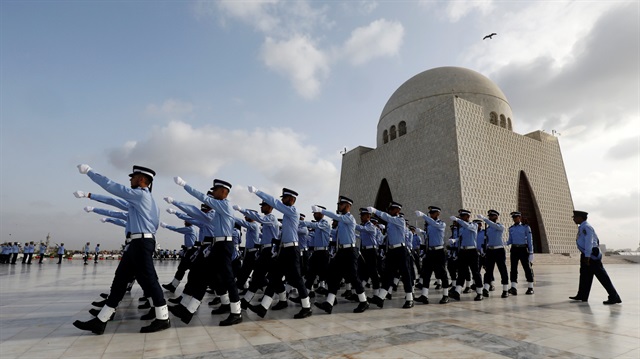
Members of the Pakistan air force march past the mausoleum of Muhammad Ali Jinnah during Defence Day ceremonies, or Pakistan's Memorial Day, in Karachi, Pakistan September 6, 2018.
Pakistani nation on Thursday marked the “Defense and Martyrs Day” to pay tributes to the soldiers who lost their lives for the defense of the country, local media reported.
The day dawned with 31-gun salute in the country’s capital city Islamabad and 21-gun salute in the all four provincial capital cities of Pakistan, according to the state-run Radio Pakistan.
Pakistanis celebrate Defence Day with a military ceremony on September 6, 2018, in Islamabad, Pakistan.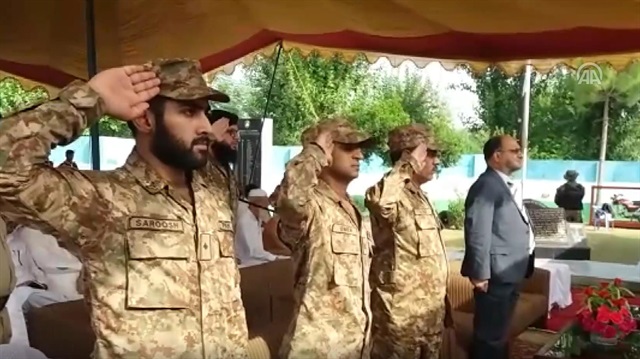
Pakistan celebrates Defence Day
Pakistan marks Sept. 6 every year to remember the sacrifices of armed forces for the defense of the country during 1965 war with India.
The intense fighting between the two countries took place between August and September, with both sides claiming victory after it ended on Sept. 22 with a UN-sponsored ceasefire.
Special prayers and recitation of holy Quran were also being held in mosques across the country for the martyrs, who sacrificed their lives in the war against terrorism.
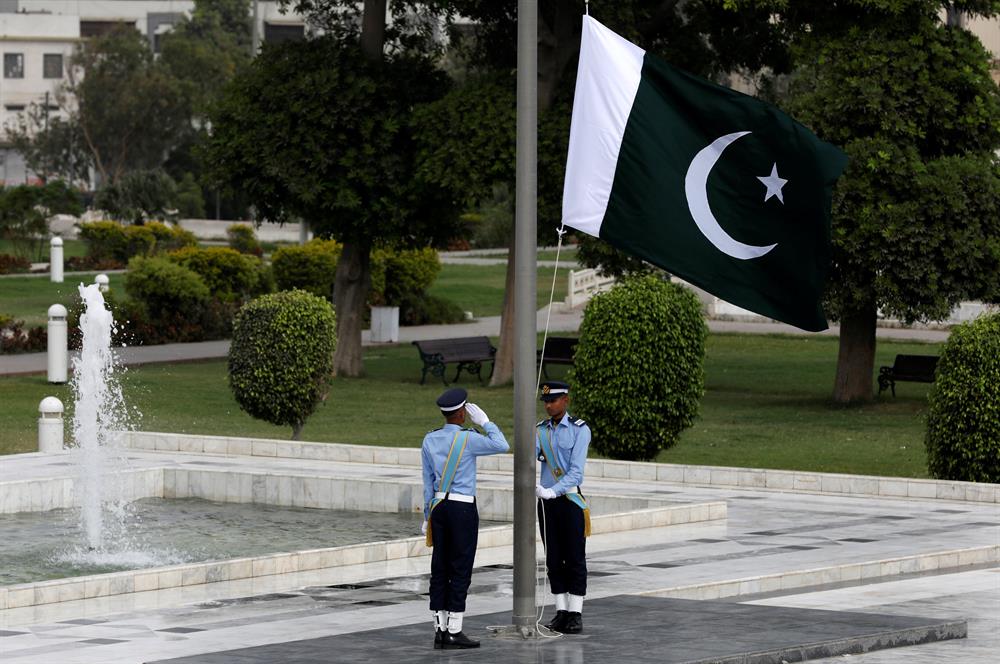
Pakistan's newly-elected Prime Minister Imran Khan paid tributes to the martyrs.
In a statement, Khan said Pakistan believes in peaceful coexistence and wants to promote mutual cooperation with all its neighbors and the entire world on equal basis.
“This year the Defence Day is quite unique because the Armed Forces of Pakistan, keeping in view their magnificent traditions, have achieved standout achievements in the war against terrorism which provided further stability and continuity to the motherland,” Khan said.
The main event was held at military headquarters Rawalpindi, which was attended by the prime minister, Chief of Army Staff Gen. Qamar Javed Bajwa, diplomats, officials and relatives of martyrs.
U.S. Secretary of State Michael Pompeo arrived in Pakistan on Wednesday in a renewed attempt to "reset bilateral relations", which have plummeted in recent years.Pompeo held meetings with Prime Minister Imran Khan, Foreign Minister Shah Mahmood Qureshi and army chief Gen. Qamar Bajwa, merely days after Washington blocked $300 million in military aid to Islamabad.Though Pompeo dubbed his visit as an effort to "reset relationship" between the two allies on the war against terrorism, analysts believe that his key agenda was to engage Pakistan's civilian and military leadership to help Washington in war-torn Afghanistan.They, however, do not expect a major breakthrough, considering U.S. President Donald Trump's recent actions against Pakistan, including aid cuts and Washington’s negative role in bringing Islamabad on the “gray list” of the Financial Action Task Force (FATF), an international money-laundering watchdog.“I doubt Pompeo’s visit will yield any results because Pakistan cannot do what Washington wants it to do,” Hamid Mir, an Islamabad-based political analyst, and an expert on Afghan affairs told Anadolu Agency.Pakistan reassured the U.S. on Wednesday that it would use its influence to bring Taliban to the negotiating table in Afghanistan.Following talks with Pompeo, Foreign Minister Shah Mehmood Qureshi said: “The U.S. wants Pakistan to play its role for negotiations and reconciliation in Afghanistan. This is what our policy and desire is. We want peace and stability in Afghanistan, and I have fully assured them in this regard.”The outcome of the meeting signal toward a thawing of frosty ties between the two allies on the war on terror.US expects India to buy energy products, aircraft to fix trade gap'Taliban influence a myth'Contesting the foreign minister's opinion, Mir, who was the last journalist to interview slain Al-Qaeda chief Osama bin Laden in 2001 in Afghanistan, said both sides were pursuing a "confused policy" in Afghanistan.“Pakistan must tell the truth that it no longer has any influence over Afghan Taliban. They no longer trust Islamabad. Similarly, the U.S on the one hand demands strict action against Taliban, while on the other, it also wants Islamabad to use its influence over them,” Mir said.He claimed that Islamabad gradually lost its influence over Taliban due to the death of several key leaders in custody of Pakistan's security agencies and other secret military operations against them on pressure from U.S.“This (influence) is just a myth. And Pakistan does not deny that," he said, adding that Taliban would come to the negotiating table on their own terms.“They did not listen to Saudi Arabia [for talks], why would they listen to Pakistan,” he said, referring to a recently held Riyadh-sponsored Ulema conference, which called upon the Taliban to lay arms and negotiate with Kabul for reconciliation. The call, however, was rejected by the Taliban.Professor Ijaz Khan, another Islamabad-based political analyst, agrees with Mir.“The U.S. has already sent a message to Pakistan before the secretary of state’s visit by cutting military aid. This simply means, he (Pompeo) is here not to mend ties but to bully Pakistan,” he told Anadolu Agency.“I don’t think Pakistan’s offer of using its influence over Taliban is something new. Pakistan will continue in that area as it had in the past. Additionally, Pakistan’s influence over Taliban is not unlimited," Khan added. Pakistan to help US bring Taliban to negotiating tableNew beginningMazhar Abbas, a Karachi-based political commentator, appears to be optimistic about Pompeo’s visit -- the first from any top U.S. official following elections and formation of a new government in Pakistan.“This is true that there will be no immediate breakthrough in the ongoing diplomatic deadlock but this will be equally wrong if we think Pompeo’s visit was a mere formality," he told Anadolu Agency.“It can be a new beginning because the U.S. itself has recognized that its arm-twisting tactics have not worked out," he added.In 2017, U.S. President Donald Trump's new policy for South Asia accused Pakistan of patronizing militants, a charge Islamabad denies.“Trump administration has shown flexibility in its initial stance towards Pakistan because it has failed to achieve its targets in Afghanistan without Islamabad’s cooperation,” Mushahid Hussain Syed, a senator and security analyst, observed.Islamabad had already agreed to initiate fresh efforts to bring Taliban back to negotiation following an ice-breaking visit of Pakistan's army chief to Kabul earlier this year. But a wave of Taliban attacks across Afghanistan ruined the development.Pakistan had brokered a landmark round of direct talks between the fragile Afghan government, and the Taliban in Islamabad in July 2015, but the process broke down after the Taliban announced the death of their longtime leader Mullah Omer, triggering a bitter power struggle within the militant group.Chances for resumption of the stalled process deteriorated further following death of Mullah Omer’s successor, Mullah Mansur in a U.S. drone strike last year in southwestern Pakistan near the Afghan border.Several attempts aimed at resuming the halted process have been made since July 2015 by a four-nation group comprising of Pakistan, Afghanistan, U.S. and China but they have all failed one after another.
Pompeo's Pakistan visit reeks of old rhetoric: analysts
Pakistan reassured the U.S. on Wednesday that it would use its influence to bring Taliban to the negotiating table in war-struck Afghanistan.“The U.S wants Pakistan to play its role for negotiations and reconciliation in Afghanistan. This is what our policy and desire is. We want peace and stability in Afghanistan, and I have fully assured them in this regard,” Foreign Minister Shah Mahmood Qureshi said at a news conference after a meeting with U.S Secretary of State Mike Pompeo in capital Islamabad.Pompeo arrived in the capital for a one-day visit, shortly after the U.S. announced a military aid cut of $300 million to Pakistan. On Thursday, he will set out to India.“America will lead peace talks with the Taliban,” Qureshi added, pointing to a thawing of ties between the two allies on the war on terror.Video: Pompeo meets with Pakistan foreign minister in IslamabadThe two sides agreed that the present conditions in Afghanistan were conducive to intensifying efforts for a political settlement, said a statement from the Foreign Ministry after the meeting. Pompeo conveyed the U.S desire to work with Pakistan in furthering the shared objectives of peace and stability in Afghanistan, the statement added.In a tweet after the meeting Pompeo said: "In #Pakistan with my colleague friend CJCS Gen Joe Dunford. Today we met with PM @ImranKhanPTI FM Shah Mehmood Qureshi to discuss our diplomatic military to military relationship. @StateDept."U.S. army chief Gen. Joseph Dunford also accompanied the U.S. secretary of state.The Pakistani foreign minister observed that a lingering diplomatic deadlock between Pakistan and the U.S had been broken by Pompeo’s visit.“There had been a long deadlock in relations between the two sides. But the situation has totally changed in this meeting,” he said.Responding to a question regarding the aid cut, Qureshi said: "We do not have a give and take relation with the U.S. We are a sovereign nation, and we do not want to talk about money but about principles."He added that Pompeo had extended him an invitation to visit Washington, which he accepted.Advisor to newly-elected Pakistani premier resignsOther visitsEarlier on Wednesday, Pompeo met newly-elected Prime Minister Imran Khan and army chief Gen. Qamar Javed Bajwa.Khan said that his government's agenda was focused on human development and poverty alleviation for which peace and stability in the region was a pre-requisite. He underscored his commitment to peace with all neighbors, according to a statement released from the prime minister house.Pompeo conveyed the desire of the U.S. administration to work with Pakistan to achieve the common objectives of peace and stability in Afghanistan and the region, the statement added.
Pakistan to help US bring Taliban to negotiating table