

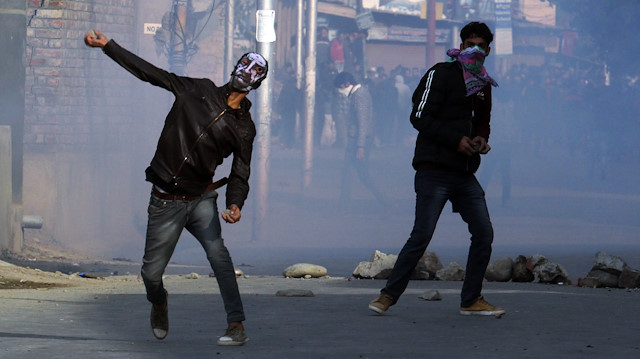
Protests in Kashmir
Pakistan on Saturday marked "Black Day" to show solidarity with the people of Kashmir on the 71st anniversary of the dispute over the region.
The day began with a moment of silence, bringing traffic across the country to a halt for a minute as a mark of solidarity and support for Kashmiris under Indian rule.
On Thursday, the government urged the public to wear black armbands and hold prayers for the Kashmiris who lost their lives in the conflict in Indian-administered Kashmir.
Political, social, and human rights activists held rallies in cities such as Lahore, Islamabad, Peshawar, and Muzaffarabad to protest the “illegal occupation” of the valley and demand the United Nations implement relevant resolutions.
Pakistan’s ambassador to Ankara on Friday called on the UN Security Council to help resolve the conflict in Kashmir.In an interview with Anadolu Agency given in the wake of the 71st anniversary of the Kashmir dispute, Muhammad Syrus Sajjad Qazi called for an "independent and transparent" inquiry under the UN auspices to hold the perpetrators of the acts accountable.On Oct. 27, 1947, Indian troops positioned themselves in Kashmir’s largest city Srinagar after India and Pakistan gained their independence at the end of the British colonial rule. The 71st anniversary of this Indian action is observed by Pakistanis and Kashmiris as a “Black Day”, while India commemorates it as “Accession Day.”Qazi said: "As a result of the Indian occupation, not only the entire region has been facing threats to peace and security for the past seven decades, but the Kashmiris under occupation have endured the worst atrocities and human rights abuses.”Kashmir, a Muslim-majority Himalayan region, is held by India and Pakistan in parts and claimed by both in full. The two countries have fought three wars -- in 1948, 1965 and 1971 -- since they were partitioned in 1947.Since 1989, Kashmiri resistance groups have been fighting in Indian-held Kashmir against Indian rule for independence, or for unification with neighboring Pakistan.Qazi said an estimated 95,000 Kashmiris have been martyred and thousands of women have been raped and molested since 1989."For the Kashmiris, this day not only symbolizes the start of an era of occupation, repression, and grave and systemic human rights abuses by Indian occupation forces, but also marks the start of Kashmiri people’s resistance and defiance against this illegal occupation," Qazi said.He noted that India took the dispute to the UN Security Council, but the country has refused to implement the Security Council resolutions."The continued suffering of the Kashmiris under the Indian occupation is also a sad reflection on the inability of the international community, in particular the United Nations Security Council to implement its moral and legal responsibilities," Qazi said.The ambassador also said despite calls by the international human rights organizations, including the Office of the High Commissioner for Human Rights (OHCHR), India continues to deny access to all human rights monitors and media to the occupied territory."Our position on the settlement of Jammu and Kashmir dispute is consistent with the UN Security Council Resolutions. Sadly, India continues to shy away from this reality, and is instead dragging the entire region down the precipice of conflict.Pakistani president to pay two-day visit to TurkeyPakistan wishes 'comprehensive dialogue' with IndiaHe added Pakistan wishes to resolve all disputes with India through a "serious and comprehensive" dialogue that covers all issues of concern.Qazi said India frequently violates the ceasefire along the Line of Control [a military boundary splitting the disputed Kashmir region between India and Pakistan] in Kashmir, adding: "It is also threatening to wage a 'limited war' against Pakistan.""This belligerent and irresponsible attitude will only push the region further down the precipice of conflict and instability," he said.The ambassador added there can be no lasting peace in South Asia without a just settlement of the Kashmir dispute based on the UN Security Council resolutions and the will of the Kashmiri people."International community, in particular the United Nations Security Council, has an important role to play in the just resolution of this dispute," he said.Qazi added the UN as well as the Organization of Islamic Cooperation (OIC) have an important role to play in ending the "gross and systematic" violations of human rights being perpetrated by the Indian forces.
Pakistani Ambassador in Turkey commemorates ‘Black Day’
On Oct. 27, 1947, Indian troops positioned themselves in Kashmir’s largest city, Srinagar, after India and Pakistan gained their independence from British colonial rule. The anniversary of this Indian action is observed by Pakistanis and Kashmiris as "Black Day", while India commemorates it as "Accession Day". The region has been a source of tension between India and Pakistan ever since.
In 1989, Kashmiri resistance groups launched a campaign for independence or unification with Pakistan, leading to more than 70,000 deaths. India maintains more than half a million troops in the region.
In separate messages, Pakistan’s president and prime minister reiterated their unflinching diplomatic and political support for the cause of the people of Kashmir.
"We pay homage to the sacrifices of our brethren in Occupied Kashmir and reiterate our unflinching and steadfast moral, diplomatic, and political support for the just cause of the people of Indian-occupied Jammu and Kashmir," President Arif Alvi said in his message.
Premier Imran Khan said the day was a tragic one in the history of South Asia.
"Pakistan will not relent in its moral, political and diplomatic support until the Kashmiris realize their legitimate right to self-determination in accordance with UN Security Council resolutions," Khan reiterated.
Citing a June UN report on Kashmir, Khan said it acknowledged how Indian policies of occupation include well-documented human rights atrocities.
Kashmir, a Muslim-majority Himalayan region, is held by India and Pakistan in parts and claimed by both in full. A small sliver of Kashmir is also held by China.
Since they were partitioned in 1947, India and Pakistan have fought three wars -- in 1948, 1965, and 1971 -- two of them over Kashmir. Kashmiri resistance groups in Jammu Kashmir have been fighting against Indian rule for independence, or for unification with neighboring Pakistan.
Pakistan managed to take one-third of the Himalayan Valley in the wake of the 1948 war, with the remaining two-thirds of Kashmir going to India.