

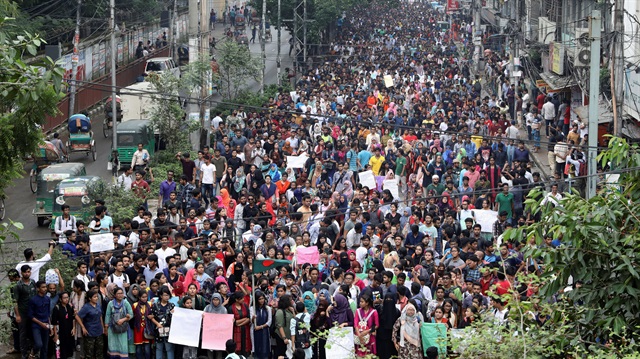
Thousands of students join in a protest over recent traffic accidents that killed a boy and a girl, in Dhaka, Bangladesh.
Khurshid Alam says he pulls 17-hour shifts three days a week driving a private bus in Dhaka, where tens of thousands of students held angry protests for over a week demanding an end to rash driving that killed two teenagers late last month.
Prime Minister Sheik Hasina's government has moved swiftly to defuse the protests that were threatening to spiral, with an eye on general elections due by the end of the year. On Monday, the cabinet approved raising the maximum jail time for rash driving deaths to five years from three.
Overworked and underpaid drivers like Alam are often blamed for Bangladesh's high traffic casualty rate - road accidents kill or injure at least five people an hour in the country - and the resentment against them has been aggravated by the deaths of the two students last Friday.
Most bus drivers do not get paid monthly salaries but earn commissions based on the number of passengers picked, leading them to race each other for passengers.
The two students were killed when the driver of a bus speeding to pick up passengers ahead of other buses in a congested part of Dhaka lost control and ploughed into the bus stop, a court heard this week.
The crowded capital of 18 million has been paralysed by angry students since then, although the protests have now tapered off. Police have fired tear gas and used water cannon to disperse protesters, as students, many in their school uniforms, stopped vehicles, demanding to check drivers' licences and their vehicles' roadworthiness.
"I start driving at 6 am and continue up to 11 pm," said a bearded Alam, 45, as he got ready for a trip on his green and ash bus with a cracked windshield, in a city teeming with scuffed up buses and beaten-up, used cars.
Alam said he had reported the cracked windshield to the bus owner, but it was yet to be replaced.
He said he works for three days a week, making up to 1,200 taka ($14) a day. A bus driver on contract with the Delhi Transport Corporation in neighbouring India earns as much as three times that.
"If we get a monthly salary then we can drive without any tension. We always have to keep thinking about our earnings," Alam said.
As he stepped on the accelerator, a cycle-rickshaw with two passengers suddenly appeared in front of the bus, forcing him to hard-brake.
SAFETY COSTS
"We are working to bring discipline in the streets," said Khondaker Enayet Ullah, secretary general of the Bangladesh Road Transport Owners Association.
"It's true that shortage of drivers often compels us to hire unskilled drivers. But we are asking the transport owners not to appoint anyone without proper licenses from now on."
About 4,000 people were killed in driving deaths in Bangladesh in 2017 and 2,350 in the first seven months of this year, according to data compiled by the Accident Research Institute at the Bangladesh University of Engineering and Technology.
Many protesters have demanded the government tighten transport regulations, including by setting limits on the hours worked by drivers and providing a minimum monthly salary.
But Abul Qasem, who owns the Tusher Transport Company in Dhaka that has 10 buses, said implementing those suggestions would mean higher fares that customers in the price-sensitive country would not readily agree to.
"If the government asks us to fix eight hours duty a day, we will follow it. In that case, fares will increase because then there will be at least two shifts a day," said Qasem. "That will anger passengers. Will the government then subsidise us?"
The drivers say they also want the government to install more traffic lights and build dedicated lanes for pedestrians, instead of putting all the blame on drivers.
"Everybody has a guardian to take care of their interests but we don't," said bus driver Alam.
The U.S. has called on Bangladeshi authorities to take legal action against those involved in carrying out an attack on its envoy’s convoy in the capital Dhaka, local media reported on Tuesday.The demand was made in a diplomatic letter sent by the U.S. Embassy in Dhaka to the Foreign Ministry of Bangladesh on Monday evening, reported Prothom Alo, a local daily.University and high school students in Dhaka have been protesting for safer roads and justice for their two peers who were killed in an accident in Dhakaon July 29.On Saturday, the U.S. envoy’s convoy came under attack from a group of armed adults. Ambassador Marcia Bernicat and her security team left the area unharmed following the attack but two security vehicles were damaged, a statement by the U.S. Embassy said.Meanwhile, EU Heads of Mission in Dhaka also expressed concern over the violent clashes in Dhaka.“We expect all sides to remain calm and to respect the right to peaceful protest. Incidents of unlawful or disproportionate violence or action against protestors, journalists or others need to stop; those that happened must be investigated and perpetrators held to account,” the statement by the mission said.Police and ruling party men filed cases against top opposition Bangladesh Nationalist Party (BNP) leaders for allegedly provoking student protest.Besides, some 1,200 unknown people were also sued for alleged attack on the party office of ruling Awami League on Saturday, reports local daily The Daily Star.US convoy attacked, 50 injured in protests in BangladeshBangladesh considers capital punishment for driving deaths
US demands probe into attack on envoy’s convoy in Dhaka
Bangladesh's cabinet on Monday will consider capital punishment for traffic accident deaths, a law ministry official said, as thousands of students held protests for a ninth day over the deaths of two teenagers by a speeding bus in Dhaka.Tens of thousands of angry school and colleges students have been demanding changes to Bangladesh's transport laws, paralysing the crowded capital of 18 million, after the two teenagers were killed when a privately operated bus ran over a group of students on July 29."In this amendment it has been proposed to award the highest level of punishment if it is killing by an accident," said the law ministry official, who has been briefed on the matter but declined to be named ahead of a decision.Bangladesh cracks down on dangerous driving after protestsThe current punishment is a maximum jail term of three years. Using the death penalty for road accidents is rare anywhere in the world. Bangladesh's transport authority listed punishments given in different countries that ranged from 14 years in the U.K. in extreme cases to two years in India.Sheikh Shafi, a student of a polytechnic institute in Dhaka who lost his brother in a road accident in 2015, said one of the problems was that bus drivers are not paid fixed monthly salaries instead only earn commissions based on the number of passengers, forcing them to work long hours."Our demand is that the owners must appoint them and they will work a maximum of 10 hours. The commission based system must be eliminated," said Shafi, who was injured while protesting on Saturday.Student road safety protests engulf capital: BangladeshAmid the ongoing protests, an official vehicle carrying the U.S. ambassador to Bangladesh was attacked by a group of armed men on Sunday, some on motorcycles, the embassy said in a statement. There were no injuries but two vehicles were damaged.The embassy has condemned the "brutal attacks and violence" against the students protesters by security forces, a charge the government denies.Police said they did not have an immediate explanation as to why the U.S. ambassador came under attack.
Bangladesh considers capital punishment for driving deaths
Bangladesh police on Sunday launched a crackdown on dangerous driving as the government tries to quell student unrest sparked by the death of two teenagers who were mowed down by a speeding bus a week ago.Tens of thousands of students have protested since last Sunday when a privately run bus hit and killed the college students, alarming the government ahead of a general election this year. "Our police force has started a week-long drive to bring discipline on the roads," Prime Minister Sheikh Hasina said at an event in Dhaka on Sunday.Spontaneous student protests are rare in Bangladesh and Hasina suggested her political rivals were using the issue to stir up anti-government sentiment.The opposition Bangladesh Nationalist Party denied any involvement in the protests. Separately, the U.S. embassy said in a statement outgoing envoy Marcia Bernicat's vehicle was attacked by armed men, some on motorcycles, in Dhaka on Saturday."The ambassador and her security team departed the area unharmed ... however, two security vehicles sustained some damage," it said in the statement issued on Sunday. Police said they had not identified the attackers.The protests spreading across Bangladesh have highlighted traffic risks in the densely populated country, where more than 4,000 people die in road accidents each year, one of the world's highest rates, the World Bank says.Bangladesh student protest spurs warning against opposition meddlingStudent road safety protests engulf capital: Bangladesh
Bangladesh cracks down on dangerous driving after protests