

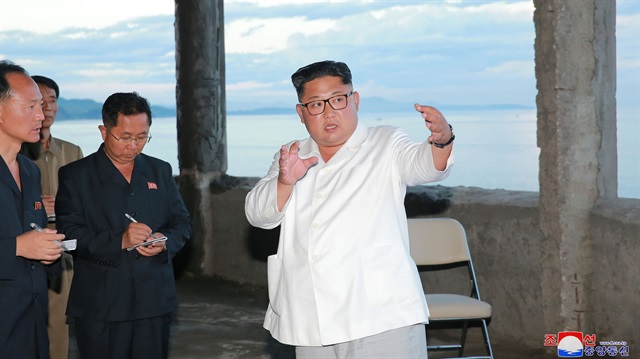
North Korean leader Kim Jong-un
Russian President Vladimir Putin has expressed his readiness to meet North Korean Chairman Kim Jong-un “at an early date,” according to Pyongyang’s state-run KCNA news agency Wednesday.
Putin has been kept waiting for an answer after asking Kim to attend next month’s economic forum in Vladivostok, but Pyongyang did confirm this week that South Korean President Moon Jae-in will visit the North Korean capital “within September.”
When South Korean businessman Kim Yong-tae worked with North Koreans at the Kaesong Industrial Complex before it was closed in 2016, one of the biggest challenges was communicating in what is ostensibly a shared language."There were confounding moments because there were terms I never heard of while working and living just in South Korea," he said, describing blank looks from some North Korean workers when he used the word "container," which is pronounced similar to its English term in South Korea.Between the South's increasing adoption of international terms and the North's political sensitivity to some words, the growing language divide is complicating cooperation on a range of joint cultural and economic exchanges as ties between the neighbours improve.To counter the confusion and promote a feeling of unity, the South Korean government is working to restart an obscure academic project aimed at developing a common Korean language dictionary with the North.North and South Korea speak the same language based on the Hangeul alphabet, but after decades of division, only about 70 percent of words are mutually understood, according to some experts.GROWING APARTThe two Koreas officially maintain the goal of reunification, but as each side has developed in strikingly different ways, that dream has faded.North Korea's government has maintained - at least officially - a tight grip on its economy, meaning many North Koreans are unfamiliar with some economic and business terms common in the South's more capitalist system."Homelessness, yearly rent, monthly rent: The North Koreans have no such terms since everything is owned by the state which gives out housing," said Kim Wanseo, a South Korean lexicographer on the committee working to compile the dictionary.After she defected to the South in 2002, Kim Young-hee said she had to learn a number of financial terms that didn't exist in the North, including the words for stocks and shares."When it comes to general terms, I would say seven out of 10 words can be mutually understood by people from each side," said Kim, the lexicographer. "However, when it comes to jargon and technical words there is a big, big difference between the two now."The North's cultural and political isolation has also meant North Koreans have adopted fewer English words.This became obvious when the players from North and South Korea combined for a joint ice hockey team during the Olympics."The only two words we shared were 'skates' and 'puck'," said Kim Jung-min, spokesman for the Korea Ice Hockey Association. "We had to coordinate before all training started, and we printed out the list of different terms between the two and stuck them on the athletes’ lockers."COMPILING A DICTIONARYIn the wake of April’s summit between North Korean leader Kim Jong Un and South Korean President Moon Jae-in, the two counties have embarked on a number of cooperation projects designed to avoid running afoul of sanctions.Besides the dictionary, began in 2006 but halted in 2015 due to political tensions, projects being discussed include the archaeological excavation of a palace in North Korea, performances by a North Korean art troupe in South Korea, pest control projects in the North, and a number of sporting events.And in a gesture of unity, North Korea changed its time zone by half an hour to realign with the South.The South's Unification Ministry says preserving and unifying the language is needed to prepare for eventual unification.Politics is never far away, however, and past dictionary discussions with the North Koreans often involved sensitive terms.For example, the dictionary's authors had to avoid one term for "him," which was typically used only to apply to North Korean leaders, and the United States could not be mentioned in examples, said Kim, the lexicographer.The sides debated the definition of the word "dong-mu," which means childhood friend in the South, but has come to mean comrades who experienced the communist revolution together in the North."We had to negotiate what an impartial definition is – and ended up defining it as ‘someone who strives together for a single goal,’ Kim said.Other debates were less serious.In South Korea, the verb "sal-ji-da" is used to say "hey, you’ve gained some weight.""It’s insulting in some contexts here too, but it’s a very insulting word to the North Koreans - to a whole new level," Kim said. "They only use this verb for farm animals."
Language hurdles plague two Koreas after years of division
The Russian leader’s personal message celebrated the 73rd anniversary of Korea’s liberation from Japanese colonial rule, which is marked as a holiday in both the North and the South.
Putin reportedly mentioned the need “to discuss urgent issues of bilateral relations and important matters of the region”. They would apparently include “reciprocal cooperation” involving economic ties between Russia and both Koreas.
Meanwhile, at the risk of arousing suspicion from the South’s military ally the United States, Moon declared his ambition to create a Northeast Asian ‘railroad community’ including his own country along with the North, Russia, China, Japan and Mongolia.
North Korea's Foreign Ministry stated Thursday that "one cannot expect any progress in the implementation" of Pyongyang's denuclearization agreement with the U.S. if Washington maintains its emphasis on sanctions.The reclusive state took steps such as dismantling its nuclear test site even before the unprecedented North Korea-U.S. summit on June 12, but the two sides have still failed to decide any timeline for Pyongyang to give up its existing nukes.Three S Korean firms imported N Korean coal in breach of sanctionsEarlier in the day, the North's official Rodong Sinmun newspaper insisted the first step towards peace should be formally ending the 1950-53 Korean War, but Washington has maintained that Pyongyang must denuclearize before securing either a peace treaty or sanctions relief.North Korea then released a statement following up on Foreign Minister Ri Yong-ho's criticism of the U.S. last weekend for not carrying out simultaneous measures after Pyongyang also allowed the U.S. to pick up war remains last month -- even though Washington did suspend joint military drills with South Korea this summer.Koreas to hold high-level talks on MondayThe ministry threatened to hold back on denuclearization "as long as the U.S. denies even the basic decorum for its dialogue partner and clings to the outdated acting script which the previous administrations have all tried and failed," according to a spokesperson quoted by the North's state-run KCNA news agency.However, the statement offered the U.S. a way forward if it responds sincerely "even at this belated time".North Korea urges US to relent on peace treaty stance
North Korea threatens to keep nukes
North and South Korea agreed to hold a summit in Pyongyang in September, the latest step forward in cross-border ties this year after more high-level talks on Monday, the South's Unification Ministry said.North Korean leader Kim Jong Un and South Korean President Moon Jae-in met in April and May at the border truce village of Panmunjom, within the demilitarised zone (DMZ) that separates the two Koreas, and agreed that the next summit in autumn would be held in the North Korean capital.The two Koreas held a fresh round of talks at the DMZ on Monday to discuss the third summit, led by the South's Unification Minister Cho Myoung-gyon and Ri Son Gwon, chairman of the North's reunification committee.Ri said both sides agreed on specific details, including the date for the summit, but declined to elaborate.However, again without giving details, he said it was important to clear "obstacles" that prevent inter-Korean relations from moving forward as planned."If the issues that were raised at the talks aren't resolved, unexpected problems could emerge and the issues that are already on the schedule may face difficulties," Ri said at the end of the meeting.Cho also refused to specify the problems raised by Ri but said there was talk of humanitarian issues and ways to improve inter-Korean relations.He said the next summit in Pyongyang would help improve cross-border ties by allowing the two leaders to discuss the North's denuclearisation and how to establish peace on the Korean peninsula.North Korea's Kim has a held a flurry of diplomatic summits with the leaders of South Korea, China, and the United States this year. Moon, the only South Korean leader to have met a North Korean leader twice, will become the first leader to visit Pyongyang this year.The North has been heavily sanctioned over its pursuit of nuclear weapons and ballistic missiles but Kim and U.S. President Donald Trump agreed at their landmark summit in Singapore in June to work towards the denuclearisation of the Korean peninsula.North Korea has denounced U.S.-led efforts to maintain sanctions despite what Pyongyang says are goodwill gestures, including halting its weapons testing and returning the remains of U.S. troops killed in the 1950-1953 Korean War.U.S. officials familiar with the talks, however, told Reuters that North Korea had yet to agree to a timeline for eliminating its nuclear arsenal or to disclose its size, which U.S. estimates have put at between 30 and 60 warheads.Red Cross warns of food crisis in North KoreaLanguage hurdles plague two Koreas after years of divisionNorth Korea threatens to keep nukes
North, South Korea agree on third summit to be held in Pyongyang
“This community will lead to an energy bloc and economic bloc in Northeast Asia by expanding our economic area to the northern continent and becoming the foundation of co-existence and prosperity in Northeast Asia,” the South Korean president said in his Liberation Day address.
While insisting that “economic cooperation can really take off” when North Korea has denuclearized, the South’s president added that Seoul aims to connect roads and railways across the inter-Korean border by the end of the year.
The U.S. has called on all countries to adhere to global sanctions against the North, which is yet to agree on a timeline for its denuclearization despite two months passing since June 12’s summit agreement between Chairman Kim and U.S. President Donald Trump.