

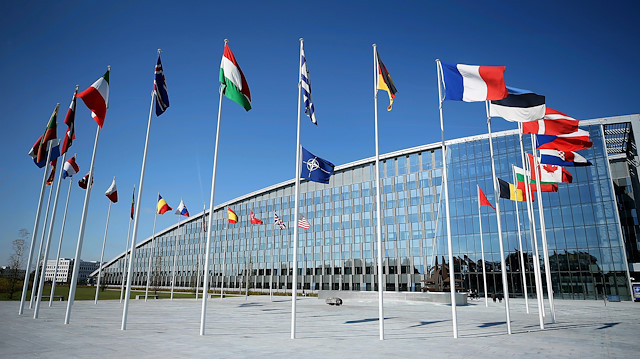
NATO Headquarters in Brussels
NATO ships are routinely patrolling the Black Sea and will continue to assess its presence in the region, the alliance’s spokesperson said in the wake of the maritime tensions between Russia and Ukraine.
Speaking to Anadolu Agency in Brussels, Oana Lungescu said that NATO has substantially increased its presence in the Black Sea, since Russia’s illegal annexation of Crimea in 2014.
“Today, NATO ships routinely patrol and exercise in the Black Sea,” Lungescu said. “There is already a lot of NATO in the Black Sea, and we will continue to assess our presence in the region."
Her remarks came after Ukrainian President Petro Poroshenko called on NATO member countries, including Germany, to send their vessels to the Sea of Azov to back his country.
Ukraine will impose restrictions on Russian citizens in Ukraine, President Petro Poroshenko said in a tweet on Thursday.His office could not immediately confirm what those restrictions were.Poroshenko earlier accused Russia's President Vladimir Putin of wanting to annex all of Ukraine and called for NATO to deploy warships to a sea shared by the two nations. Ukrainian leader says Putin wants his whole country, asks for NATO helpRussia deploys new S-400 missile systems in CrimeaMerkel: We sanction Russia for the sake of international lawRussia to build new missile early-warning radar station in Crimea
Ukraine to impose restrictions on Russian citizens: president
During her interview, Lungescu recalled that NATO ships spent 120 days in the Black Sea this year, compared to 80 in 2017.
“Several allies conduct NATO air policing in the region, and allies also conduct regular reconnaissance flights over the Black Sea. We also have a Romanian-led multinational brigade based in Craiova.
“Three NATO members -- Bulgaria, Romania, and Turkey -- are littoral states, with their own national capabilities deployed in the Black Sea region," she added.
On Sunday, Russia seized two Ukrainian navy ships and a navy tugboat along with 23 crew members off Crimea, accusing Kiev of entering its waters and provoking a conflict.
Ukrainian President Petro Poroshenko on Thursday accused Russia's Vladimir Putin of wanting to annex his entire country and called for NATO to deploy warships to a sea shared by the two nations.Poroshenko's comments to German media were part of a concerted push by Kiev aimed at gaining Western support for more sanctions against Moscow, securing tangible Western military help, and rallying opposition to a Russian gas pipeline that threatens to deprive Ukraine of important transit revenue.His Western allies have so far not offered to give him any of these things soon, despite his warnings of a possible invasion by Russia after Moscow seized three Ukrainian naval ships and their crews on Sunday.Moscow and Kiev blame each other for the Black Sea incident, which took place off Russian-annexed Crimea."Don't believe Putin's lies," Poroshenko told Bild, Germany's biggest-selling paper, comparing Russia's protestations of innocence in the affair to Moscow's 2014 denial that it had soldiers in Crimea even as they moved to annex it."Putin wants the old Russian empire back," he said. "Crimea, Donbass, the whole country. As Russian Tsar, as he sees himself, his empire can not function without Ukraine. He sees us as his colony."Volodymyr Omelyan, Ukraine's infrastructure minister, on Thursday accused Russia of imposing a de facto blockade on two Ukrainian ports on the Sea of Azov by barring ships from leaving and entering the sea via the Russian-controlled Kerch Strait.The Kremlin denied it was restricting shipping, saying it had not heard of any problems. If there were any delays they were due to bad weather rather than politics, it said.Poroshenko told Bild he also wanted NATO to deploy warships to the Sea of Azov. There was no immediate reaction from the alliance, which has condemned Russia's seizure of the Ukrainian ships. The Kremlin said Poroshenko's request looked designed to cause more tensions in the area.Russia deploys new S-400 missile systems in CrimeaRussia to build new missile early-warning radar station in Crimea'FORTRESS CRIMEA'There were further signs that Russia was pressing ahead with its plans to fortify Crimea and turn it into what Kremlin-backed media have called a fortress.Russia on Thursday deployed a new battalion of advanced S-400 surface-to-air missile systems in Crimea, its fourth such, TASS news agency cited a spokesman for Russia's Black Sea Fleet as saying.Citing a Crimean security source, Interfax news agency also reported Russian plans to build a new missile early-warning radar station in Crimea next year that would be able to track ballistic and cruise missiles from a long distance.Russia was also working on a new technical system to allow it to better track shipping around the peninsula in order to protect its maritime borders, Interfax said.The United States and the EU have both imposed sanctions on Russia over its conduct towards Ukraine since 2014, when Moscow seized and annexed Crimea after a pro-Russian leader was toppled in Kiev.Moscow later backed pro-Russian separatists in eastern Ukraine in a conflict in which more than 10,000 people have been killed. Major fighting ended with a 2015 ceasefire but deadly exchanges of fire are still frequent.Poroshenko, whom Putin has accused of manufacturing the Black Sea crisis to boost his flagging ratings before an election next year, called on Germany to halt an undersea pipeline project that would allow Russia to supply more gas to Germany directly.The Nord Stream 2 project is a potentially serious problem for Ukraine which currently earns large transit fees from piping Russian gas to Europe and stands to lose out."We need a strong, resolute and clear reaction to Russia's aggressive behaviour," Poroshenko told Funke. "That also means stopping the Nord Stream 2 gas pipeline project."But Germany's economy minister dismissed the idea that his country's commitment to the pipeline undermined efforts to de-escalate the Ukraine crisis."These are two separate questions," Peter Altmaier told the ARD public broadcaster.Poroshenko's attempts to get the EU to impose new sanctions on Russia appeared to be falling flat.Heeding his suggestion, the EU's hawks have called for more sanctions but the divided bloc is not going to act swiftly, if at all, diplomatic sources have said.German Chancellor Angela Merkel said she would raise the Black Sea issue with Putin at a G20 summit which starts in Argentina on Friday where the Russian leader is also due to hold talks with U.S. President Donald Trump.NATO has urged Russia to release the three Ukrainian navy ships and their crews, saying there was no justification for Moscow's actions. But the military alliance, which Ukraine one day hopes to join, has stopped short of offering to deploy new forces in the area to deter Russia. 
Ukrainian leader says Putin wants his whole country, asks for NATO help
It said the vessels had ignored calls to stop, sparking military action.
Russia intervened as the Ukrainian ships were relocating from the Black Sea port of Odessa to the port of Mariupol in the Sea of Azov.
Ukraine also accused Russian warships of opening fire on the ships, asserting that crew members were wounded and the vessels were seized by Russia.
Russia and Ukraine have been at loggerheads since 2014, when Russia annexed Crimea after a controversial referendum.
Turkey, as well as the UN General Assembly, viewed the annexation as illegal.
Ukraine has also blamed Russia for separatist violence in eastern Ukraine, near the border with Russia.
Russia on Thursday deployed a new battalion of advanced S-400 surface-to-air missile systems in Crimea, its fourth such battalion, the TASS news agency cited a spokesman for Russia's Black Sea Fleet as saying.The new battalion had been deployed in Djankoy in northern Crimea, the spokesman said.News of the new deployment in Crimea, which Russia annexed from Ukraine in 2014, follows Russia's seizure of three Ukrainian navy vessels off the coast of the peninsula on Sunday.Merkel: We sanction Russia for the sake of international lawRussia to build new missile early-warning radar station in CrimeaTurkey to purchase Russian S-400s with local currency, says ErdoğanRussia blocks Ukrainian Azov Sea ports
Russia deploys new S-400 missile systems in Crimea
German Chancellor Angela Merkel said the West was imposing sanctions on Russia to stand up for international law and added that she would address the Sea of Azov issue with Russian President Vladimir Putin at an upcoming G20 summit."We don't impose sanctions on Russia for sanctions' sake, rather we impose sanctions to make clear that countries, even if their territorial situation puts them close to Russia, have the right to their own development," she told a Germany-Ukraine conference in Berlin. "Those are the principles of international law."The European Union's hawks have called for more sanctions on Russia after a fresh flare-up of tensions with Ukraine but the divided bloc is not going to act swiftly, if at all, diplomatic sources have said. 
Merkel: We sanction Russia for the sake of international law