

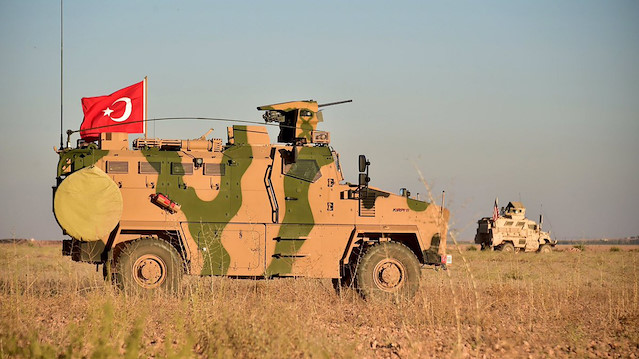
File photo: Turkish and U.S. troops are pictured during a joint patrol around Manbij
Local tribes in Syria’s Manbij region have declared their support for Turkish efforts to rid the area of the YPG/PKK terrorist group.
Leaders of the tribes, many members of which have been displaced by YPG/PKK terrorists, met recently in Jarabulus, which was liberated from the Daesh terrorist group by Turkey’s Operation Euphrates Shield.
A total of 800 people -- including representatives of 25 tribes, the Syrian opposition's interim government and the Free Syrian Army -- attended the meeting.
Attendees stressed the importance of national unity and solidarity. Some attendees held banners reading: "Yes to supporting just institutions" and "Let’s collaborate to rebuild the city".
Tribal representatives, for their part, said they wanted to return to their homes and voiced support for Turkey’s efforts to rid Manbij of YPG/PKK elements.
The Kurdistan Workers’ Party (PKK), which previously arrested teachers who refused to teach the syllabus outlined by the terror group, has now banned the wearing of the hijab (headscarf) by students and teachers.The PKK published a notice in which it announced that students attending schools in areas it occupies would have to wear uniforms.The terrorist organization banned usage of the Arabic alphabet and declared Kurdish the official language in the areas it occupies.The move has garnered a reaction from the public, and some parents showed their anger by demonstrating at various schools.Turkish jets neutralize 19 terrorists in N. Iraq Meanwhile, attempts by the U.S. to show the People’s Protection Units (YPG) as separate and different from the PKK continues.Washington's new special envoy to Syria and former Ankara ambassador James Jeffrey said last week during a teleconference that the U.S.'s position on the PKK was "clear" and that it did not classify the YPG as a terror organization like the PKK.The U.S has supplied the Democratic Union Party (PYD) terror organization and its armed wing, the YPG, with more than 5,000 truckloads of weapons to allegedly use in the fight against Daesh, despite Ankara’s warnings that they are the Syrian offshoots of the PKK terror organization.Following U.S. orders, the group has removed posters of Abdullah Öcalan, the PKK ringleader, and other symbols related to the PKK in Manbij and Tel Abayd.US monitors Turkey from military bases located near borderTribes revolt against PKK/YPGSome tribes that had enough of the terror group’s oppression raided a PKK checkpoint in Manbij and neutralized five terrorists.Tensions have also flared in Raqqa, where the PKK declared a state of emergency in order to keep up pressure on the public. Limitations have been imposed on entering and leaving the city.The PKK is listed as a terrorist organization by Turkey, the European Union and the United States. The PKK has been conducting armed violence in the southeastern part of Turkey since 1984. More than 40,000 people, mostly civilians, have been killed in the three-decade long conflict.PKK adopts Daesh tactic of rigging model aircrafts with explosivesPKK terrorist confesses to women, child abuse by groupUS establishes five terror bases in Iraq’s Sinjar for PKK as Turkish troops advanceSyrians in Turkey protest against YPG/PKK terror group
PKK bans hijab in occupied areas of NW Syria
In a closing statement released after the meeting, attendees condemned the YPG/PKK for discriminating against the people of Manbij and its policy of trying to change the region’s demographics.
Since Nov. 1, Turkish and U.S. troops have been conducting joints patrols in Manbij.
The Turkish military has been conducting unilateral patrols in the region since June.
A deal between Turkey and the U.S. calls for the withdrawal of all YPG/PKK terrorists from the city and region, which is located in the northeast of Syria's northern Aleppo province.
In its more than 30-year terror campaign against Turkey, the PKK -- listed as a terrorist organization by Turkey, the U.S. and the EU -- has been responsible for the death of some 40,000 people, including women and children. The YPG is the PKK’s Syrian affiliate.
Turkey’s Operation Euphrates Shield, which began in August of 2016 and concluded in March of last year, was aimed eliminating the terrorist threat in the Syrian regions of Jarabulus, Al-Rai, Al-Bab and Azaz with the help of the Free Syrian Army backed by Turkish air cover and artillery support.
Turkey continues its efforts to return peace and prosperity to Syria’s northwestern Afrin, which was liberated from Kurdistan Workers’ Party (PKK) terrorists within the scope of Operation Olive Branch in March 2018, by investing in various projects to boost social and economic growth in the region.Turkey has been developing new projects in trade, agriculture and transportation to end long-lasting deprivation and normalize daily life in the town.The Olive Branch Customs Gate along the Turkish-Syrian border, which was officially opened on Nov. 8, is one of the ground-breaking projects developed to speed up the delivery of humanitarian aid to the city and meet the infrastructure needs of the region.On Jan. 20, Turkey launched Operation Olive Branch in coordination with the Free Syrian Army (FSA) troops to clear terrorist groups from Afrin amid growing threats from the region.Turkey to open post office in liberated Afrin, SyriaA new post office The Turkish Post and Telegraph Organization (PTT) is preparing to open a new branch in Afrin at a refurbished and renovated building which had been used a post office before the conflict in Syria began.The new branch will provide mail, banking, and logistics services to residents as well as local Turkish officials.Video: Turkey to open post office in liberated Afrin, SyriaAfrin’s olivesTurkey also announced that Syrians in Afrin will be exporting their crops, especially Afrin’s famous olives, through the Turkish Agricultural Credit Cooperatives to enhance trade relations in the region.Turkey's Independent Industrialists’ and Businessmen’s Association (MUSIAD) on Thursday also opened a new branch in northern Syria's opposition-held Azaz region.They are both expected to contribute to the cities’ economic growth.Underlining that trade is the most important point in the normalization process, Ibrahim Uyar, the head of MUSIAD's foreign organization and development commission, expressed their desire to work on establishing free trade zones.New Olive Branch crossing to Syria's Afrin opened Thursday: Trade min
Turkey develops new projects to boost economy in Syria’s Afrin