

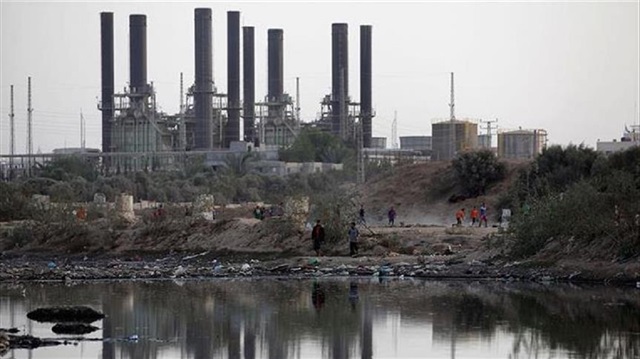
File photo
Israel on Friday morning allowed more Qatar-funded fuel shipments into the blockaded Gaza Strip via the Kerem Shalom commercial crossing.
“The Israeli authorities opened the crossing to allow trucks laden with Qatari fuel into the strip,” a Palestinian security source told Anadolu Agency.
The crossing is usually shut on Fridays and Saturdays to coincide with the weekend in Israel.
The source, who spoke anonymously due to restrictions on speaking to media, said a total of four trucks carrying 150,000 liters of fuel had entered the Gaza Strip en route to the enclave’s sole functioning power plant.
Wissam Abd al-Majid Shalaldeh, a 28-year-old Palestinian man, died Friday in Israel’s Ayalon Prison, according to the Ramallah-based Palestinian Prisoners Society.According to the NGO, the Israeli authorities informed Shalaldeh’s family -- by phone -- of his death, the reasons for which remain unclear.A father of four from the village of Saer near the occupied West Bank city of Hebron, Shalaldeh was arrested by the Israeli authorities in 2015 for illegal weapons possession and slapped with a seven-year jail term.The Prisoners Society held Israel entirely responsible for Shalaldeh’s death, noting that he was the fourth Palestinian this year to die in Israeli police custody.Roughly 6,500 Palestinians are currently being held by the Israeli authorities, including dozens of women and scores of minors, according to Palestinian figures.Hamas eyes truce with Israel in return for end of siege198 martyred by Israel since Gaza protests beganIsrael releases former Hamas MP
Palestinian man dies in Israeli jail
Tuesday saw a first pair of fuel-loaded trucks entering Gaza from Israel through Kerem Shalom.
On the same day, Stephane Dujarric, a spokesperson for UN Secretary-General Antonio Guterres, said that 15 fuel-laden trucks would soon begin entering Gaza on a daily basis.
Dujarric also expressed the UN secretary-general’s appreciation for Qatar’s $60-million contribution to the fuel-shipment scheme, which is ostensibly aimed at alleviating the difficult living conditions faced by blockaded Gaza’s Palestinian inhabitants.
Jamal Khashoggi, the Saudi dissident who went missing last week after entering the Saudi consulate in Istanbul, tweeted about a range of critical regional issues in the days leading up to his (as-yet-unexplained) disappearance.Along with the Palestine-Israel issue, the crisis in Syria, and Iranian intervention in the Arab world, Khashoggi also alluded to U.S. President Donald Trump’s recent suggestion that Saudi Arabia pay the U.S. for the protection it provides.أغادر لندن وفلسطين في البال، حضرت مؤتمرا وتعرفت على باحثين وناشطين مؤمنين بعدالة قضيتها من أطراف الارض.—رغم قوة اللوبي الاسرائيلي الذي حاصر اَي تعاطف معها الا ان صوتها لا يزال عاليا هنا.—في عالمنا يحاولون تغييب فلسطين لكسر الغضب فينا ولكنها حاضرة في ضمير كل مواطن … وان صمت. pic.twitter.com/qnOF5ZyUgu— جمال خاشقجي (@JKhashoggi) 1 Ekim 2018 After taking part in a pro-Palestine seminar in London, Khashoggi tweeted on Oct. 1 (only one day before his disappearance): “I am leaving London and Palestine is still on my mind. I attended a conference where I met [pro-Palestinian] researchers and activists from all over the world who believe in the justice of their cause”.He added: "Despite the power of the Israeli lobby [in the U.K.] … the voice of Palestine is still loud here. They are trying to marginalize the Palestinian cause … but it remains ever-present in the popular conscience."Khashoggi also tweeted several times about the arrest of his friend Essam al-Zamel, a prominent Saudi businessman and economy expert, by the Saudi authorities."Essam doesn't deserve such treatment,” Khashoggi asserted. “The accusations leveled against him don’t convince anyone!"قبل اعتقاله بيومين، كان عصام ضمن وفدا من #مركز_أداء بواشنطن يساعدهم بخبرته ويجول معهم على مؤسسات أمريكية للاستفادة من خبراتها @essamz لا يستحق هكذا معاملة وهكذا اتهامات لم تقنع أحداً ! pic.twitter.com/vQubNDEoOG— جمال خاشقجي (@JKhashoggi) 1 Ekim 2018 The Saudi authorities accuse al-Zamel -- an outspoken critic of Crown Prince Mohamed bin Salman’s “reform” initiative -- of maintaining covert affiliations with the Qatari government (with which Riyadh severed relations last year) and of having links to the Muslim Brotherhood (which Riyadh considers a “terrorist group”).Late last year, the Saudi authorities detained dozens of people -- including a number of princes and cabinet ministers (both former and current) -- in a massive "anti-corruption" sweep.Saudi billionaire investor Prince Alwaleed bin Talal and Prince Miteb bin Abdullah, minister for the Saudi National Guard, were among those rounded up.Only two months earlier, the Saudi authorities had launched a campaign targeting several Saudi intellectuals and Muslim scholars, including Salman al-Awda, Safar al-Hawali and Ali Al-Omari.In the days leading up to his disappearance, Khashoggi had also tweeted about his country’s dwindling role in Syria and alleged plans by the Saudi leadership to normalize ties with the Assad regime."Those who want to restore the Arab role in Syria should not do so through an Iranian ally [i.e., the Assad regime], which has forfeited its legitimacy and relinquished [the country’s] sovereignty...," Khashoggi tweeted on Sept. 30.Saudi Arabia had been one of the main supporters of the Syrian uprising that began in 2011 and which later erupted into full-blown conflict -- involving numerous regional and international actors -- after the Assad regime cracked down on protesters with unexpected ferocity.In a Sept. 27 tweet, Khashoggi urged the Saudi leadership to review its Syria policy, saying that “the only way to get Iran out of our [Arab] world is to support the Syrian revolution and a pluralistic system in Yemen”.For the past three years, Saudi Arabia -- at the head of an Arab military coalition -- has been fighting a destructive war with Shia rebels in Yemen who Riyadh accuses of serving as Iranian proxies.Khashoggi also urged the Saudi leadership to support the "the Arab people’s desire for freedom”. "The [Arab] people dislike the Iranian regime… as much as the regimes they rose up against in 2011 [in the so-called ‘Arab Spring’ uprisings]," Khashoggi declared.As for Trump's recent suggestion that the Saudi regime pay for the protection the U.S. provides, Khashoggi tweeted: "Trump himself is the biggest threat."In another tweet, Khashoggi voiced his belief that the “biggest threat” facing the Gulf States and their oil “is a president like Trump, who sees us merely as a source of oil”.Since Khashoggi went missing on Oct. 2, speculation has mounted that he was killed by the Saudi authorities, who have yet to provide a convincing explanation for his disappearance.Meanwhile, several countries -- including Turkey, the U.S. and the U.K. -- have continued to press Riyadh for clarification.According to Khashoggi’s Turkish fiancée, Hatice Cengiz, he first visited the Saudi consulate in Istanbul on Sept. 28.After being told his documents would be ready after one week, Khashoggi briefly visited London before returning to Istanbul on Oct. 1.The following day, he entered the consulate and has not been seen since.On the same day as his disappearance, 15 Saudi officials arrived in Istanbul, where they went to the consulate while Khashoggi was still presumably inside, according to Turkish police sources.France raises pressure on Saudi over Khashoggi disappearanceSaudi delegation arrives in Ankara for Khashoggi probeTurkey has recordings proving Khashoggi was killed inside Saudi consulate: Washington PostTrump: Khashoggi disappearance no reason to stop Saudi investments
In final tweets, Khashoggi alluded to Palestine, Syria
On Tuesday, the Ramallah-based Palestinian government -- in reference to the fuel shipments -- announced its “total rejection” of what it described as “suspicious projects”.
According to Ramallah, the fuel shipments are part of a scheme aimed at wrecking Palestinian unity by uncoupling Gaza from the West Bank, “thus derailing the Palestinian national cause”.
Last week, Israeli daily Haaretz reported that a deal had been struck with Qatar by which the latter would finance fuel procurements for Gaza.
Since 2007, when Hamas seized the Gaza Strip from rival Palestinian faction Hamas, the coastal enclave has groaned under an Israeli blockade that has deprived its two million inhabitants of many basic commodities.
Ismail Haniyeh, political chief of Palestinian resistance group Hamas, says his movement is seeking a truce with Israel in exchange for an end to the latter’s 12-year blockade of the Hamas-run Gaza Strip.Haniyeh made the assertion in a taped address played during the opening session of an international conference on Jerusalem held Friday in Istanbul.The event is being attended by more than 700 Arab and Muslim figures who will discuss recent developments pertaining to Jerusalem and the Palestinian national project.“Today we are seeking -- along with Egypt, Qatar and the UN -- to reach an understanding that could yield a truce [with Israel] in exchange for an end to the siege,” Haniyeh said in the pre-recorded address.He stressed, however, that the sought-for truce would not have any political strings attached; would not be part of the so-called “Deal of the Century” (a backchannel peace plan proposed by the U.S. administration); and would not lead to Gaza’s separation from the West Bank.Friday’s conference was organized by the International Coalition for the Support of Jerusalem and Palestine and the Center for Turkish-Islamic Relations.The two-day event aims to raise awareness about the Palestinian national cause in response to Washington’s recent diplomatic maneuvering in the region and rising authoritarianism in the Arab world, according to organizers.198 martyred by Israel since Gaza protests beganIsrael releases former Hamas MP
Hamas eyes truce with Israel in return for end of siege