

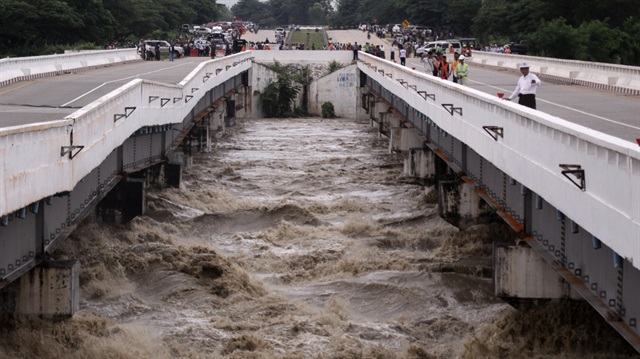
Swar creek bridge is seen damaged after flooding at the Yangon-Mandalay express highway in Swar township, Myanmar, August 29, 2018.
More than 50,000 people have evacuated their homes in central Myanmar after part of a dam failed on Wednesday, inundating communities and damaging a bridge on a major highway, officials said.
The incident spotlights safety concerns about dams in Southeast Asia following last month's collapse of a hydroelectric dam in neighbouring Laos that displaced thousands of people and killed at least 27.
Myanmar fire authorities sent a team to the dam after the breach at 5:30 a.m. (2300 GMT) unleashed water into the nearby town of Swar and several other settlements.
A Myanmar government spokesman on Wednesday rejected a report by United Nations investigators that called for top generals to be prosecuted for genocide, saying the international community was making "false allegations".His comments came a day after the U.N report, which marked the first time the organisation has explicitly called for Myanmar officials to face genocide charges over a brutal crackdown on Rohingya Muslims last year."Our stance is clear and I want to say sharply that we don't accept any resolutions conducted by the Human Rights Council," Zaw Htay, the main government spokesman, said in an interview published in state media.'Myanmar is like Nazi Germany'Myanmar did not allow U.N investigators to enter the country, he said. "That's why we don't agree and accept any resolutions made by the Human Rights Council."He added that the country has "zero tolerance to any human rights violation" and had set up a Commission of Enquiry to respond to "false allegations" made by the U.N and "other international communities".Authorities earlier this year set up a panel comprised of two local and two international members – Filipino diplomat Rosario Manalo and Kenzo Oshima, Japan's former ambassador to the U.N - to investigate human rights abuses.UN chief urges Myanmar to ensure immediate, full accessMyanmar has denied most of the allegations, saying the military responded to a legitimate threat from Rohingya militants, who attacked police posts across the western Rakhine state."If there is any case against human rights, just give us strong evidence, record and date so that we can take legal action against those who break the rules and regulations," Zaw Htay said.The same day as the U.N released its report, Facebook shut down the account of army general Min Aung Hlaing and other top military officials, accusing them of using its platform to spread "hate and misinformation".'Let us not fail Rohingya again': Oscar-winning actressIn the interview published on Wednesday, Zaw Htay said the government had not ordered the ban and was questioning Facebook about the action, saying it had caused "mounting criticism and fear among the people".Myanmar's civilian government shares power with the military, which controls key ministries including home affairs and immigration. 
Myanmar spokesman rejects UN genocide report
"The (spillway) of the dam was broken and flooded the two villages close to the highway," the fire department said on its Facebook page.
Authorities had given the dam the all-clear after an inspection just days earlier, despite residents' concerns about overspill, state-run media said.
"If you go to my house, there are no belongings left," said farmer Aung Aung, whose village of Kone Gyi Lan Sone was inundated without warning, sending him scrambling to tell his neighbours. They all ran to higher ground to escape.
The atrocities targeting Myanmar’s Rohingya minority are similar to those committed by Nazi Germany, according to a prominent Buddhist human rights activist.Speaking to Anadolu Agency in Kent, the UK, Maung Zarni, a coordinator at the Free Rohingya Coalition, said the international community should act against his country of origin.'Let us not fail Rohingya again': Oscar-winning actressZarni’s remarks come after the UN released a report earlier this week documenting mass gang rapes, killings -- including of infants and young children -- brutal beatings and disappearances committed by Myanmar state forces. In its report, UN investigators said such violations may have constituted crimes against humanity.“We have a situation wherein a UN member state run by a Nobel Peace Prize winner, Aung San Suu Kyi, and her partners in power, Burmese military generals…is found by the [most] credible and highest body of human rights authorities in the world to be like Nazi Germany,” Zarni said.“Genocide is what the Nazis did. Genocide is what happened in Rwanda, in Cambodia, or to the Bosnian Muslims.”Zarni underlined that when a case is determined to be “genocidal”, the responsibility for dealing with it lies with all UN member states.“The highest political and moral obligation rests with the [UN] Security Council,” he added.He said setting up an international criminal court as was done for Rwanda or Bosnia would not be enough; the Rohingya minority needs “a protected region where they can live safely and as normal, decent human beings”.The UN Independent International Fact-Finding Mission on Myanmar has called on Myanmar’s top military officials, including army commander-in-chief Senior General Min Aung Hlaing, to be tried at the International Criminal Court for genocide committed against Rohingya Muslims.“My expectation, in an ideal world…[is that] the UN Security Council will authorize some form of intervention so that the atrocities can be stopped and the Rohingya can be given their land back and allowed to live in dignity and in safety,” Zarni said.- SanctionsZarni said there are now more Rohingya living outside Myanmar than those who are left in the country following decades of violence but especially after a full-scale attack was launched against them in August last year.Underlining that the international community should impose sanctions on Myanmar’s government and army, Zarni pointed out that the exclusion policy against the Rohingya must end.Rohingya Muslims “are being purged,” and the ultimate goal in introducing sanctions against Myanmar should be “to fundamentally change the Burmese state’s policies and change the structures [which] have been mobilized by the Burmese military and public opinion makers to repress and persecute and essentially annihilate this population,” Zarni added.The ultimate goal of multiple sanctions should be providing Rohingya “international protection” and creating “an autonomous region where the Burmese military would not be allowed to continue the atrocities,” he said.- SolutionZarni said Myanmar has four major pillars: the military, the Buddhist order, political parties, and the public.“All four of these major institutions…have categorically rejected the Rohingya. We are telling them they don’t belong to Burma, we don’t want them in Burma.”Zarni said the solution to the problem does not lie in the country but has to be formulated internationally and within the UN institutions.- Call for Turkey's assistanceZarni added that Turkish President Recep Tayyip Erdogan and the Turkish government “have been extremely vocal and supportive of the Rohingya people”.“This is the time for Turkey to show serious moral and political leadership,” he said.Pointing out that the UN Security Council is in a “coma” and “paralyzed” as it cannot resolve the problems, Zarni emphasized that Turkey can really help in Myanmar’s case by “leading to form a coalition of Muslim and non-Muslim governments that accept that this is genocide and [say] we must not be bystanders to genocide”.He said there are more than 500,000 Rohingya trapped in Myanmar and they can be driven out any time, adding it is the time to act and to form a coalition.“My appeal is not to the Burmese people. My appeal is to the Islamic world as well as non-Islamic communities to help the Rohingya.“Because this is not just about Muslim people. They are human beings. But we, Burmese, in my country treat them like [they are] less than animals.”On Aug. 25, 2017, Myanmar launched a major military crackdown on the Muslim ethnic minority, killing almost 24,000 civilians and forcing 750,000 others, including women and children, to flee to Bangladesh, according to the Ontario International Development Agency.The Rohingya, described by the UN as the world's most persecuted people, have faced heightened fears of attack since dozens were killed in communal violence in 2012.
'Myanmar is like Nazi Germany'
"It was only after that we realised the situation," he told Reuters. "The little shop over there is completely destroyed and washed away," he added, as floodwaters and broken branches swirled around the wooden homes in the village.
Many people, including some not directly hit by flooding, had decided to leave their homes for fear the waters could rise further, said an official of the Natural Disaster Management Department who sought anonymity, in the absence of authorisation to speak to media.
As many as 14 clusters of hamlets were battling flooding, the department said.
UN Secretary General Antonio Guterres Tuesday called on Security Council member states to urge Myanmar to cooperate in solving the humanitarian crisis experienced by Rohingya Muslims in Rakhine state.Guterres described the situation as "one of the world’s worst humanitarian and human rights crises" in an address to the Security Council."I ask members of the Security Council to join me in urging the Myanmar authorities to cooperate with the United Nations, and to ensure immediate, unimpeded and effective access for its agencies and partners," Guterres said. His remarks come one day after a UN fact-finding mission published a report that said top military officials in Myanmar, including Commander-in-Chief Min Aung Hlaing should be investigated for genocide.Facebook banned the accounts and pages of Myanmar army officials Monday, citing they were spreading hate by attacking the Rohingya Muslim population through social media.UN chief warns against military escalation in SyriaGuterres said the Myanmar government has refused to work with UN human rights groups despite repeated calls by the Security Council to do so.Recounting a story of when he visited Cox's Bazar in Bangladesh, he discussed the horrific stories that he encountered there."One father broke down as he told me how his son was shot dead in front of him. His mother was brutally murdered and his house burned to the ground. He took refuge in a mosque only to be discovered by soldiers who abused him and burned the Quran," the UN chief said.'Let us not fail Rohingya again': Oscar-winning actress"Some 130,000 Rohingya remain confined in camps with severe restrictions on their freedom of movement. They have extremely limited access to health, education and other essential services, and to ways of making a living," Guterres added.On Aug. 25, 2017, Myanmar launched a major military crackdown on the Muslim ethnic minority, killing almost 24,000 civilians and forcing 750,000 others including women and children to flee to Bangladesh, according to the Ontario International Development Agency (OIDA).The UN documented mass gang rapes, killings -- including of infants and young children -- brutal beatings, and disappearances committed by Myanmar state forces. The UN has described the Rohingya as the “world's most persecuted people.”"It is clear that conditions are not yet met for the safe, voluntary, dignified and sustainable return of Rohingya refugees to their places of origin or choice."Guterres stressed the UN should follow the framework set by former Secretary General Kofi Annan, and as long as there is fear and persecution remains in the Rakhine state, they will not allow refugees to return."A year has passed. This crisis cannot continue indefinitely," Guterres said.
UN chief urges Myanmar to ensure immediate, full access
In all, 12,000 households, or a total of 54,000 people, were displaced, said another official, from the Department of Relief and Resettlement, who also declined to be named.
A surge of water as high as 8 feet (2.4 m) hit the first downstream village of Kyun Taw Su, besides flooding Swar and part of the larger town of Yedashe, said Ko Lwin, a journalist based in Swar.
A Yedashe administrative official said authorities could not rule out that people were still trapped in small villages near the dam, adding that of three people reported missing and feared swept away by the waters, one was found alive.
UN Refugee Agency goodwill ambassador Australian actress Cate Blanchett on Tuesday urged the UN Security Council not to fail Rohingya "again" as the minority Muslims have been enduring violence for a year."I have heard the gut-wrenching accounts. Stories of grave torture, of women brutally violated, people who have had their loved ones killed before their eyes. Children who have seen their grandparents locked in houses that were set alight," said Blanchett.Her remarks came during her address to the UN Security Council in New York on the situation in Myanmar and the Rohingya refugee crisis."I am a mother, and I saw my children in the eyes of every single refugee child I met. I saw myself in every parent. How can any mother endure seeing her child thrown into a fire?"Their experiences will never leave me," she said. In her remarks, she said the focus of the Council's member states must be to provide much-needed support inside Bangladesh while working to ensure conditions in Myanmar are conducive to return.She said from her accounts with many Rohingya refugees she talked to, the minority Muslims view Myanmar as their home and cited their fears about returning there."The Rohingya cannot return to the very conditions they were forced to flee," she said."We have failed the Rohingya before. Please, let us not fail them again," she concluded.On Aug. 25, 2017, Myanmar launched a major military crackdown on the Muslim ethnic minority, killing almost 24,000 civilians and forcing 750,000 others including women and children to flee to Bangladesh, according to the Ontario International Development Agency (OIDA).The UN has documented mass gang rapes, killings -- including of infants and young children -- brutal beatings and disappearances committed by Myanmar state forces and has described the Rohingya as the “world's most persecuted people”.Over 200 Rohingya wait to enter Bangladesh: ReportTurkey reiterates support for Rohingya MuslimsBangladesh: 87 pct Rohingya unwilling to go to islandMyanmar generals had 'genocidal intent' against Rohingya, must face justice: UNRohingya in US mark first year of Rakhine massacre
'Let us not fail Rohingya again': Oscar-winning actress
"The two other people are still missing," said the official, Aye Myin Kyi. "We don't assume them dead, we are still looking for them."
About 7,000 people were staying in 17 camps in the town, she added, while 16 more held 3,500 people in Taungoo, the nearest major town, with still more in monasteries and elsewhere.
Pictures on social media showed soldiers using makeshift bamboo rafts and kayaks to evacuate people from flooded homes and shops, some carrying children and the elderly through knee-deep waters.
WATERS SUBSIDE
The waters had begun to subside on Wednesday afternoon but still rushed beneath a damaged bridge along the road linking Myanmar's major cities of Yangon, Mandalay and the capital Naypyitaw surrounded by acres of flooded fields.
The bridge stayed closed to heavy traffic as the carriageway for vehicles travelling north to south had buckled.
"When the water flooded the bridge we closed it, and by the time we arrived here around 8 a.m., two columns had sunk around two feet," said Deputy Minister of Construction Kyaw Linn, who joined in repair work by surveyors and workers.
Myanmar's heavy annual monsoon rains have caused widespread flooding that displaced more than 100,000 people and killed at least 11 in July.
Some dams were reported to be overflowing this month, but an irrigation and water management official told the privately-run Myanmar Times newspaper there was no risk of a collapse.
The dam built across the Swar creek in 2004 can hold 216,350 acre-feet of water to irrigate more than 20,000 acres (8,100 hectares) of farmland, says a Ministry of Agriculture and Irrigation document posted online.
Swar residents had expressed concerns that the dam was overflowing, said Ko Lwin, the journalist.
On Monday, the state-run Myanmar Alin newspaper said an administrator and an irrigation official had inspected the dam.
"There is nothing to be concerned about," it reported the administrator, Tun Nay Aung, as saying, as the dam had not exceeded its capacity.
Reuters was unable to trace contact details for Tun Nay Aung on Wednesday. Government spokesman Zaw Htay did not answer telephone calls from Reuters to seek comment regarding the prior concerns over the dam.
The Myanmar government is assessing some dam projects to help eliminate chronic power shortages, but their potential environmental impact makes the projects controversial.
Large areas were still cut off by the floods, said Aye Aye, 47, one of the relief providers in the Swar area.
"I don't know about all the people," she added. "But there were quite a lot of dogs. Motorcycles were also underwater. (We saw) dead buffaloes, dead cows."