

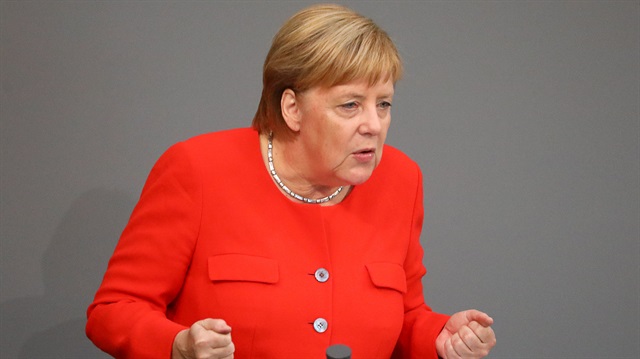
German Chancellor Angela Merkel
Chancellor Angela Merkel said on Wednesday Germany could not simply look away if chemical attacks took place in Syria, two days after her government said it was in talks with its allies about a possible military deployment in the war-torn country.
The conservative leader said Germany's could not just reject military intervention, a direct rebuke of her Social Democratic coalition partners, who have rejected participation in military action against Syria.
"It cannot be the German position to simply say 'no', no matter what happens in the world," she told the Bundestag lower house of parliament.
Germany, the world's fourth largest economy, is under pressure from the United States to boost military spending and shoulder more responsibility within NATO. It did not participate in military strikes carried out by U.S., French and British forces on Syria in April after a chemical weapons attack.
The UK's UN ambassador "strongly" agreed with Turkish President Recep Tayyip Erdoğan on Tuesday amid a mounting offensive on northwestern Syria's Idlib province.“We strongly agree with President Erdogan,” Karen Pierce told the UN Security Council citing an op-ed penned by Erdoğan.Erdogan on Monday said in the Wall Street Journal: “All members of the international community must understand their responsibilities as the assault on Idlib looms. The consequences of inaction are immense.”“A regime assault [in Idlib] would also create serious humanitarian and security risks for Turkey, the rest of Europe and beyond,” he added.UN chief says 'essential' to avoid Idlib 'bloodbath'US rips Russia, Iran, Assad regime amid Idlib offensiveHe noted the regime's criminal acts -- arbitrary arrests, systematic torture, summary executions, barrel bombs, chemical and conventional weapons -- which targeted Syrians for seven years."As a result of the Syrian civil war, which the United Nations Human Rights Council calls ‘the worst man-made disaster since World War II’, millions of innocent people have become refugees or have been internally displaced," he said.He also noted Turkey's role in protecting the Syrian people, as it hosts the largest number of refugees in the world at 3.5 million.Pierce said the council faces "a choice", between a Syrian regime and Russian "military assault on Idlib in which, as many colleagues have said today, thousands of civilians will die," or "we allow Turkey and opposition groups the support, space and time to separate out the terrorists and tackle them themselves."Turkey has a plan, Madam President, in Idlib and it does involve reaching an agreement with the Syrian opposition whereby the regime refrains from attacking them while they combat terrorism," she said referring to Nikki Haley, the U.S.'s UN envoy and council president."This is what we should be discussing today, Madam President, but I think it has been absent from the briefing we received from Russia just now," Pierce added.Haley further blamed Russia and the regime for allegedly carrying out more than 100 airstrikes, some of which she said were "ruthless double tap" strikes targeting first responders.“It is a disgusting tactic of terrorists, not professional soldiers,” she said.She alleged Moscow, Tehran and Damascus are not interested in pursuing a political solution to the Syrian crisis, saying “Turkey learned this lesson last week” during trilateral talks in the Iranian capital.“The United States is long past taking Russia and Iran at their word that they are interested in protecting civilians in Idlib from further violence," she said. "If Assad, Russia, and Iran continue down the path they are on, the consequences will be dire. The world will hold them responsible. And no number of Security Council meetings will ever change that.”The UN warned Monday at least 30,000 residents in Idlib have been displaced in the first nine days this month amid the Russian and regime air campaign there.
UK 'strongly' agrees with Turkey's Erdoğan on Idlib
But Merkel and her conservatives must win over the more pacifist Social Democrats (SPD), junior partners in the ruling coalition, and overcome massive public opposition to Germany's participation in military combat missions.
SPD leader Andrea Nahles on Wednesday told lawmakers her party would not agree to military intervention in Syria unless the United Nations authorised such action.
Combat missions remain a sensitive topic in Germany, given its Nazi past. Participation in any air strikes in Syria would also put Germany on a collision course with Russia, the main backer of President Bashar al-Assad.
Seventy-four percent of Germans oppose participation in a military intervention in the event of another chemical weapons attack by the Syrian government, according to a new poll by Die Welt newspaper that was published Wednesday.
UN Secretary General Antonio Guterres said Tuesday it is "absolutely essential" for a full-blown military offensive to be avoided in northwestern Syria's Idlib province."This would unleash a humanitarian nightmare unlike any seen in the blood-soaked Syrian conflict," Guterres told reporters at the UN's New York headquarters. "It must not be transformed into a blood bath."The UN warned Monday at least 30,000 residents in Idlib have been displaced in the first nine days of September amid the Russian and regime air campaign there.Guterres said half of the 2.9 million people living in Idlib have gone to the northwestern province after fleeing violence elsewhere in Syria."They include close to 1 million children. Their lives have been upended and they have nowhere to go," he said. "I understand that the present situation in Idlib is not sustainable and the presence of terrorist groups cannot be tolerated. But fighting terrorism does not absolve warring parties of their core obligations under international law."Guterres made a particular appeal to Turkey, Iran and Russia -- known as the Astana guarantors. You should "spare no effort to find solutions that protect civilians. Preserve basic services and hospitals. Ensure full respect for international humanitarian law"."I think it is absolutely essential [for] Russia, Iran, and Turkey, not to mention other countries directly or indirectly involved in this situation, to really come together at the present moment more than ever because Idlib is such a mess that, without a strong commitment of all these parties, we could be moving into a situation that would lead to the kind of massive battle that would have unpredictable consequences," he said.The UN warned last week an offensive on Idlib would likely lead to the “worst humanitarian catastrophe of the 21st century.”
UN chief says 'essential' to avoid Idlib 'bloodbath'
The U.S. on Tuesday blasted Russia, Iran and the Syrian regime amid a growing military offensive in northwestern Syria's Idlib province.“Russia, Iran and Assad are demolishing Idlib and asking us to call it peace,” Nikki Haley, the U.S.'s UN envoy said in remarks before the Security Council.Since the beginning of September, at least 30 civilians have been killed in Idlib and Hama, and dozens injured, by airstrikes and attacks by the regime and Russian warplanes, according to the White Helmets civil defense agency.Turkey, Russia, Iran, UN discuss SyriaThe UN warned Monday at least 30,000 residents in Idlib have been displaced in the first nine days of this month amid a Russian and regime air campaign there.Haley blamed Russia and the regime for allegedly carrying out more than 100 airstrikes, some of which she said were "ruthless double tap" strikes targeting first responders.“It is a disgusting tactic of terrorists, not professional soldiers,” she said.'Attack on Idlib to sabotage ongoing political process’She alleged Moscow, Tehran and Damascus are not interested in pursuing a political solution to the Syrian crisis, saying “Turkey learned this lesson last week” during trilateral talks in the Iranian capital.“The United States is long past taking Russia and Iran at their word that they are interested in protecting civilians in Idlib from further violence," she said. "If Assad, Russia, and Iran continue down the path they are on, the consequences will be dire. The world will hold them responsible. And no number of Security Council meetings will ever change that.”Vasily Nebenzia, Russia's UN ambassador, defended the deteriorating security situation in Idlib, which is an established "de-escalation zone" as part of the trilateral talks.Turkey's UN envoy demands immediate cease-fire in idlib"Sooner or later," Nebenzia said, such areas "were to be replaced first by local truces, and in cases where that did not take place, a counter-terrorist operation.”“The Astana process is ongoing, and with the help of the process we will have tangible results,” he said, referring to the trilateral process with Iran and Turkey.Last week, the UN warned an offensive on Idlib would likely lead to the “worst humanitarian catastrophe of the 21st century”.
US rips Russia, Iran, Assad regime amid Idlib offensive
Merkel calls for European solidarity to tackle illegal migration
German Chancellor Angela Merkel appealed to European Union members to show solidarity to ensure the Frontex border agency has sufficient powers to be effective and help stop illegal migration, in line with European Commission plans.
"The question of fighting illegal migration means we have to strengthen external border protection ... that means also that the countries with an external border must give up some of their national responsibilities," Merkel told parliament on Wednesday.
"That requires a degree of solidarity, it is about people coming to us or our duty to make legal migration possible to help countries that are in trouble," she added.
Turkish security forces held 597 irregular migrants during nationwide operations on Monday, according to military sources.Gendarmerie and border military units held 497 irregular migrants in northwestern Turkish province of Edirne, the sources said on condition of anonymity due to restrictions on talking to the media.The migrants were from Pakistan, Azerbaijan, Palestine, Algeria, Syria, Iran, Iraq, and Bangladesh, the sources added.The migrants were sent to the provincial immigration office.Meanwhile, Turkish gendarmeries held 40 irregular migrants of Afghan national were held in the eastern province of Van.In a separate operation, 29 irregular migrants were held in northwestern province of Çanakkale.The security forces held the migrants -- all Afghan nationals --, including women and children, who were planning to cross to the Greek island of Lesbos.These migrants were sent to immigration authority, while the van driver was arrested over human trafficking.A total of 31 Syrian migrants illegally crossing into Turkey were held in bordering Hatay province.Turkey has been a main route for refugees trying to cross to Europe, especially since 2011, the beginning of Syria's civil war.
Nearly 600 irregular migrants held across Turkey
Swedes voted on Sunday in an election dominated by fears over asylum seekers and welfare, with the anti-immigration Sweden Democrats vying to become the biggest party in a country long seen as a bastion of liberal values.Far-right parties have made spectacular gains throughout Europe in recent years after a refugee crisis sparked by civil war in Syria and conflicts in Afghanistan and parts of Africa.In Sweden, the influx of 163,000 asylum seekers in 2015 has polarised voters, fracturing the political consensus and could give the Sweden Democrats, a party with roots in the white supremacist fringe, a veto over who forms the next government."Traditional parties have failed to respond to the sense of discontent that exists," said Magnus Blomgren, a social scientist at Umea University."That discontent maybe isn't directly related to unemployment or the economy, but simply a loss of faith in the political system. Sweden isn't alone in this."The centre-left bloc, uniting the minority governing Social Democrat and Green parties with the Left Party, is backed by about 40 percent of voters, recent opinion polls indicate, with a slim lead over the centre-right Alliance bloc.The Sweden Democrats, who want the country to leave the European Union and put a freeze on immigration, have about 17 percent, up from the 13 percent they scored in the 2014 vote, opinion polls suggest."Everything points to us having a good election," Sweden Democrats leader Jimmie Akesson told Reuters on the sidelines of a party rally in the southern town of Malmo on Saturday that drew supporters as well as chanting protesters."What we, the Sweden Democrats, are saying, and which is considered incredibly controversial in Sweden, is normal politics in the rest of Europe."The party's support was widely underestimated before the previous election and some online surveys give them as much as 25 percent, a result that would be likely to make them the biggest party, dethroning the Social Democrats for the first time in a century."It would send a big 'go to hell' message to me and my kind," said Stefan Jovanovic, 26, a music business manager with roots in Serbia."Because we all know that their whole political message is about one thing and one thing only, and that is the question of immigration."Such an outcome could weaken the Swedish crown in the short term, but analysts do not see any long-term effect on markets from the election because economic growth is strong, government coffers are well stocked and there is broad agreement about the thrust of economic policy.EUROSCEPTIC VOICESSweden has flirted with populism before. New Democracy, founded by an aristocrat and a record producer, won nearly 7 percent of the vote in 1991, on the promise of strict immigration policies, cheaper alcohol and free parking, only to crash out of parliament three years later.The Sweden Democrats are bidding to become the biggest populist party in the Nordic region, topping the Danish People's Party, which gained 21 percent in 2015, and trump the 12.6 percent for the far-right Alternative for Germany, which swept into the Bundestag last year.With an eye on the European Parliament elections next year, Brussels policymakers are watching the Swedish vote closely, concerned that a nation with impeccable democratic credentials could add to the growing chorus of euroscepticism in the EU.Sweden took in more asylum seekers per capita than any other country in Europe in 2015, magnifying worries about a welfare system that many voters already believe is in crisis.Lengthening queues for critical operations, shortages of doctors and teachers and a police service that has failed to deal with inner-city gang violence have shaken faith in the "Swedish model", built on a promise of comprehensive welfare and social inclusion.The Sweden Democrat's Akesson has labelled the vote a choice between immigration and welfare in election campaign that has been unusually antagonistic."It has been really unpleasant," student Katze Collmar, 32, said while voting in central Stockholm."It feels like Sweden could take a step in this election that we won't be able to recover from very easily."Mainstream politicians have so far refused to cooperate with the Sweden Democrats.But with some kind of cooperation between parties in the centre-left and centre-right blocs the only other alternative to the current political deadlock, analysts believe that Akesson may yet end up with some influence on policy.Akesson has promised to sink any government that refuses to give his party a say in policy, particularly on immigration.With deadlock looming, it could take weeks to form a government.Voting stations close at 1800 GMT, with exit polls set be published by Sweden's two main broadcasters. Results from the vote will become clear later in the evening.
Anti-immigration party set for election gains as Sweden swings right
Merkel condemns far-right violence in eastern Germany
Chancellor Merkel also condemned recent far-right violence in eastern Germany and called for stronger efforts to strengthen peaceful coexistence in Germany.
“Jews, Muslims belong to our society, just like Christians and atheists,” Merkel said.
She denounced violence by far-right extremists in several eastern German cities in recent weeks, following reports of murder and other crimes allegedly perpetrated by foreigners.
“There can be no excuse or justification for tracking people down, using violence, chanting Nazi slogans and displaying hostility on people who look different,” she stressed.
Far-right groups organized various rallies in eastern cities of Chemnitz and Koethen in recent weeks, where mobs hunted down foreign-looking people on the streets and attacked restaurants owned by Jews or other migrants.