

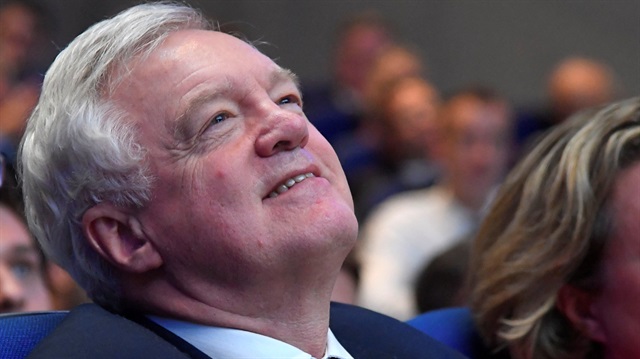
Conservative MP David Davis
Prime Minister Theresa May's ministers should "exert their collective authority" to force a change in her Brexit strategy, former Brexit minister David Davis said on Sunday, stepping up pressure on Britain's leader.
In an article in the Sunday Times newspaper, Davis again pressed May to abandon her proposal for leaving the European Union, saying the bloc "has rejected it. The public does not like it. Parliament will not vote for it".
With less than six months before Britain leaves the EU in its biggest trade and foreign policy shift in more than 40 years, May is struggling to get backing for not only her vision for future ties with the bloc but also over a so-called backstop deal for Northern Ireland, one of the trickiest hurdles left.
British Prime Minister Theresa May was struggling on Friday to find consensus on Brexit proposals that would be acceptable to her ministers, her Conservative Party and the Northern Irish lawmakers who prop up her minority government.Brexit negotiations with the European Union have accelerated and become more positive over the past week, though significant hurdles remain, finance minister Philip Hammond said."What has happened over the last week, 10 days, is that there has been a measurable change in pace," he told the BBC."But that shouldn't conceal the fact that we still have some big differences left to resolve," Hammond said. "So process is a lot more positive this week - substance still very challenging."Under pressure from parliamentary partner, UK's May meets ministersWith less than six months to go until the United Kingdom is due to leave the EU, May is seeking to rally support at home on the details of a divorce deal though it is unclear if she can win parliament's approval for any agreement.British and EU negotiators are making headway on the Irish border issue, the biggest hurdle to an overall agreement, and hope for a Brexit deal breakthrough on Monday, diplomats said.The Irish border "backstop", which seeks a way to avoid customs checks on the frontier between the British province of Northern Ireland and Ireland if there is no overall exit deal, has become the biggest sticking point in negotiations.As both sides seek to clinch a deal, the United Kingdom will publish on Friday more of its so-called technical notices which lay out the impact of a no-deal Brexit on specific sectors of the economy.Tony Blair says UK needs a referendum to stop BrexitDEAL OR NO-DEAL?May's Northern Irish supporters vehemently oppose any checks between the province and mainland Britain after Brexit.The head of the Democratic Unionist Party, Arlene Foster, said May "could not in good conscience" back an EU proposal for checks on goods being imported to Northern Ireland from Britain after Brexit.Under May's proposals, the whole of the United Kingdom would forge a customs partnership with the EU after a transition period ends in December 2020 in the event of the backstop being triggered.Some of May's ministers have urged her to put a time limit on that plan.The Times newspaper said May was warned the issue was so serious that she could face further cabinet resignations unless she found a way to ensure the backstop was not permanent.Speaking to Northern Ireland journalists at her Downing Street office, May said on Thursday that talks on the Irish backstop were likely to continue until November. 
As Brexit talks progress, UK PM May struggles to find support at home
British Prime Minister Theresa May will meet ministers on Thursday to discuss Brexit, hours after her parliamentary partner threatened to withdraw its support if she accepts what it calls a "draconian solution" on offer from the European Union.Just six months before Britain is due to leave the EU, the two sides differ on their view of the talks - the bloc says a withdrawal deal is within reach, while British officials say "significant obstacles" still lie in the way of any agreement.They do agree on one thing - that time is running out to seal a deal to pave the way for Britain's divorce, the biggest trade and foreign policy shift for more than 40 years. As that departure date creeps closer, those wanting to influence May's approach to Brexit are stepping up their efforts.EU's Barnier calls for 'decisive progress' on Brexit for summit next weekOne of the biggest hurdles is an agreement on the so-called Irish backstop to prevent the return of a hard border between the British province of Northern Ireland and EU member Ireland if there is no immediate trade deal.A seamless border is part of the settlement which largely ended decades of violence in the province.Neither side has indicated there has been a deal on the Irish backstop. But after meetings in Brussels, the Democratic Unionist Party, which props up the Conservative government in parliament, has issued a series of terse warnings to May.DUP Brexit spokesman Sammy Wilson condemned what he said was the EU's offer for a backstop that would keep Britain in the customs union for an unspecified time-limited period, would exclude Northern Ireland from any new British trade deals and see checks on goods moving from mainland Britain to the province.EU's commissioner says 'we are not there yet' on BrexitBrexiteers set limit for UK PM Theresa May's trade deal with EUMay's acceptance of such a proposal "would have implications not just for Brexit legislation – 50 per cent of which would not have passed without DUP support – but also for the budget, welfare reform and other domestic legislation", he said."She will not have DUP support regardless of whether the government tries to bribe, bully or browbeat us into accepting it," he wrote in the Daily Telegraph newspaper.By withdrawing its support, the DUP could make it impossible for May to pass legislation through parliament, including the budget which will be voted on later this month.Tony Blair says UK needs a referendum to stop BrexitMeetingMay will gather several of her ministers later on Thursday as part of routine meetings to keep her cabinet team updated on progress in Brexit talks.The meeting takes place against growing criticism over her plans to leave the EU with some Conservative eurosceptic lawmakers saying they will vote against any deal based on her so-called "Chequers" proposal, named after her country residence.Former prime minister John Major, whose career as leader was crushed partly by eurosceptics, said the behaviour of some of those Conservatives was "an intolerable way to treat a prime minister who's in the middle of negotiations".But the parliamentary arithmetic is difficult for May. With the support of the DUP she commands a majority of only 13 lawmakers and needs to keep either her own party onside or attract votes from the main opposition Labour Party.Labour leader Jeremy Corbyn has said the party will vote against any deal that does not meet its tests - something the Chequers plan does not fulfil.And former Labour leader Tony Blair added his voice to calls for the party to vote down May's Brexit divorce deal."My view is this only happens if there is blockage in parliament. But if there is blockage in parliament it is a very simple argument. You say look we have been two and a bit years trying to reach an agreement that works, parliament is blocked." 
Under pressure from parliamentary partner, UK's May meets ministers
Talks with Brussels have been all but non-stop before a summit on Wednesday when the two sides hope to agree a draft withdrawal treaty to outline the divorce terms, including a transition agreement and a solution to Northern Ireland.
Davis, who again criticised the government of which he was once part for accepting "the EU's language on dealing with the Northern Ireland border" in December, said it was now up to the so-called cabinet of top ministers to exert their influence.
"This is one of the most fundamental decisions that government has taken in modern times. It is time for cabinet members to exert their collective authority," Davis wrote.
"This week the authority of our constitution is on the line."
Davis also said Britain should use the 39 billion pounds Britain has agreed in a financial settlement with the EU as the "biggest bargaining chip" to secure a beneficial future trading relationship with the bloc.
The head of the Northern Irish party that props up British Prime Minister Theresa May's government said on Saturday she would prefer no Brexit deal to a bad deal, describing current plans as amounting to "the annexation of Northern Ireland" by the EU.British and European Union negotiators this month have accelerated the push for a Brexit deal but talks remain snagged on the issue of the border between Northern Ireland, which is part of the UK, and the Irish Republic, an EU member state.In the absence of a comprehensive EU-UK trade partnership after Brexit, the EU is seeking a "backstop" arrangement whereby Northern Ireland would effectively remain subject to the bloc's regulations to avoid a hard border on the island of Ireland.But the DUP, whose support May needs to pass legislation in the British parliament, vehemently opposes any proposals under which the province would be treated differently to the rest of the UK."I fully appreciate the risks of a 'no deal' (Brexit) but the dangers of a bad deal are worse," Foster wrote in an article in the Belfast Telegraph published on Saturday."This backstop arrangement would not be temporary. It would be the permanent annexation of Northern Ireland away from the rest of the United Kingdom and forever leave us subject to rules made in a place where we have no say," she added.Britain wants any 'backstop' arrangement to be time-limited. Hardline supporters of Brexit in May's ruling Conservative Party fear it could be used to keep the whole UK inside a customs union indefinitely with the EU.The EU is opposed to any specific cut-off date.EU's Barnier calls for 'decisive progress' on Brexit for summit next weekEU's commissioner says 'we are not there yet' on BrexitNo GameFoster said her party, which has 10 lawmakers in the UK parliament, was not bluffing in its tough stance on the talks."This is no game. Anyone engaging in this in a light-hearted way foolishly fails to grasp the gravity of the decisions we will make in the coming weeks," Foster said."The coming days, weeks and months will be critical. The decisions taken will shape the type of Northern Ireland that our grandchildren will live in."Foster said she wanted to secure a deal that would work for both Northern Ireland and the Republic of Ireland and said she would travel to Dublin for talks on Monday.In an article in another Northern Ireland newspaper, the Belfast News Letter, former British foreign minister Boris Johnson also took aim at the backstop, describing May's agreement to accept a backstop as a "dreadful mistake"."The only way to put things back on the right track is to ditch the backstop...," Johnson wrote.As Brexit talks progress, UK PM May struggles to find support at homeUnder pressure from parliamentary partner, UK's May meets ministersTony Blair says UK needs a referendum to stop Brexit
DUP leader prefers no Brexit deal to EU 'annexation' of Northern Ireland
Brexit hardliner Boris Johnson, a former British foreign minister, called on Prime Minister Theresa May on Saturday to rebuff the European Union's demand for a special "backstop" deal to avoid a hard border in Ireland after Brexit."The only way to put things back on the right track is to ditch the backstop and then to chuck Chequers," Johnson wrote in an article for the Belfast News Letter, referring to a set of proposals formulated in July at May's Chequers country retreat.Johnson resigned over the Chequers plan, which envisages maintaining close ties with the EU on trade in goods after Brexit. As Brexit talks progress, UK PM May struggles to find support at home
Boris Johnson calls for PM May to ditch Brexit border backstop