

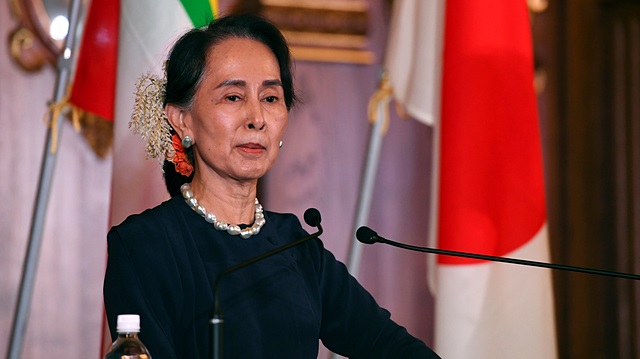
Myanmar's State Counsellor Aung San Suu Kyi
A Malaysian deputy prime minister on Friday criticized Myanmar leader Aung San Suu Kyi for inaction over the persecution of minority Muslim Rohingya in the country.
“I am sad that Aung San Suu Kyi has done little. We had hoped that she would intervene,” said Wan Azizah Wan Ismail after a meeting with EU foreign policy chief Frederica Mogherini at the 12th Asia-Europe Meeting (ASEM) summit in Brussels.
She said she has informed Mogherini that Malaysia received a large number of Rohingya refugees and was doing its best “to help” them.
The Rohingya, described by the UN as the world's most persecuted people, have faced heightened fears of attack since dozens were killed in communal violence in 2012.
Hours after Indian TV channels flashed that the country was deporting seven Rohingya Muslims to Myanmar, Sahidullah said he received a call from his nephew: "Uncle, please get us out of here. They will send us back too."Sahidullah, a Rohingya living in the far north of India after fleeing what he called persecution in Buddhist-majority Myanmar in 2010, said his relative, Sadiur Rahman, 40, was lodged in one of several detention centres for illegal immigrants in the distant northeastern state of Assam.Rahman, he said, had been incarcerated with his brother and eight other relatives since being caught in 2012 at a railway station as they fled to India via Bangladesh. Sahidullah had taken the same route two years earlier, but like many others had escaped detection.He said Rahman made the phone call when he was taken out for a routine medical checkup on Oct. 3, the day when India moved the seven Rohingya men out of a similar detention centre and took them to the border.India deports seven Rohingya despite global concernThey were handed to the Myanmar authorities the next day, the first ever such deportations of Rohingya here, spreading panic among an estimated 40,000 refugees who have fled to India from its neighbour.About 16,500 of the refugees, including Sahidullah, have been issued identity cards by the United Nations High Commissioner for Refugees (UNHCR) that it says helps them "prevent harassment, arbitrary arrests, detention and deportation".India says it does not recognise the cards and has rejected the UN's stand that deporting the Rohingya violates the principle of refoulement – sending back refugees to a place where they face danger."Anyone who has entered the country without a valid legal permit is considered illegal," said A. Bharat Bhushan Babu, a spokesman for the Ministry of Home Affairs. "As per the law, anyone illegal will have to be sent back. As per law they will be repatriated."In recent days, Reuters interviewed dozens of Rohingya in two settlements, one in the northern city of Jammu and a smaller one in the capital, Delhi, and found communities who feel they are being increasingly vilified.Many now fear Prime Minister Narendra Modi's Hindu nationalist government is about to act on its stated position – that it wants to deport all Rohingya Muslims from the country. With a general election due by next May, they worry that targeting them will be a populist tactic used by Modi and his ruling Bharatiya Janata Party (BJP).Addressing an election rally in the central state of Madhya Pradesh on Saturday, BJP chief Amit Shah said that all illegal immigrants were "like termites eating into the nation's security"."Elect us back next year and the BJP will not allow a single one of them to stay in this country," Shah said, without specifically mentioning any group of migrants.UN ‘concerned’ over India’s deportation of RohingyaHatred GrowingSahidullah – who like many Rohingya goes by only one name - is not just worried about his detained relatives but also his family living in a mainly Hindu region of India's only Muslim-dominated state, Jammu & Kashmir, in the country's northern tip.The restive Himalayan state that borders Pakistan and is home to Muslim separatists battling Indian rule, has the biggest population of Rohingya in the country with around 7,000 people scattered in various makeshift settlements, largely in the Jammu region."We came to India because people told us things were better here, there's more work and one could move freely unlike back home," said Sahidullah, who works as a cleaner at a car showroom in Jammu city to support his aging amnesiac mother, wife and four children."All that's true and we are thankful to India for letting us live here. But hatred against us is growing," he told Reuters as he sat on a colourful linen sheet laid on the floor of his self-made wood and plastic-sheet house built on a rented plot of land.UN says Rohingya children in need of basic educationMohammed Arfaat, a 24-year-old Rohingya youth leader in Jammu, said that locals often accuse them of having links with militants without any proof."They want us out of here and that has got our families worried," said Arfaat, switching between English and Hindi as nearly a dozen community elders seated around him on the rough concrete floor of a Rohingya house started leaving for Friday prayers. "Everybody here is aware of the deportation and is afraid."Indian authorities said that the repatriation of the seven was a routine procedure and that it sends all illegal foreigners back home.But the UNHCR voiced deep concern on Friday about the safety and security of those expelled, saying they had been denied access to legal counsel and a chance to have their asylum claims assessed."Current conditions in Myanmar's Rakhine state are not conducive for safe, dignified and sustainable return of stateless Rohingya refugees," said UNHCR spokesman Andrej Mahecic.Most Rohingya used to live in Rakhine.In August last year, attacks by Rohingya fighters on security posts in Rakhine led to a bloody military crackdown that caused around 700,000 Rohingya to flee across the border to Bangladesh.The United Nations has accused Myanmar of acting against the Rohingya with "genocidal intent," a charge Myanmar refutes, saying its military did not use excessive force and was reacting to militant attacks.Increasingly UglyThe atmosphere facing the Rohingya in India has been getting increasingly ugly.Jammu's Chamber of Commerce & Industry last year threatened to launch an "identify and kill movement" against the settlers, which it said pushed the government into taking the issue of Rohingya more seriously.The chamber's president, Rakesh Gupta, told Reuters on Friday that there was nothing new in taking the law into one's hands if "someone becomes a threat to our security, to the nation's security, and the security forces don't tackle them".In some of the more virulent parts of India’s media, the Rohingya are not only accused of being terrorists but also of trafficking in drugs and humans, and of having the money to elbow out local businesses.India's home ministry has told the Supreme Court that it had reports from security agencies and other authentic sources "indicating linkages of some of the unauthorised Rohingya immigrants with Pakistan-based terror organisations and similar organisations operating in other countries"."It's definitely an election issue,” said Kavinder Gupta, a BJP legislator in Jammu & Kashmir and former deputy chief minister of the state."It's our decision to throw them out keeping in mind the security situation of the state," he told Reuters on the sidelines of a campaign meeting for municipal elections. "We have made the home ministry aware of the need to send them back to their country."Senior Jammu police officials said on condition of anonymity that they had identified all Rohingya in the area in preparation for their eventual deportation. They added they had not found any link of Rohingya with militants.Around 600 km (370 miles) south of Jammu, residents of a makeshift refugee camp in Delhi's Shaheen Bagh also said they fear deportation."We don't want to leave India. Where will we go?" said Mohammed Harun, a 47-year-old Rohingya elder in Delhi. "There are refugees from other countries in India too. Why are we being targeted? Why do they send us to jail? It is only because we are Muslims. They don't do this to the other refugees."
India’s Rohingya refugees struggle with hatred, fear as first group is expelled
Since Aug. 25, 2017, nearly 24,000 Rohingya Muslims have been killed by Myanmar’s state forces, according to a report by the Ontario International Development Agency (OIDA).
More than 34,000 Rohingya were also thrown into fires, while over 114,000 others were beaten, said the OIDA report, titled "Forced Migration of Rohingya: The Untold Experience".
Some 18,000 Rohingya women and girls were raped by Myanmar’s army and police and over 115,000 Rohingya homes were burned down and 113,000 others vandalized, it added.
The United Nations refugee agency on Friday said it is "deeply concerned" over the forced deportation of the seven Rohingya refugees by the Indian government.In a news conference, Andrej Mahecic, a UNHCR spokesman, said the organization is expecting an explanation from the Indian authorities on the deportation of seven refugees to Myanmar.Mahecic said around 18,000 Rohingya Muslims -- who were registered to UNHCR -- are living as a refugee in India's several regions. The agency had issued IDs for the refugees to prevent their deportation or arrest."The context, as I said, of this return is worrying given what has been happening and the scope of the refugee crisis that we have seen unfolding in Myanmar, especially with more than 720,000 people fleeing toward Bangladesh and other countries in the area," he said.On Thursday, India deported seven Rohingya Muslims to Myanmar, hours after the country’s top court refused to stop the government from deporting them.The immigrants were detained in 2012 and since then they were kept at the Silchar central prison in Cachar district of Assam, the northeastern state of India.- Rohingya PersecutionSince Aug. 25, 2017, nearly 24,000 Rohingya Muslims have been killed by Myanmar’s state forces, according to a report by the Ontario International Development Agency (OIDA).More than 34,000 Rohingya were also thrown into fires, while over 114,000 others were beaten, said the OIDA report, entitled "Forced Migration of Rohingya: The Untold Experience".Some 18,000 Rohingya women and girls were raped by Myanmar’s army and police, and over 115,000 Rohingya houses were burned down and 113,000 others vandalized, it added.According to Amnesty International, more than 750,000 Rohingya refugees, mostly children and women, fled Myanmar and crossed into Bangladesh after Myanmar forces launched a crackdown on the minority Muslim community in August 2017.The Rohingya, described by the UN as the world's most persecuted people, have faced heightened fears of attack since dozens were killed in communal violence in 2012.The UN has documented mass gang rapes, killings -- including of infants and young children -- brutal beatings, and disappearances committed by Myanmar state forces. In a report, UN investigators said such violations may have constituted crimes against humanity.
UN ‘concerned’ over India’s deportation of Rohingya
According to Amnesty International, more than 750,000 Rohingya refugees, mostly children, and women, fled Myanmar and crossed into Bangladesh after Myanmar forces launched a crackdown on the minority Muslim community in August 2017.
The UN has documented mass gang rapes, killings -- including of infants and young children -- brutal beatings, and disappearances committed by Myanmar state forces. In a report, UN investigators said such violations may have constituted crimes against humanity.
Southeast Asian foreign ministers urged Myanmar to give a commission of inquiry into the violence in Rakhine state full mandate to hold those who are responsible accountable, Singapore said on Tuesday.The ministers, who met informally on the sidelines of the U.N. General Assembly last week, expressed grave concern over the violence, Singapore Foreign Minister Vivian Balakrishnan told parliament, calling it "man-made humanitarian disaster".Over the last year, more than 700,000 Rohingya Muslims have fled Buddhist-majority Myanmar to neighbouring Bangladesh, according to U.N. agencies, following a military response to attacks on security posts by Rohingya insurgents.U.N. investigators issued a report in late August accusing Myanmar's military of gang rapes and mass killings with "genocidal intent" in Rakhine and called for the country's commander-in-chief and five generals to be prosecuted under international law. Myanmar has denied most of the allegations in the report, blaming Rohingya "terrorists" for most accounts of atrocities.US urges Myanmar to hold security forces accountable in Rohingya crackdown"We expressed our grave concern with these alleged acts of violence... This is a man-made humanitarian disaster and something which should not be happening in this day and age," Balakrishnan said, referring to the meeting of the 10-member Association of Southeast Asian Nations, which includes Myanmar."The foreign ministers urged the Myanmar government that...an independent commission of inquiry...should be given a full mandate to investigate and to hold all those responsible fully accountable."Myanmar established a commission of inquiry to probe allegations of human rights abuses in Rakhine in July which includes two local and two international members from Japan and the Philippines.Canada revokes honorary citizenship of Myanmar leaderASEAN, formed more than half a century ago, has historically struggled with challenges facing the region because it works only by consensus and is reluctant to get involved in any matter deemed to be internal to any of its members.Its recent joint statements on Rakhine have focused on the importance of the repatriation of displaced persons to Myanmar and reconciliation among communities.But amid the international condemnation, it appears to be taking a firmer stance on Rakhine.Balakrishnan said that if left to "fester", the situation in Rakhine could lead to the spread of terrorism which would threaten "Southeast Asia and beyond".UN sets up team to prepare Myanmar prosecution files"They (the Myanmar government) do need to do the right thing...for all the vulnerable, defenceless and innocent victims," said Balakrishnan."It is also a salutary warning to all of us in Southeast Asia - race, language and religion are live issues and can always be exploited for short-term political gains but unfair share of the burden and of the injuries are sustained by defenceless people."Singapore chairs ASEAN this year and its leaders will meet next month in the city-state.Malaysia calls on UN to act on Rohingya atrocitiesUS urges Myanmar to hold security forces accountable in Rohingya crackdown
ASEAN urges Myanmar to give inquiry into Rakhine violence full powers