

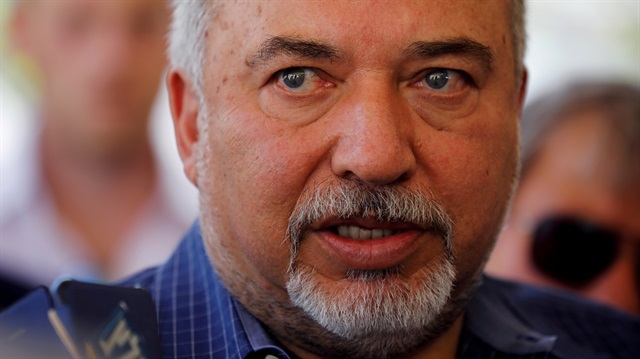
Israeli defense minister Avigdor Lieberman
Israeli Defense Minister Avigdor Lieberman on Friday threatened to escalate against Gaza-based Palestinian resistance group Hamas now that last month’s Jewish holidays have ended.
"The holiday month has gone exactly as we planned -- without any confrontations or heavy losses among the rioters on the Gaza border," Lieberman tweeted.
עברנו את חודש חגי תשרי בדיוק כפי שתכננו, ללא התלקחות ותוך גביית מחיר כבד מהמתפרעים בגבול עזה. 'אחרי החגים' הגיע. ואני אומר לראשי החמאס: 'קחו את זה בחשבון'.
תודה לחיילי צה"ל. שבת שלום
"Now that the post-holiday period has come, I tell Hamas leaders to take this into consideration," he added.
In September, Jews celebrated the Sukkot, Yom Kippur and Jewish New Year holidays.
On Thursday, Lieberman ordered the Israeli army to "maintain maximum vigilance" along the Gaza-Israel buffer zone, Israeli daily Yedioth Ahronoth reported.
Lieberman reportedly gave the command at a closed-door meeting with senior military officers, including Army Chief-of-Staff Gadi Eizenkot.
He also reportedly told the army to prepare for “any possible scenario”.
The Israeli defense and education ministers exchanged blows on Tuesday over the government’s policy toward the blockaded Gaza Strip.Education Minister Naftali Bennett described Avigdor Lieberman’s policy toward the Palestinian territory as “weak”, calling for adopting a “right-wing” iron policy in dealing with Palestinian group Hamas, which rules Gaza.“His policy is weak and leftist,” Bennett, the leader of the right-wing Jewish Home party, told the Israeli Broadcasting Authority.“Hamas is becoming increasingly rude and the time has come for a right-wing iron policy "he said.Israel denies mediation on Hamas prisoner swap dealLieberman, for his part, denied the accusations, going on to accuse Bennett of telling lies.“Bennett is completely lying,” he said. “I have always said that I do not believe in any arrangement with Hamas.”“The minister of education does not speak a single word about education, and obviously, this does not interest him," Lieberman added.Gaza has been reeling under a crippling Israeli blockade since 2007 when Hamas seized control of the seaside enclave from rival group Fatah.Israel arrests 21 Palestinians in West Bank raidsSince March, more than 180 Palestinians have been killed and thousands more injured by Israeli army fire during anti-occupation protests along Gaza border.Protesters demand the “right of return” to their homes in historical Palestine from which they were driven in 1948 to make way for the new state of Israel.They also demand an end to Israel’s 11-year blockade of the Gaza Strip, which has gutted the coastal enclave’s economy and deprived its two million inhabitants of basic commodities.
Israeli ministers trade barbs over Gaza
Israel has denied reports about Norwegian mediation to reach a prisoner swap deal with Palestinian group Hamas, according to Israeli daily Yediot Aharonoth on Tuesday."The report that Norway is mediating the deal regarding the POWs and MIAs [missing in action] is incorrect," an Israeli source said.Lebanese daily al-Akhbar on Monday reported that Norway was mediating between Hamas and Israel to reach an agreement on the return of Israeli soldiers held captive in the Gaza Strip.The newspaper claimed that a Norwegian envoy had visited Gaza last month and received a “positive response” from Hamas.There was no comment from Hamas on the report.In April, the Ezzeddin al-Qassam Brigades, the military arm of Hamas, said it was holding four Israeli soldiers, without elaborating on their condition.UNRWA employees strike over downscaling plansUS enforces $38bln military aid package to help Israel fight ‘Iran-sponsored terrorists’Israel arrests 21 Palestinians in West Bank raids
Israel denies mediation on Hamas prisoner swap deal
For the last six months, Palestinians in the Gaza Strip have staged almost-daily demonstrations along the heavily-fortified buffer zone.
Since the demonstrations began on March 30, more than 190 Palestinians have been martyred -- and thousands more injured -- by Israeli troops deployed along the other side of the buffer zone.
Protesters demand the “right of return” to their homes and villages in historical Palestine, from which they were driven in 1948 to make way for the new state of Israel.
They also demand an end to Israel’s 12-year-long blockade of Gaza, which has gutted the coastal enclave’s economy and deprived its roughly two million inhabitants of many basic commodities.
The Israeli army on Thursday announced plans to bolster its troop presence along the Gaza-Israel buffer zone, which for the last six months has seen almost-daily rallies by Palestinians.“It was decided to reinforce our forces in the Southern Command Area [i.e., near the blockaded Gaza Strip] within coming days,” an Israeli army statement read.According to the statement, the decision was taken based on a recent situation assessment conducted by Army Chief-of-Staff Gadi Eizenkot.The statement goes on to assert that the army views Hamas -- which has governed the Gaza Strip since 2007 -- as being responsible “for everything happening in and originating from” the blockaded coastal enclave.For the last six months, thousands of Palestinians in Gaza have taken part in almost-daily demonstrations along the heavily-fortified buffer zone.Since the demonstrations began on March 30, scores of Palestinians have been martyred near the buffer zone -- and thousands more injured -- by Israeli army gunfire.Protesters demand the “right of return” to their villages in historical Palestine from which they were driven in 1948 to make way for the new state of Israel.They also demand an end to Israel’s 12-year-long blockade of Gaza, which has gutted the territory’s economy and deprived its roughly two million inhabitants of many basic commodities.Israeli army rounds up 13 Palestinians in West Bank raidsHamas Gaza leader to Israeli press: 'I don't want war'US preparing Israel for war
Israel to send reinforcements to Gaza buffer zone
Yahya Sinwar, Hamas’s leader in Gaza, has told Israeli daily Yedioth Ahronoth that he does not want another war with Israel.“A new war is in no one's interest; it’s certainly not in our interest. Who really wants to confront a nuclear superpower with four slingshots?” Sinwar said in an interview with the newspaper.“War doesn't achieve anything,” he added.Sinwar went on to say he had decided to give an interview -- to an Israeli newspaper no less -- because he now sees “a true opportunity for change”.The interview was conducted by a Jewish journalist holding dual Israeli-Italian nationality.Journalist Francesca Borri spent five days in the Gaza Strip, where she conducted Sinwar's first interview ever as Hamas leader in Gaza with an Israeli media outlet.US preparing Israel for warBorri wrote after conducting the interview: “When I tell people I met Sinwar, the first question I'm asked is, ‘Where did you meet? Inside a tunnel? In a secret bunker deep underground?’ No, I reply. Most of our meetings were in his office in Gaza City.”The full text of the interview will be published -- in Yedioth Ahronoth and Italian daily La Repubblica -- on Friday.Asked whether he wanted to continue fighting Israel, Sinwar replied: “I'm not saying I won't fight anymore. I'm saying I don't want any more wars.”“What I want is an end to the siege [of the Gaza Strip]. My first commitment is to act in the interest of my people; to protect them and defend their right to freedom and independence,” he said.According to Sinwar, Israel -- which has imposed the siege for the last 12 years -- is to blame for the recent escalations along the Gaza-Israel buffer zone.“The responsibility lies with those who sealed the borders -- not those who have tried to reopen them,” he said.Video: Palestinian boy martyred in northern Gaza Strip“My responsibility is to cooperate with anyone who can help us put an end to the siege,” he added. “In the current situation, an explosion is inevitable.”In regards to recent ceasefire talks between Hamas and Israel, Sinwar said: “The agreement doesn't exist yet, but Hamas -- and almost all the other Palestinian factions -- are willing to sign and honor it.”“But at the moment, there's only the [Israeli] occupation,” he added. “It's important to make it clear: If we're attacked we will defend ourselves, as always. And we will have another war.”Sinwar also stressed the need for an extensive prisoner exchange in any future agreement with Israel, describing this as “absolutely vital”.“This isn't a political question; it's a moral question. I see it as an obligation. I'll do whatever it takes to secure the release of anyone who is still in prison [i.e. Palestinians in Israeli custody],” he said.Hamas, meanwhile, has yet to officially comment on the assertions made in the interview.
Hamas Gaza leader to Israeli press: I don't want war
Israel’s internal security agency, Shin Bet, said Wednesday that a three-member Hamas cell was arrested in the occupied West Bank for allegedly plotting attacks.In a statement, Shin Bet said Issa Shaladeh, 21, and Omar Mas’ud, 20, had been detained on suspicion of being recruited by the Qassam Brigades, Hamas’ armed wing.It claimed that the pair had planned to carry out attacks against Israelis and to aid in the transfer of funds to the Palestinian group.A third Palestinian, who was identified as 24-year-old Hazem Hamayel, a resident of the northern West Bank, was also arrested for allegedly contacting a Hamas official in Gaza “to organize terror attacks in Israel”, the statement said.There was no comment from Hamas, which rules the Gaza Strip, on the Israeli claim.Every now and then, Israeli authorities announce the arrest of Hamas-linked cells for alleged attack plot against Israeli targets in the West Bank.Israel designates Hamas as a “terrorist” group and has imposed a crippling blockade on Gaza since the Palestinian group seized control of the seaside enclave in 2007.Israel detains 7 Palestinians in West Bank raidsPalestinians appeal to Merkel to save Bedouin hamletIsraeli PM to be grilled on graft allegations on FridayIsrael slowly encroaching all of Jerusalem
Israel claims to arrest Hamas cell over attack plot
The holy city of Jerusalem, which Salahuddin al-Ayyubi salvaged from the invasion of the Crusaders 831 years ago, is falling completely into Israel's hands as a result of persistent judaization policies.Jerusalem, one of the oldest cities in history, has great importance for all three Abrahamic religions.It was first conquered in 638 by the second Muslim caliph, Umar bin al-Khattab. It was invaded by the Crusaders in 1099.Jerusalem encompassing the first qibla of Muslims, Masjid al-Aqsa, was reconquered by Ayyubi in 1187.Israel denies mediation on Hamas prisoner swap dealExcept for an 11-year occupation, the city remained under the control of Muslims until 1917 after Ayyubi's conquest.After the British invaded Jerusalem on Dec. 9, 1917, which till then had been under the control of the Ottoman Empire for 400 years, they turned a blind eye to Jewish settlements in the region.The Jewish population in the historic Palestinian territory in 1917 is said to be around 60,000.It ballooned to 800,000 in 1948, when Israel declared its independence.US enforces $38bln military aid package to help Israel fight ‘Iran-sponsored terrorists’According to the Palestinian sources, the Jewish population in Jerusalem in 1922 was approximately 34,000 while the Arab population was about 28,000.In 1946, the Jewish population in the city rose to 99,000 while the number of Palestinian Arabs remained 65,000.Israel declared it independence on May 14, 1948 whereas Arab countries including Egypt, Jordan, Lebanon and Syria waged a war against Israel on May 15, 1948.Israel, which won the war, began to implement its plan for judaizing the city by invading West Jerusalem.Israel arrests 21 Palestinians in West Bank raidsAfter the 1948 war, Israel invaded East Jerusalem and the West Bank during the six-day war in 1967.Israel declared the entire Jerusalem as its capital in July 3, 1980.In Dec. 6, 2017, U.S. President Donald Trump unilaterally recognized Jerusalem as "Israel's capital."The U.S. relocated its embassy to Jerusalem on May 14, 2018.Israel, which has built 19 illegal settlements in East Jerusalem since 1968, placed more than 200,000 Jews in these places.As of today, there are 316,000 Palestinians living in the city, which has a population of 850,000. The remaining people are Jews.The Israeli authorities are expanding Jewish settlements and also prevent Arab population in the city from building new houses.
Israel slowly encroaching all of Jerusalem