

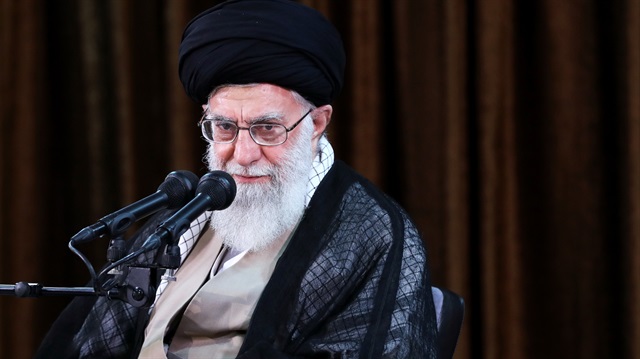
Iranian Supreme Leader Ali Khamenei
Iranian Supreme Leader Ayatollah Ali Khamenei on Thursday accused the United States and Israel of waging a media war to discourage Iranians, state TV reported, as the country faces economic hardship after the reimposition of U.S. sanctions.
"The goal of this media war is to create anxiety ... and pessimism among people towards each other and the authorities, and to exaggerate economic problems in the minds of the public," the television quoted Khamenei as saying, blaming the United States, Israel, and the Gulf Arab states.
Turkish President Recep Tayyip Erdoğan will travel to Iran’s Tehran on Friday to discuss Syria with his Iranian and Russian counterparts.Russia, an ally of Syrian President Bashar al-Assad, resumed air strikes in Idlib on Tuesday following weeks of bombardment and shelling by pro-Syrian government forces in an apparent prelude to a full-scale offensive against the oppositions' last major enclave.Turkey, which backs the opposition against Assad, has said an offensive on Idlib would be disastrous. Ankara is sheltering 3.5 million Syrian refugees.Russia says summit to help clarify military situation in Syria's IdlibSyrian opposition head calls on world to ‘stop the massacre’ in IdlibAssad regime shells Syria's IdlibErdoğan says Idlib assault would be ‘a grave massacre’UN envoy urges Erdoğan, Putin to discuss Idlib
Erdoğan to visit Iran for Syria summit
A first phase of U.S. sanctions banning the sale of dollars, gold and other precious metals to Iran has tangibly impacted the lives of the Iranian people, most notably through soaring commodity prices.Although the government is trying to reign in inflation by adopting a raft of policy measures, prices continue to rise daily, especially in the housing, automotive and imported-goods sectors. Acute shortages of diapers and sanitary napkins have caused particular concern among many Iranians. At a recent meeting with President Hassan Rouhani and members of his cabinet, Supreme Leader Ayatollah Ali Khamenei asserted that Iran’s “enemies” had orchestrated the “diapers crisis” with a view to sowing anger among the Iranian people.Iran rial hits record low around 146,000 against dollarEarlier, Ahmad Jannati, chairman of Iran’s Assembly of Experts, a deliberative body, addressed the crisis during a session of parliament. In an interview with the Iranian Labor News Agency, Seyed Hassan Dokmehchi, head of the Iranian Drugstore Union, said 10 diaper factories had recently closed in Iran due to a lack of raw materials caused by the re-imposition of U.S. sanctions.According to the Tasnim News Agency (affiliated with Iran’s Revolutionary Guards, the price of one pack of 34 diapers recently jumped from 500,000 Iranian rials (slightly less than $5) to a current 850,000 rials (over $8). In November, a second phase of U.S. sanctions banning the purchase of Iranian oil and gas is expected to come into effect.Will Trump's trade war spur the dollar’s decline?Observers fear that this will lead to further price hikes for many basic commodities, including foodstuffs and medicine, the brunt of which will be borne by Iranian citizens.In mid-2015, Iran signed a landmark nuclear deal with the P5 1 group of nations (the five permanent UN Security Council members plus Germany).The agreement placed tight restrictions on Iran's nuclear program in exchange for billions of dollars in sanctions relief.In May of this year, however, U.S. President Donald Trump unilaterally withdrew his country from the agreement in a move heavily criticized by the deal's European signatories.Washington then re-imposed sanctions on Iran, which primarily target the country’s banking sector.
Iranian citizens feel sting of US sanctions