

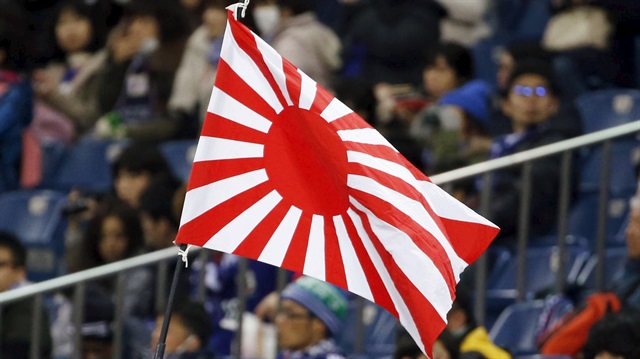
The 'Rising Sun' flag is a war-crime flag that the 20th-century Japanese imperialists used when executing their barbaric invasions into our nation and other Asian nations
Japan has decided not to take part in an international fleet review in South Korea next week after Seoul effectively asked Tokyo not to fly its "Rising Sun" flag on a warship, Japan's defence minister said on Friday, the latest spat between the two sides.
Japan's relations with both South and North Korea have long been strained by lingering resentment over its 1910-45 colonisation of Korea, territorial rows and the issue of Korean girls and women forced to work in Japan's wartime brothels.
Japan's decision comes after South Korea this week asked participating countries not to fly flags at the bow or at the stern of their vessels, Defence Minister Takeshi Iwaya told reporters.
"When it comes to the Maritime Self-Defence Force ensign, domestic laws and regulations stipulate that it must be hoisted at the stern," Iwaya said. "Regrettably, we have reached a decision that we cannot help forgoing the participation."
Many people in both Koreas see the red-and-white flag as a symbol of Japan's past military aggression and its colonisation.
"The 'Rising Sun' flag is a war-crime flag that the 20th-century Japanese imperialists used when executing their barbaric invasions into our nation and other Asian nations," North Korea's state-controlled Uriminjokkiri website said.
"Planning to enter flying the 'Rising Sun' flag is an unbearable insult and ridicule to our people."
In South Korea, articles about the controversy are among the most widely read on social media, with the president's office receiving 250 petitions for the Japanese ship to be barred.
On Friday, the South Korean Navy said Japanese naval ships flew the ensign when they participated in fleet reviews in 1998 and 2008, but it had asked all ships at this year's event to display national flags and the South Korean flag.
The "Rising Sun" ensign, used by the Japanese Imperial Navy in campaigns around Asia and the Pacific before and during World War Two, was adopted by the Maritime Self-Defence Force in 1954.
Variations of the flag are used by the Ground Self-Defence Force and on the fatigues of some Japanese sailors, but some South Koreans liken it to Nazi symbols such as the swastika.
Asian stocks fell on Tuesday as the lift from an agreement that saved the North American free trade deal faded, with cautious views on the global economy curbing risk sentiment.MSCI's broadest index of Asia-Pacific shares outside Japan fell 1.3 percent after a steady start.Australian stocks lost 0.7 percent and South Korea's KOSPI fell 0.9 percent.Bucking the overall trend, Japan's Nikkei added 0.1 percent, after rising as much as 0.8 percent to a new 27-year intra-day high of 24,448.07.Spreadbetters expected a weaker tone in European equities, forecasting a lower open for Britain's FTSE, Germany's DAX and France's CAC.China's financial markets are closed for the week of Oct. 1-5 for national holidays.Hong Kong's Hang Seng, which did not trade on Monday due to a holiday, dropped 1.9 percent in reaction to signs of weakness in the Chinese manufacturing sector shown in purchasing managers' index (PMI) numbers released on Sunday."While news that the U.S. and Canada had struck a new NAFTA trade deal gave the S&P 500 a lift overnight, dark clouds are gathering," strategists at OCBC Bank wrote in a note."With some signs of weakness in the European and Asian manufacturing PMIs Asian, markets may trade with a slightly more cautious tone."IHS Markit purchasing managers' indices released on Monday showed manufacturing growth in the euro zone slowed to a two-year low at the end of the third quarter.European shares rise as Nafta deal hopes lift sentimentThe United States and Canada forged a last-minute deal on Sunday to salvage NAFTA as a trilateral pact with Mexico, rescuing a $1.2 trillion open-trade zone that had been about to collapse after nearly a quarter century in operation.The Dow rose 0.73 percent and the S&P 500 gained 0.36 percent on Monday after the deal to preserve NAFTA helped ease trade worries."There were concerns that the resulting confusion would exceed that of the U.S.-China trade row if NAFTA was scrapped. While it appears like Canada and Mexico caved in to the United States, the outcome is positive for global trade and the economy," said Yoshihisa Maruyama, chief market economist at SMBC Nikko Securities in Tokyo.The Canadian dollar traded at C$1.2815 per dollar after rallying to a four-month high of C$1.2782 overnight following the trilateral trade pact.The euro was little changed at $1.1543 after slipping 0.25 percent on Monday on renewed concerns about heavily-indebted Italy's budget.The single currency has been hurt by concerns that a significant increase in the Italian budget will deepen Italy's debt and deficit problems.The dollar was at 113.845 yen after scaling an 11-month high of 114.06 yen on Monday, as improving investor risk sentiment weighed on the Japanese currency.The yen is usually seen as a safe haven at times of turmoil but recedes when risk appetite returns.The dollar index against a basket of six major currencies rose 0.2 percent to 95.462, its highest since Sept. 10.The greenback drew support from an uptick in U.S. Treasury yields as Wall Street gains curbed demand for safe-haven debt.In commodities, U.S. crude futures were up 0.4 percent at $75.60 a barrel.Crude contracts surged nearly 3 percent to $75.77 a barrel on Monday, their highest since November 2014, as the deal to salvage NAFTA stoked economic growth expectations, with impending U.S. sanctions on Iran seen raising prices.Brent crude edged up 0.1 percent to $85.07 a barrel after rallying 2.7 percent the previous day to a $85.45, highest since November 2014.Canadian dollar, stocks rise as NAFTA salvaged
Asia stocks slip as NAFTA lift fades; oil near 4-year highs
Prior to Iwaya's comment, Japan's top-ranking uniformed officer had signalled he was putting his foot down on the issue.
"Hoisting of the Maritime Self-Defence Force ensign is required by law," Katsutoshi Kawano, the chief of staff of the Self Defence Forces, told reporters on Thursday.
"Members take pride in the ensign, and we will never go there with the flag unhoisted."
South Korea's foreign ministry had "conveyed our stance that the Japanese side should fully consider the Rising Sun flag's emotional connotation to our people," Foreign Minister Kang Kyung-wha said.
Japan was a key player in U.S.-led efforts to isolate and punish North Korea over its nuclear weapons and ballistic missiles.
Ties between the United States and North Korea have warmed since a summit in Singapore in June. U.S. Secretary of State Mike Pompeo said on Wednesday he was optimistic a visit to Pyongyang this weekend would bring progress towards North Korea's denuclearisation.
Japan and South Korea often trade barbs over disputed islands known as Takeshima in Japan and Dokdo in Korea.
Announcing Japan's decision not to participate in the fleet review, Iwaya said that defence cooperation between Tokyo and Seoul remains extremely important.
The Japanese envoy to Turkey on Thursday said he was “mesmerized” by the “magnificent” city of Antalya.Akio Miyajima, who visited Antalya’s Governor at his office, said: Antalya is a magnificent city, I recommend all Japanese people to spend their holidays in this city."“I also visited Antalya before to play golf and for a holiday. This city mesmerized me,” Miyajima said.“Turkey and Japan are ourists from 180 countries across the world converged to the Mediterranean coastal province from January to August.friends and supporting each other regardless of their geographical distance,” he added.Video: Düden Waterfalls in Turkey's Antalya mesmerizes visitorsRecently, Japanese Princess Akiko of Mikasa visited various sites in central Anatolia, including Istanbul and Ankara, during her visit to Turkey on Sept. 9-14.Antalya is well-known for hosting tourists from home and abroad as the official data shows that more than 9 million tourists visited the holiday resort city of southern Turkey in the first eight months of 2018.Tourists from 180 countries across the world converged to the Mediterranean coastal province from January to August.
Japanese envoy ‘mesmerized’ by Turkey’s Antalya