

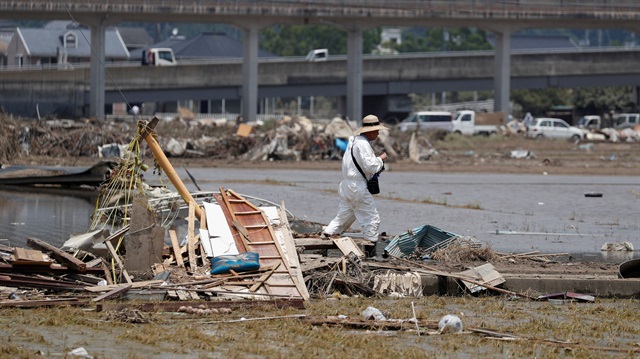
A local resident walks in a flooded area in Mabi town in Kurashiki, Okayama Prefecture, Japan, July 13, 2018.
Municipal workers in Japan struggled on Friday to restore water supply in the flood-hit western region a week after inundation caused by a record downpour killed more than 200 people in the worst weather disaster in 36 years.
Communities that grappled with rising floodwaters last week now find themselves battling scorching summer temperatures well above 30 degrees Celsius (86°F), as foul-smelling garbage piles up in mud-splattered streets.
"We need the water supply back," said Hiroshi Oka, 40, a resident helping to clean up the Mabi district in one of the hardest-hit areas, the city of Kurashiki, where more than 200,000 households have gone without water for a week.
"What we are getting is a thin stream of water, and we can't flush toilets or wash our hands," he added, standing over a 20-litre (4.4-gallon) plastic tank that was only partly filled after almost four hours of waiting.
Intense heat and water shortages raised fears of disease outbreaks in flood-hit western Japan on Thursday as the death toll from the worst weather disaster in 36 years neared 200.More than 200,000 households had no water a week after torrential rains caused floods and set off landslides across western Japan, bringing death and destruction to decades-old communities built on mountain slopes and flood plains.The death toll rose to 195, with several dozen people still missing, the government said on Thursday.'You are my very heart': Wife of diver who died in Thai cave mourns a heroWith daily temperatures above 30 Celsius (86 Fahrenheit) and high humidity, life in school gymnasiums and other evacuation centres, where families spread out on mats on the floors, began to take a toll.Television footage showed one elderly woman trying to sleep by kneeling with her upper body on the seat of a folding chair, arms over her eyes to keep out the light.With few portable fans in the evacuation centres, many survivors tried to cool themselves with paper fans.German FM: ‘We are not captives’ of Russia or USThe limited water supply meant that people are not getting enough fluids and in danger of suffering from heatstroke, authorities said. People are also reluctant to use what water they do have to wash their hands, raising fears of epidemics."Without water, we can't really clean anything up. We can't wash anything," one man told NHK television.The government has sent water trucks to the disaster area, but supplies remain limited.More than 70,000 military, police and firefighters toiled through the debris in a grim search for the missing.Some teams shovelled dirt into sacks and piled the bags into trucks. Others used diggers and chainsaws to work through landslides and splintered buildings.Many areas were buried deep in mud that smelled like sewage and had hardened in the heat, making the search more difficult.Disasters set off by torrential rains have become more frequent in Japan, perhaps due to global warming, experts say. Dozens of people died after similar rains caused flooding around the same time last year."It's an undeniable fact that this sort of disaster due to torrential, unprecedented rain is becoming more frequent in recent years," Chief Cabinet Secretary Yoshihide Suga said at a news conference in Tokyo."Preserving the lives and peaceful existence of our citizens is the government's biggest duty. We recognize that there's a need to look into steps we can take to reduce the damage from disasters like this even a little bit," he added.
Japan flood toll nears 200, sun scorches thousands battling thirst
Water supply has been restored to some parts of the district, a city official told Reuters, but he did not know when normal operation would resume, as engineers are still trying to locate water pipeline ruptures.
The soaring temperatures have fuelled concern that residents, many still in temporary evacuation centres, may suffer heat strokes or illness as hygiene levels deteriorate.
Public broadcaster NHK has spread advice on coping with high temperatures and maintain hygiene, such as a video tutorial on how to make a diaper from a towel and plastic shopping bag.
More than 70,000 military, police and firefighters have fanned out to tackle the aftermath of the floods. There have been 204 deaths, the government said, with dozens still missing.
Chief Cabinet Secretary Yoshihide Suga, the government spokesman, urged people in flood-hit areas to take precautions against the heat, and guard against thunderstorms.
"People still need to be aware of the possibility of further landslides," he told a regular news conference on Friday.
Severe weather has increasingly battered Japan in recent years, including similar floods last year that killed dozens of people, raising questions about the impact of global warming.
Prime Minister Shinzo Abe, who cancelled a scheduled overseas trip to deal with the rescue effort, visited Kurashiki on Thursday, and said he aimed to visit other flood-damaged areas on Friday and over the weekend.