

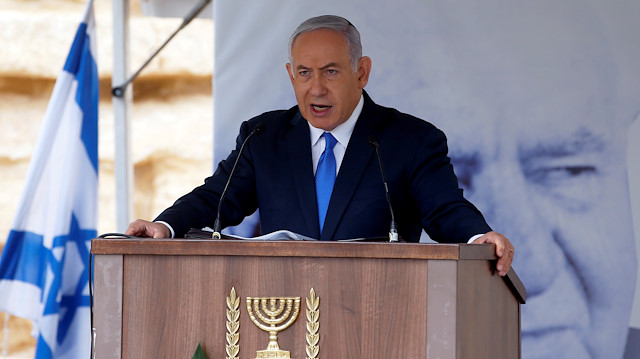
Israeli Prime Minister Benjamin Netanyahu
Scores of Israelis rallied outside the Knesset (Israel’s parliament) in Jerusalem on Wednesday to call for the resignation of Prime Minister Benjamin Netanyahu over a cease-fire deal with Gaza-based Palestinian factions.
Protesters denounced Netanyahu’s decision to approve the Gaza cease-fire deal, amid accusations for him of “betraying the people of southern Israel”.
The protest came one day after Palestinian resistance factions in Gaza announced an Egypt-brokered cease-fire agreement with Israel.
Israeli Defence Minister Avigdor Lieberman was due to make a public statement on Wednesday and a source close to the far-right politician said he may announce his resignation over the government's policy towards the Gaza Strip."He is thinking of quitting," the source told Reuters, after Lieberman's office said he had opposed a security cabinet decision on Tuesday to stop attacks in Gaza, where a ceasefire agreed by Palestinian armed groups ended a two-day surge in fighting.Israel's Haaretz newspaper reported sources close to Lieberman saying that he does intend to step down and has been planning the move for some time, feeling he "isn't leading the defence establishment to the place he wants to go".Lieberman's departure would probably also mean withdrawing his Yisrael Beiteinu party from the ruling coalition. Without its five seats in the 120-member parliament, Prime Minister Benjamin Netanyahu would be left with a majority of just a single seat. That could prompt Netanyahu to consider bringing forward a national election slated for November 2019.Lieberman's office said he would address media at 1100 GMT after convening a special session of his party. A Lieberman spokesman declined to comment on the content of his planned announcement.Lieberman has spoken in favour of harsh Israeli military action in the Gaza Strip, even as the government authorised a Qatari cash infusion to the impoverished enclave last week and, on Tuesday, accepted the Egyptian-mediated truce that halted Palestinian rocket attacks and Israeli air strikes.Lieberman, a former foreign minister, received the defence portfolio in May 2016. Despite his hawkish talk on Gaza, he has been criticised by another far-right party within the coalition, the Jewish Home, as easily swayed by a cautious military brass.Born in the former Soviet Union, Lieberman's voter base is made up of fellow Russian-speaking immigrants, and rightists and secularists who share his hostility to Israel's Arab minority and the religious authority wielded by ultra-Orthodox Jewish parties. 
Israeli defense minister to make statement, may quit over Gaza
Four Israeli ministers, however, have announced their opposition to the deal, including Defense Minister Avigdor Lieberman.
The agreement came after at least 14 Palestinians were killed in Israeli attacks in the blockaded Gaza Strip since Sunday after rocket fire from the seaside territory.
At least one Israeli soldier was reportedly killed and another injured in the violence.
Since March 30, more than 200 Palestinians have been martyred by Israeli army gunfire -- and thousands more injured -- while taking part in ongoing rallies along the Gaza-Israel buffer zone.
Israeli settlers vandalized a Palestinian vehicle in a suspected “price tag” attack in the Israeli-occupied West Bank on Wednesday, according to a local Palestinian official.“Settlers attacked the car in the village of Urif, south of Nablus, and sprayed racist slogans on it,” Ghassan Daghlas, a Palestinian official responsible for tracking Israeli settlement activity in the area, told Anadolu Agency.He said settlers have recently stepped up their attacks as Palestinian farmers began to harvest their olive crops."Price tag" vandalism is a strategy used by extremist Jewish settlers to attack Palestinians and their property in retaliation for perceived threats to Israeli settlement expansion.According to Palestinian figures, more than 700,000 Jewish settlers now live on 196 settlements (built with the Israeli government’s approval) and more than 200 settler outposts (built without its approval) across the occupied West Bank.International law views the West Bank and East Jerusalem as "occupied territories" and considers all Jewish settlement-building activity on the land to be illegal.Jewish religious candidate elected Jerusalem's mayorGaza resistance factions announce ceasefire with IsraelHamas: We taught Israel a ‘serious lesson’
Settlers vandalize Palestinian vehicle in West Bank
A religious Jewish candidate won election as mayor of Jerusalem on Wednesday in a run-off against a secular contender for a post that shapes Israel's rule over the holy city at the heart of its conflict with the Palestinians.Moshe Lion, a skullcap-wearing bureaucrat favored by two key members of Prime Minister Benjamin Netanyahu’s rightist cabinet, defeated Ofer Berkovitch, the 35-year-old deputy mayor, after neither took enough votes in a five-man contest two weeks ago to win outright.Nearly final results after Tuesday's run-off gave Lion close to 52 percent of the vote.Israel reportedly restricting tourist visas for TurksThe ballot was held as part of nationwide Israeli municipal elections in which many candidates run as independents or on non-traditional party lists, making it difficult to gauge any broader political impact from the results.While Netanyahu’s own approval ratings are strong, a senior member of his party and cabinet who ran for Jerusalem mayor with his blessing, Zeev Elkin, came in third in the first round of the poll.Conspiracies plotted against Palestinian cause: AbbasThe Jerusalem vote was largely boycotted by Palestinians who make up a third of the city’s population. They live in East Jerusalem, which Israel captured in the 1967 Middle East war and annexed in a move that has not won international recognition.Many Jerusalem Palestinians complain of entrenched neglect by the Israeli municipality. A Palestinian candidate who bucked the boycott by running for the administrative Jerusalem City Council failed to garner enough votes to get in. Both Lion and Berkovitch had vowed to appeal to all sectors of the city, 21 percent of its Jewish population is secular and another 43 percent are religiously traditional and 36 percent are ultra-Orthodox. Jewish settlers damage Palestinian property in West BankJewish settlers converge on J'lem's Aqsa Mosque complex
Jewish religious candidate elected Jerusalem's mayor