

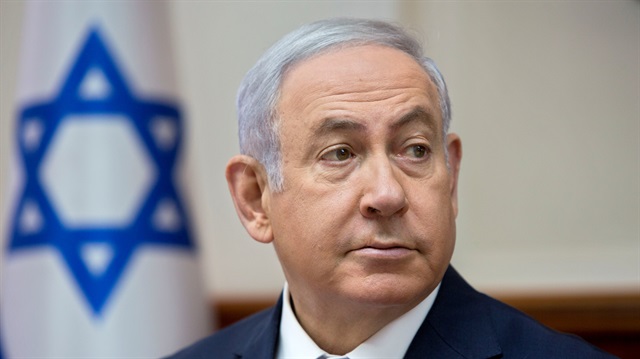
Israeli Prime Minister Benjamin Netanyahu
Israeli Prime Minister Benjamin Netanyahu on Wednesday warned Iran of a military response if it attempts to close the key Bab al-Mandab Strait on the Red Sea.
“If Iran tries to close Bab al-Mandab, I’m sure it will face a strong coalition which will prevent it,” Netanyahu said at a graduation ceremony of naval officers in the northern city of Haifa.
“Israel will be in that coalition too,” he said, but did not specify the other countries that would be part of it.
He said the sea provides Israel with many opportunities, and Israeli ships were able to reach a vast area thanks to it.
Israel committed at least 90 “violations” against Palestinian journalists last month, a U.K.-based NGO that advocates for press freedom said Wednesday.According to the Journalist Support Committee, violations included acts of aggression that led to the injury of 28 journalists, 17 of whom had been covering Palestinian protests near the Gaza-Israel buffer zone.'Double standards of the Israeli judicial system'Over the same period, the NGO recorded another 11 injuries and acts of aggression in the Israeli-occupied West Bank.The NGO also registered four cases of prolonged detention, two cases of torture and at least one case of domestic confinement.Seventeen additional violations were registered in which journalists were prevented -- by various means -- from carrying out their journalistic responsibilities.Israel denies exit to hundreds of Gazans in 2018Last month, the Israeli authorities also designated the Lebanon-based Al-Quds television channel as a “terrorist group”.Four of the channel’s journalists were reportedly threatened by the Israeli authorities, while the homes of five others were raided.Last month, the total number of journalists now being held in Israeli prisons rose to 27, including two who suffer from serious medical conditions.According to Palestinian figures, as many as 6,500 Palestinians are currently languishing in Israeli prisons, including scores of women and some 350 minors.
Israel commits 90 breaches against journos in July: NGO
“This gives the state of Israel considerable power,” he added.
Last week, Saudi Arabia suspended crude oil shipments through the strategic Bab al-Mandab Strait after two of its oil tankers were allegedly attacked by Iranian-backed Houthi rebels off Yemen’s coast.
Following the attacks, an Iranian military commander warned that the Red Sea would “no longer be safe” for U.S. vessels amid an ongoing war of words between U.S. President Donald Trump and Iranian military officials.
An Israeli court this week sentenced Darin Tatour, a prominent Palestinian poet, to five months in jail after convicting her of “inciting terrorism” in a poem she posted on social media.Tatour, a 36-year-old resident of the northern Galilee region, was first detained by the Israeli authorities in 2015 for her poem entitled, “Resist, My People, Resist”.On Tuesday, she was sentenced to five months behind bars and six months’ probation after being convicted of “inciting violence” and “supporting a terrorist organization”.The poem that drew the Israeli authorities’ wrath reads in part:Resist them, my people, resistResist the settler’s robberyFollow the caravan of martyrsTear the constitution of shameThey burn the childrenResist them, my people, resistIt remains unclear whether Tatour plans to appeal Tuesday’s court sentence.Israeli court slaps Palestinian poet with jail termDouble standardsIn a Wednesday article, Israeli daily Haaretz appeared to criticize the double standards of the Israeli judicial system, which it accused of turning a blind eye to the incitement of violence by extremist rabbis and Jewish groups.The Israeli judicial system, Haaretz asserted, “cannot discriminate between offenders who commit similar offenses based on their ethnicity or religion”.The Israeli authorities, the newspaper goes on, appear to have “learned nothing” from their “resounding failure to mete out justice against rabbis who encourage ‘the heroes of the Jewish underground’ [i.e., extremist Jews who call for violence against non-Jews]”.The jail term received by Tatour, it added, “shows that what rabbis in Israel may do, an Arab poet may not”.“When it’s Jews [inciting violence], it’s an ‘underground’, not terrorism,” the newspaper states.Over 3,900 settlers stormed Al-Aqsa complex in JulyAccording to Haaretz, those who praised the “heroism” of Baruch Goldstein -- an extremist Jewish settler who killed 29 Muslim worshipers in the city of Hebron in 1994 -- “paved the way for the assassination the following year of [Israeli] Prime Minister Yitzhak Rabin”.Haaretz also cited a case from 2012 in which Israeli Attorney-General Yehuda Weinstein halted an investigation into the authors of “Torat Hamelekh”, a religious tract that discussed how Jewish religious law viewed the killing of non-Jews.Israel arrests 9 Palestinians in overnight raidsThe newspaper goes on to quote the doctrine of certain extremist rabbis -- verbatim -- who openly call for the murder of non-Jewish infants.“Even [when it comes to] babies who violate the seven Noahide commandments [that apply to non-Jews], consideration should be given to killing them due to the future danger that will be posed if they are allowed to grow up to be evil like their parents,” it reads, according to Haaretz.
'Double standards of the Israeli judicial system'
The remarks, made by Qasem Soleimani, commander of Iran’s elite Quds Force, come amid tensions between Tehran and Washington that have steadily mounted since Trump withdrew the U.S. from a 2015 nuclear deal between Iran and the West.
Senior Iranian officials on Tuesday rejected U.S. President Donald Trump's offer of talks without preconditions as worthless and "a humiliation" after he acted to reimpose sanctions on Tehran following his withdrawal from a landmark nuclear deal.Separately, Iranian President Hassan Rouhani said Trump's repudiation of the accord reached in 2015 was "illegal" and Iran would not easily yield to Washington's renewed campaign to strangle Iran's vital oil exports.In May, Trump pulled the United States out of the multilateral deal concluded before he took office, denouncing it as one-sided in Iran's favour. On Monday, he declared that he would be willing to meet Rouhani without preconditions to discuss how to improve relations.Iran's foreign ministry spokesman said Trump's offer to negotiate with Tehran contradicted his actions as Washington has imposed sanctions on Iran and put pressure on other countries to avoid business with the Islamic Republic.Iran MP calls for Tehran-US hotline to avoid escalation"Sanctions and pressures are the exact opposite of dialogue," Bahram Qasemi was quoted as saying by Fars news agency on Tuesday."How can Trump prove to the Iranian nation that his comments of last night reflect a true intention for negotiation and have not been expressed for populist gains?" he added.The head of the powerful Revolutionary Guards equally dismissed Trump's tentative offer, saying the Islamic Republic was not North Korea."Mr Trump! Iran is not North Korea to accept your offer for a meeting," Guards commander Major General Mohammad Ali Jafari was quoted as saying by Fars News agency. "Even U.S. presidents after you will not see that day."'Tehran sees no value in Trump's talks offer': Senior Iranian diplomatThe head of Iran's Strategic Council on Foreign Relations said on Tuesday Tehran saw no value in Trump's offer, made only a week after he warned Iran it risked dire consequences few had ever suffered in history if it made threats against Washington."Based on our bad experiences in negotiations with America and based on U.S. officials' violation of their commitments, it is natural that we see no value in his proposal," Kamal Kharrazi was quoted as saying by the semi-official Fars news agency.“Trump should first make up for his withdrawal from the nuclear deal and show that he respects his predecessors’ commitments and international law,” added Kharrazi, a former foreign minister.Kharrazi said Trump likes “meeting for the sake of meeting” and was not concerned about its results.Senior Iranian MP says it's not a good time for Iran-US talksThe Strategic Council on Foreign Relations was set up by Iranian Supreme Leader Ayatollah Ali Khamenei to help formulate long-term policies for the Islamic Republic.Trump's move to force Iran into fresh negotiations has for now reunited Iranian hardliners who opposed the nuclear deal and pragmatists like Rouhani who championed it to end the Islamic Republic's economically crippling stand-off with Western powers.Ali Motahari, the deputy speaker of Iran's parliament who is seen as part of Iran's moderate camp, said that to negotiate with Trump now "would be a humiliation"."If Trump had not withdrawn from the nuclear deal and not imposed (new) sanctions on Iran, there would be no problem with negotiations with America," he told state news agency IRNA.Tehran says Trump wrong to expect Saudis to cover loss of Iran oil supplyIran's interior minister chimed in that Tehran did not trust Washington as a negotiating partner. "The United States is not trustworthy. How can we trust this country when it withdraws unilaterally from the nuclear deal?" Abdolreza Rahmani Fazli was quoted as saying by the semi-official Fars news agency.A senior aide to Rouhani said the only way back to talks was for Washington to return to the nuclear agreement."Respecting the Iranian nation's rights, reducing hostilities and returning to the nuclear deal are steps that can be taken to pave the bumpy road of talks between Iran and America," Hamid Aboutalebi tweeted on Tuesday.Under the 2015 deal, the fruit of Rouhani's efforts to ease Iran's international isolation to help revive its economy, Iran curbed its shadowy nuclear programme and won relief from U.N. and Western sanctions in return.NUCLEAR PACT IN JEOPARDYTrump condemned the deal in part because it did not cover Iran's ballistic missile programme and involvement in Middle East conflicts. He reactivated U.S. sanctions, the most all-encompassing measures against Iran, and warned countries to stop importing Iranian oil from Nov. 4 or risk U.S. penalties.The three major European signatories to the 2015 deal have been searching for ways to salvage it but cautioned Tehran that they may not be able to persuade many major investors not to bolt from business with Iran to avoid U.S. punishment.Rouhani said during a meeting with Britain's ambassador on Tuesday that after what he called the "illegal" U.S. withdrawal from the nuclear deal, "the ball is in Europe's court now".He added, "The Islamic Republic has never sought tension in the region and does not want any trouble in global waterways, but it will not easily give up on its rights to export oil.”Rouhani and some senior military commanders have said Iran could disrupt oil shipments from Gulf states through the Strait of Hormuz if Washington tries to choke off Iranian oil exports.Reiterating Tehran's official stance, Iranian Navy Commander Rear Admiral Hossein Khanzadi was quoted as saying by Tasnim news agency on Tuesday that the strait would remain open "if Iran's national interests are preserved".Iran's OPEC governor, Hossein Kazempour Ardebili, told Reuters on Tuesday that Trump was mistaken if he expected Saudi Arabia and other oil producers to compensate for losses of Iranian oil caused by U.S. sanctions."It seems President Trump has been taken hostage by Saudi Arabia and a few producers when they claimed they can replace 2.5 million barrels per day of Iranian exports, encouraging him to take action against Iran,” Ardebili said."Now they and Russia sell more oil and more expensively. Not even from their incremental production but their stocks."He said oil prices, which Trump has been pressuring the Organization of the Petroleum Exporting Countries to bring down by raising output, will instead rise unless the United States grants waivers to buyers of Iranian crude.Iran’s currency plumbed new depths on Monday, dropping past 120,000 rials to the dollar, but Trump's expressed willingness to negotiate with Tehran sparked a minor recovery on Tuesday to 110,000 rials on the unofficial market.Iranian Vice-President Eshagh Jahangiri said the government and the central bank would unveil a new economic plan by the end of this week to tackle the U.S. sanctions and the rial's fall.Videos on social media showed hundreds of people rallying in Isfahan in central Iran, and Karaj near Tehran, in protest at high prices caused in part by the rial's devaluation under heightened U.S. pressure. 
Iran rejects Trump offer of talks as 'humiliation', without value
“Never, ever threaten the U.S. again or you will suffer consequences the likes of which few throughout history have suffered,” Trump recently told his Iranian counterpart Hassan Rouhani on Twitter.