

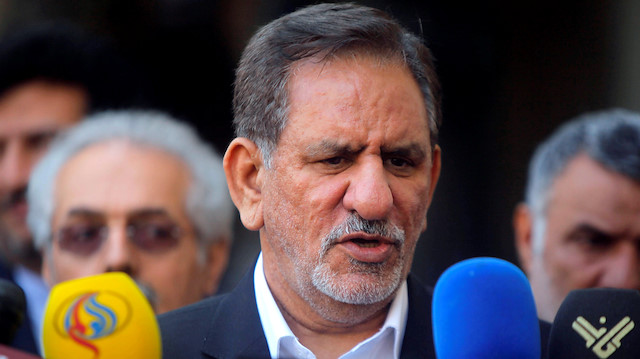
Iranian Vice President Eshaq Jahangiri
Iran has been able to sell as much oil as it needs despite U.S. pressure, Iranian Vice President Eshaq Jahangiri was quoted as saying on Tuesday.
The United States on Monday restored sanctions targeting Iran’s oil, banking and transport sectors and threatened more action to stop what Washington called its "outlaw" policies, steps Tehran called economic warfare and vowed to defy.
The measures are part of a wider effort by U.S. President Donald Trump to curb Tehran’s missile and nuclear programmes and diminish the Islamic Republic’s influence in the Middle East, notably its support for proxies in Syria, Yemen and Lebanon.
Global oil markets are currently stable, Kuwait's Oil Minister Bakhit al-Rashidi said on Tuesday, adding that he expects such stability to continue until the end of the year.Rashidi told reporters in Kuwait City that the upcoming OPEC meeting next month will look at whether the oil market needs more crude and if there is a build up in inventories.OPEC and its allies are set to meet in Vienna on Dec. 6-7 to decide their oil supply policy and agree a long-term mechanism to manage the market beyond 2018. US waiver allows China to buy 360,000 bpd of Iran oil for 180 daysTrump wary of sanctions effect on oil prices
Oil markets are stable: Kuwait oil minister
Trump’s moves target Iran’s main source of revenue - its oil exports - as well as its financial sector, essentially making 50 Iranian banks and their subsidiaries off limits to foreign banks on pain of losing access to the U.S. financial system.
"The Americans constantly said they would reduce the sale of Iran’s oil to zero but I have to say that so far, we have been able to sell our required amounts of oil," the Tasnim news agency quoted Jahangiri as saying.
"The Americans, with the help of propaganda, don't see the realities."
Turkey's foreign minister criticised on Tuesday the United States' renewal of sanctions on Iran's oil and shipping industries, saying it was dangerous to isolate Iran and unfair to punish its people, Anadolu news agency reported.Mevlüt Çavuşoğlu's comments to reporters in Japan came a day after the United States reimposed sanctions, abandoning a 2015 Iran nuclear deal, while temporarily allowing top customers including Turkey to keep buying crude from the Islamic Republic.Video: Turkish FM meets with Japanese Premier in TokyoSaudi Arabia should explain what happened to Khashoggi's bodySaudi Arabia bears responsibility to find out what happened to the body of Jamal Khashoggi, Çavuşoğlu said, reiterating Ankara's stance that it was not King Salman who ordered the killing.Turkey has further information which it will share when Ankara knows for sure that the investigation has been completed, he added.He also said it was not possible for a 15-man team to come to Turkey to kill a Saudi citizen without orders.Turkey has said that a 15-man security team flew in hours before the killing and carried it out. All these individuals, and three others, were arrested in Saudi Arabia.Khashoggi, a Washington Post columnist and critic of Saudi Arabia's Crown Prince Mohammed bin Salman, was killed inside the Consulate of Saudi Arabia in Istanbul after he went there to obtain documents for his forthcoming marriage.The Saudi government initially insisted Khashoggi had left the consulate, later saying he died in an unplanned "rogue operation". On Oct. 25, the kingdom's public prosecutor Saud Al Mojeb said the attack was premeditated.Istanbul chief prosecutor Irfan Fidan said last week that Khashoggi was suffocated as soon as he entered the consulate, and his body then cut up and disposed of. Turkey has demanded cooperation from Saudi officials.UK, Canada say urgent need to resolve Khashoggi murderTrump wary of sanctions effect on oil prices
Turkish FM says dangerous to isolate Iran
Jahangiri said he had spoken to a handful of managers from companies on the U.S. sanctions list and that some had already formulated plans on how to deal with the measures.
Jahangiri also said officials should be open with the Iranian public about the difficulties that may lie ahead, according to the Islamic Republic News Agency (IRNA).
"It is our duty to keep some of the worries to ourselves,” IRNA quoted Jahangiri as saying. "But there shouldn’t be an issue that is hidden from the people. This is the people’s right."
A U.S. waiver to sanctions on Iran allows China to buy 360,000 barrels per day (bpd) of oil from the Islamic Republic for 180 days, two sources familiar with the matter told Reuters on Tuesday.The waiver includes conditions, including requiring the disclosure of counter-parties and settlement methods, one of the sources said.China purchased an average of 655,000 bpd from Iran during the January-September period, according to Chinese customs data.Turkish FM says dangerous to isolate Iran
US waiver allows China to buy 360,000 bpd of Iran oil for 180 days
U.S. President Donald Trump said Monday he is cautious about the effects his sanctions will have on global oil markets, saying the penalties will be imposed gradually."I don’t want to drive the oil prices in the world up," he said addressing reporters shortly after the U.S. reinstated all of the sanctions it lifted as part of a nuclear accord world powers struck with Iran."I’m not looking to be a great hero and bring it down to zero immediately," he said, referring to global imports of Iranian oil. "I could get the Iran oil down to zero immediately, but it would cause a shock to the market. I don’t want to lift oil prices."The U.S. earlier announced that eight countries -- China, Greece, India, Italy, Japan, South Korea, Taiwan and Turkey -- are being granted temporary six month waivers from the economic penalties targeting imports of Iranian crude. Iran is OPEC's third largest oil exporter.US's Bolton says more sanctions on Iran comingSenior official says Iran not concerned about reimposed US sanctionsSecretary of State Mike Pompeo said the exemptions are intended to ensure oil markets continue to be well-supplied.Pompeo said each country which received waivers “has already demonstrated significant reductions of the purchase of Iranian crude over the past six months," adding two of the eight have reduced imports of Iranian crude to zero."We continue negotiations to get all of the nations to zero," he said.Trump unilaterally withdrew the U.S. from the 2015 Joint Comprehensive Plan of Action in May, setting the stage for Washington to reimpose all of the sanctions it lifted as part of the agreement.All of the other signatories -- China, the European Union, France, Germany, Iran, Russia and the United Kingdom -- have remained in the deal.The accord provided Iran with billions of dollars in relief from international sanctions in exchange for sweeping curbs on and inspections of its nuclear program.Airbus China CEO says 'no winner' from US-China trade war
Trump wary of sanctions effect on oil prices