

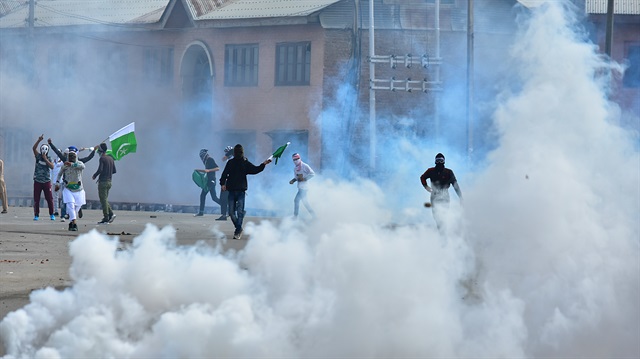
Anti India protest in Kashmir
The Indian Supreme Court on Friday adjourned the hearing of the case that challenges Kashmir’s permanent resident law till the second week of January, bringing temporary relief to the Kashmir’s citizens.
The representatives of the Indian central government and the Jammu and Kashmir government both asked the court for the case to be pushed back, saying it could trigger unrest and affect efforts to organize long-delayed local body elections in the region scheduled for the end of this year.
While the Supreme Court in Delhi heard the case on Article 35A on Friday, the Jammu and Kashmir region observed a complete shutdown for the second consecutive day.
Several argue that the Indian government wants to change the demography of the Muslim-majority region by tempering with the land ownership laws. The shutdown was called by the region's pro-Independence leadership.
Prime Minister Imran Khan said on Thursday that he would move the Organization of Islamic Council (OIC) to raise the matter of a Dutch anti-Islam cartoon contest in the United Nations.In a video message, the newly elected premier said: "This is not the issue of a single Muslim or country. This is the issue of every Muslim in the world."His message came as members of a religious party, Tehreek-i-Labbaik Pakistan (TLP), began a march to capital Islamabad vowing to continue a sit-in until the expulsion of the Dutch ambassador.Khan said the issue could not be addressed by expelling an ambassador but through a joint stand against the Dutch Freedom party leader Geert Wilders, mastermind of the contest, in the UN through the OIC.A government delegation led by Foreign Minister Shah Mehmood Qureshi is trying to persuade the protesters to end their march.Pakistani party protests Dutch cartoon contestHe added that a minority in the West was involved in Islamophobic and anti-Islam acts."This is our fault that we have failed to make them understand how important this issue is. How much it hurts us. Noble Prophet Mohammad lives in our hearts."Wilders, known for his anti-Islam stance, announced in June a contest to draw cartoons of Prophet Mohammad.The decision raised criticism across Muslim states, including Pakistan, as physical depictions of God or Prophet Mohammad are forbidden in Islam.Dutch politician calls off anti-Islam cartoon contest
Pakistan to raise anti-Islam cartoon issue in UN
Article 35A, which is under contention in the Indian Court, was incorporated in the Indian Constitution by a 1954 presidential order.
It confers special status to the permanent residents of Jammu and Kashmir, and bars people from outside the state from acquiring any immovable property in the state, thereby maintaining its Muslim-majority character.
Kashmir, a Muslim-majority Himalayan region, is held by India and Pakistan in parts and claimed by both in full. A small sliver of Kashmir is also held by China.
Since they were partitioned in 1947, the two countries have fought three wars -- in 1948, 1965 and 1971 -- two of them over Kashmir.
Talks between longtime rivals India and Pakistan on lingering water sharing disputes ended with no breakthrough on Thursday, local media reported.At the end of the two-day talks, Islamabad warned to go for international arbitration if New Delhi ignores its concern over several controversial projects.The much-awaited talks held in the northeastern city of Lahore marked the first diplomatic engagement with India by the new government in Pakistan.The nine-member Indian delegation was led by water commissioner Pradeep Kumar Saxena. Pakistan was represented by Mehr Ali Shah along with other senior officials.Pakistan is mainly objecting to the construction of two hydropower projects -- 1,000-megawatt (MW) Pakal Dul and 48-MW Lower Kalnal -- on the Chenab River by India .Islamabad views the construction of the projects a violation of the Indus Water Treaty, an objection New Delhi rejects. Under the treaty brokered by World Bank in 1960, the waters of the eastern rivers – the Sutlej, Beas, and Ravi – have been allocated to India, while the three western rivers – the Indus, Jhelum, and Chenab – to Pakistan. Initially, the two countries had signed a three-month water sharing “standstill agreement” in 1947; however, the issue remained a flash point between the two neighbors till the signing of the Indus Water Treaty.“We have categorically made it clear that we will have no option but to use international forums, [including] taking the case to the International Court of Arbitration, etc -- in case India failed to address our concerns that are absolutely genuine and can be resolved amicably,” local English daily Dawn reported quoting an unnamed Pakistani official who attended the talks.The Indian side, according to the newspaper, assured Pakistanis of taking up the issues in the next meeting of the commission to be held in India. No date has been fixed for the next round of talks.According to the treaty, Pakistan gets 131 million acre-feet of water annually, which provides almost 70 percent of Pakistan’s needs for irrigation. India, on the other hand, gets 26 million acre-feet of water from the three western rivers, which cope for less than 10 percent of India’s irrigation needs.India has also been locked in a water tussle with China, which plans to construct its own dams and proposed diversion of the Brahmaputra River that originates in Tibet and provides a third of India’s needs for irrigation.Islamabad has already approached the World Bank seeking its assistance in resolving the simmering dispute.The World Bank in May this year said it was seeking an “amicable “ solution to the water dispute between the two nuclear rivals.It paused the process of negotiation in December 2016, to help India and Pakistan consider alternative approaches to resolve their dispute over the two hydroelectric plants. “We are announcing this pause to protect the Indus Water Treaty,” the World Bank President Jim Yong Kim had said.
No breakthrough in Pakistan-India water talks
Also, in Siachen glacier in northern Kashmir, Indian and Pakistani troops have fought intermittently since 1984. A cease-fire came into effect in 2003.
Some Kashmiri groups in Jammu and Kashmir have been fighting against Indian rule for independence, or for unification with neighboring Pakistan.
According to several human rights organizations, thousands of people have reportedly been killed in the conflict in the region since 1989.