

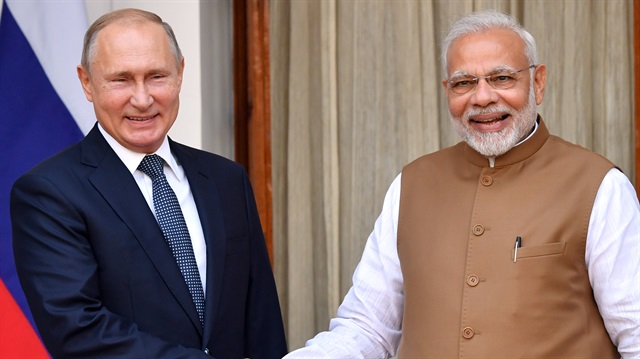
Indian Prime Minister Narendra Modi welcomes Russian President Vladimir Putin
Indian and Russia leaders on Friday signed the deal for five Russian S-400 Triumf missile shield systems, according to media reports, with an official statement expected later in the day.
After arriving in New Delhi on Thursday for a two-day visit, Russian President Vladimir Putin met on Friday with Indian Prime Minister Narendra Modi at Hyderabad house where formal talks for the 19th annual India-Russia bilateral summit are going on.
The S-400 is one of the world's most advanced long-range air defense systems. India had already indicated that it would go ahead with the S-400 deal, notwithstanding possible sanctions.
Air Chief Marshal BS Dhanoa told reporters, “As and when the government approves it, delivery [of the missiles] will be in 24 months."
Russian President Vladimir Putin met Indian Prime Minister Narendra Modi on Friday in Hyderabad House in New Delhi for annual bilateral summit talks.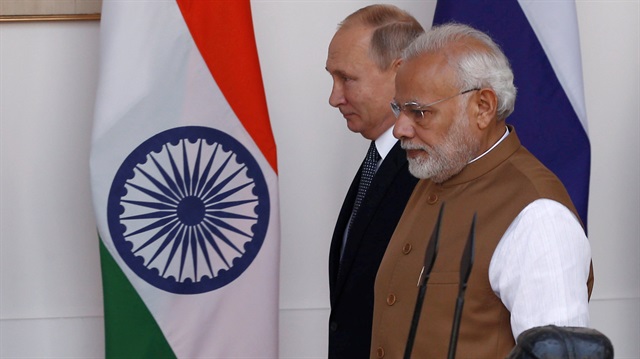
Putin meets Modi in New Delhi for annual summit talks
The U.S. has warned that under the Countering America’s Adversaries Through Sanctions Act (CAATSA), it can impose sanctions on any country that has “significant transactions” with Iran, North Korea, or Russia.
Separately, the U.S. has urged Turkey against purchasing the S-400 systems, with Turkey insisting this is a national decision.
Modi and Putin are also discussing the issues of security challenges in the Afghanistan-Pakistan region, the threat of terrorism from Pakistan, and regional and global issues.
India is also planning to acquire four Krivak-class frigates from Russia, two of which will be built in India. Under the $2.5 billion deal, two ships will be built at the Goa shipyard and two others will be acquired from Russia. India already operates six similar frigates, said a report in India.
This is the third meeting between the Modi and Putin after the informal meeting in the Russian resort city of Sochi in May and a bilateral one on the sidelines of the July BRICS summit in South Africa.
The United States has warned India against a planned purchase of S-400 surface-to-air missiles from Russia when President Vladimir Putin's visits New Delhi this week, saying such an acquisition would attract sanctions under U.S. law.India's military wants the missile batteries, both as a deterrent against China and to gain an edge over traditional rival, Pakistan, as they are able to track and shoot down combat aircraft, even stealth planes, at unprecedented ranges.India and Russia will sign the missile deal, estimated at more than $5 billion, during Putin's visit for annual summit talks with Indian Prime Minister Narendra Modi beginnning on Thursday, a Kremlin aide said.But the United States has warned countries trading with Russia's defence and intelligence sectors they would face automatic sanctions under a sweeping legislation called Countering America’s Adversaries Through Sanctions Act (CAATSA) that President Donald Trump signed into law last August.Russian gas exports to boom despite US pressure and rivalryThe law is designed to punish Putin for the 2014 annexation of Crimea from Ukraine, involvement in the Syrian civil war and meddling in the 2016 U.S. presidential election."We urge all of our allies and partners to forgo transactions with Russia that would trigger sanctions under the CAATSA," a U.S. State Department representative said."The administration has indicated that a focus area for the implementation of CAATSA Section 231 is new or qualitative upgrades in capability – including the S-400 air and missile defense system."Last month, the United States imposed sanctions on China's military for its purchase of combat fighters as well as the S-400 missile system it bought from Russia this year.Russian military tests arms to gain experience in SyriaThe United States is also concerned about NATO ally Turkey’s decision to buy the Russian missile system, seeing it as incompatible with the alliance systems.Modi's government, caught in the U.S.-Russia crossfire, hopes the Trump administration will give it a pass on the proposed arms transfer from Russia, officials in New Delhi said.Defence Minister Nirmala Sitharaman told reporters India was closing in on the deal to buy the air defence system from Russia, with which it has long-standing military ties."Negotiation on S-400 air defence systems has been on for a long while and it is at a stage where it can be finalised," Sitharaman said last week. "We have a big legacy of buying defence equipment from Russia."US would destroy banned Russian warheads if necessary: NATO envoyMore than 80 percent of India's military equipment was of Soviet origin during the days of the Cold War, but since its breakup New Delhi has diversified its weaponry.The United States is one of its top arms suppliers, closing $15 billion worth of deals in just the last decade.U.S. firms Lockheed Martin and Boeing lead the race to sell the Indian military hundreds of aircraft to replace its ageing Russian MiG planes.The Modi government hopes the Trump administration will not disrupt burgeoning defence ties with the world's biggest arm importer by levying sanctions the U.S. Congress has sought.The Trump administration faced competing pressures from Congress pursuing a hard line on Russia, said Jeff Smith, a specialist on South Asia at the Heritage Foundation."The administration was critical of the CAATSA and fought hard for a national security waiver at the cabinet secretary level but was denied by Congress," he said."The administration is not only trying to navigate competing geopolitical interests but relatively stringent conditions imposed by a Congress determined to tie its hands on Russia policy." 
India risks US sanctions with $5-bln purchase of Russian missiles