

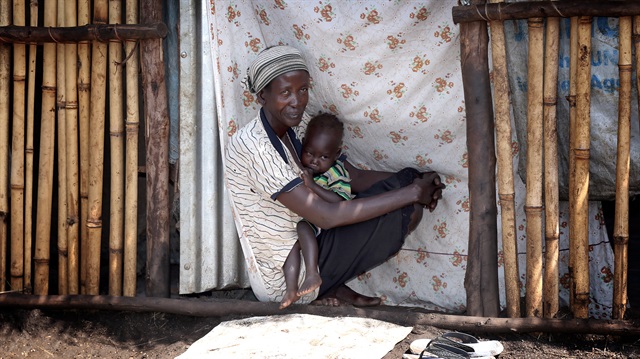
File photo: Nguenyyiel refugee camp in Ethiopia
The Ethiopian capital Addis Ababa is getting warmer and brighter as clouds and thunderstorms from the rainy season recede.
The fragrance of butter flowers that accompany the Ethiopian New Year wafts through the air.
But some 1,125 kilometers (699 miles) from Ethiopia, in the ancient country of Yemen, there are no floral scents, no hope. Instead, there are dark clouds of fear as death and destruction forced many to flee to Ethiopia, where they are now refugees.
Impoverished Yemen has remained wracked by violence since 2014, when Houthi rebels overran much of the country, including Sanaa.
The conflict escalated in 2015 when Saudi Arabia and its Sunni-Arab allies launched a massive air campaign in Yemen aimed at rolling back Houthi gains.
The ongoing violence has devastated Yemen’s basic infrastructure, prompting the UN to describe the situation as “one of the worst humanitarian disasters of modern times”.
According to the United Nations High Commission for Refugees (UNHCR), at the end of June 2018, there was a total of 22,443 refugees in Addis Ababa, mainly from Eritrea, Yemen, Somalia and South Sudan, as well as refugees of other nationalities mainly from the Great Lakes region.
Of the 22,443 urban refugees, 17,720 or 79 percent are Eritrean and 1,900 are Yemenis, the agency stated.
Jemal al-Hada, 58, is an Ethiopian-born Yemeni painter. The grey-haired and soft-spoken al-Hada is culturally connected to the host country due to his Ethiopian blood.
“Here in Addis Ababa, it is a bright first month of the Ethiopian calendar. But my beloved country, Yemen, has been plunged into the darkness of an endless, destructive war,” he said.
Ethiopia has failed to transfer to a Turkish foundation the schools linked to Fetullah Terrorist Organization (FETÖ), despite instructions given by the Ethiopian Prime Minister’s Office.In March 2017, the Prime Minister’s Office had directed the Ministry of Education to transfer six schools owned by the FETÖ to Turkey’s Maarif Foundation.FETÖ and its U.S.-based leader Fetullah Gulen orchestrated the failed coup of July 15, 2016, which left 251 people martyred and nearly 2,200 injured.Ankara also accuses FETÖ of being behind a long-running campaign to overthrow the state through the infiltration of Turkish institutions, particularly the military, police, and judiciary.According to information obtained by Anadolu Agency, the schools were not transferred to the foundation, despite a letter was sent by Ethiopian former Prime Minister Hailemariam Desalegn to the then Education Minister Shiferaw Teklemariam and Trade Minister Bekele Gulado.The letter signed by Desalegn was not implemented due to the network of the terror group in Ethiopian bureaucracy.The letter directed the relevant authorities to revoke the license of the investment group, named Kaynak, due to its ties to the terror group and transfer the schools to Maarif Foundation.Teklemariam, the then education minister, was dismissed from his post by new Prime Minister Abiy Ahmed. He was later appointed as Ethiopian ambassador to South Africa.Shortly after the Ethiopian President Mulatu Teshome said the FETÖ-linked schools will be handed over to the Turkish foundation, the schools were fraudulently sold to a German citizen.The schools were renamed as "Intellectual Schools".
Ethiopia fails to hand over FETÖ schools to Turkey
‘Wiping Yemen off the map'
Al-Hada said he is always frightened to switch on the television and watch the news. “Because I fear that I could hear and watch the shocking incident similar to the bombing of the school bus last August,” he added.
On Aug. 9, a Saudi-led airstrike targeted a bus carrying children in Yemen’s northwestern Saada province. At least 50 people, mostly children, were killed and dozens of others injured. In September, the coalition expressed regret over “mistakes” committed in a deadly airstrike on the bus.
“When burdens of the pains of my country and family weigh me down, I take my brush and canvas and express my feelings,” the painter added.
Mehider Mohammed, a retired pilot who has served Yemeni flag carrier Yemenia for 35 years, arrived in Ethiopia eight months ago.
Speaking to told Anadolu Agency, Mohammed said the war had made his retirement life “deplorable.”
“For me, it was a time to be with my family in my country, but I have no country. I live in Ethiopia, Egypt and Dubai,” he said.
In a loud and angry voice, he added: “Regional powers, different factions are about to wipe Yemen off the map. The war is neglected and we have no hope.”
Yemeni refugees in Addis Ababa frequently gather and dine at two restaurants, Sanaa and Nakla, which offer Yemeni food.
Al-Hada said that financial support from relatives in Yemen was no longer forthcoming as the economy has been in tatters and 22 million Yemenis are in need of humanitarian assistance.
“We are poor and live on monthly assistance of $70 provided by the UNHCR, he said, adding that the Ethiopian and Yemeni communities had been lending them a helping hand.
The Israeli government has consented to take in some 1,000 Falasha Jews from Ethiopia, according to a Monday statement issued by Prime Minister Benjamin Netanyahu's office."As part of the decision, [Falasha] parents will be able to bring with them their spouses and unmarried children [from Ethiopia]," the statement read.Israel’s Interior Ministry, it added, would provide all incoming Falashas with "all the rights typically granted to Ethiopian immigrants”.According to the PM’s office, the move is based on a 2006 government decision calling for the “reunification” of Falasha families from Addis Ababa and the city of Gondar, where most of Ethiopia’s Falasha community is concentrated.In 2003, Tel Aviv decided to allow Falashas -- whom Israel deems to be authentically Jewish -- to immigrate to the self-proclaimed Jewish state, where they now number roughly 130,000.Gaza to launch 1st marine ambulanceIsrael preparing for offensive against Gaza: NetanyahuIsrael arrests sister of West Bank shooterIsrael frees Palestinian after 30 years behind bars
Israel vows to take in 1,000 Falasha Jews from Ethiopia
Perilous journey
“The Ethiopian government had allowed Yemeni refugees living in Djibouti to enter Ethiopia and settle in the capital,” al-Hada added.
Ethiopia and Yemen share centuries of cultural and historical ties and there have been intermarriages.
“We feel at home, anyways,” al-Hada said.
Despite the unabated conflict and deteriorating humanitarian conditions in Yemen, many Eritrean refugees living in Addis Ababa contemplate taking the perilous journey to Yemen as their escape route to Europe.
According to the UNHCR, there are more than 280,000 refugees from the Horn of Africa, and last year, 87,000 new arrivals landed on Yemeni shores. Many had been subjected to detention and abuse by criminal groups in a lawless country while hundreds drowned in the Gulf of Aden.
Epherem Tadesse, 35, was an Eritrean soldier who escaped to Ethiopia five years ago.
“In Addis Ababa, we are treated well by the public,” he said. “However, Ethiopian law does not allow us to get employed or engage in business,” he added.
According to him, the recent diplomatic rapprochement that ended two decades of no war, no peace could not guarantee them freedom to return home.
In July, Ethiopian Prime Minister Abiy Ahmed and Eritrean President Isaias Afewerki agreed to end two decades of stalemate caused by the 1998-2000 border war, which killed tens of thousands of people from both sides. Now borders are opened to business.
“We fear retribution from the [Eritrean] regime, which is known for punishing its opponents and deserters without the due course of the law,” he asserted.