

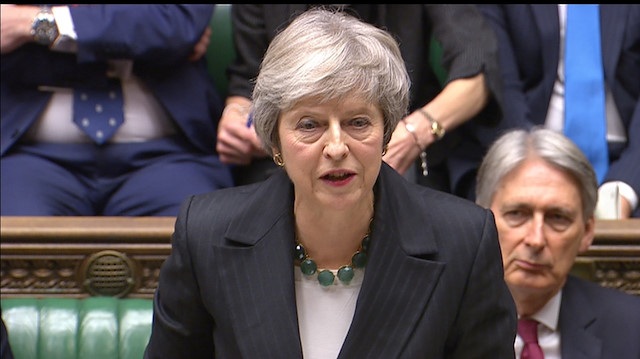
Britain's Prime Minister Theresa May
Britain's Prime Minister Theresa May on Friday rejected a suggestion that she was a modern-day Neville Chamberlain, the British leader mocked for claiming he had secured peace with Germany's Adolf Hitler a year before World War Two broke out.
Some lawmakers in May's Conservative Party argue that her draft divorce deal with the European Union is a capitulation to the bloc which will leave Britain subject to its rules indefinitely after the country leaves in March 2019.
Asked whether she was a modern-day Chamberlain, May told LBC radio: "No I don't and the reason is this: we are not going to be locked in forever to something that we don't want."
Dominic Raab tripped up on Michel Barnier's Brexit staircase -- that is how EU negotiators see how the reworking of a draft deal reached a month ago led to new demands on Britain that prompted him and other ministers to resign.It lays out a descending trade-off between rights and obligations, from full EU membership at the top left (many rights like full access to the EU market but many obligations such as open migration, strict EU rules and budget payments) to Canada's free trade pact EU at bottom right, which commit the North Americans to relatively little beyond the commercial area.According to EU officials and diplomats close to the Brexit negotiations, it was demands by Brexit Secretary Raab and Prime Minister Theresa May to seek more rights than were offered in a draft deal a month ago -- notably a guarantee of a customs union -- that led to Wednesday's deal ending up laden with further obligations which Raab and other Brexiteers could not stomach.Brexit divorce deal thrusts UK PM May into biggest crisis of premiership"They came up against Barnier's staircase," one senior EU official said of how the drafts were transformed since Oct. 13 to build in more rights for Britain but also more demands. "We have to have an exact balance of rights and obligations."That, EU diplomats say, is also something that Britons who want to reopen negotiations would do well to bear in mind.British politicians complain that rigid euro-thinking is their biggest problem. But an EU diplomat said Raab may have miscalculated how Brussels trades off access for rules as he tried to step up from "Canada plus" -- a super free trade deal near the bottom towards a bare-bones customs union that officials label "Turkey minus".France preparing transport, customs measures in case of no-Brexit dealMONTH OF CHANGEOn Oct. 13, the technical experts hammering out the details of the pact -- Barnier's deputy Sabine Weyand and May's adviser Oliver Robbins -- arrived at a draft deal that addressed fears of disruptive checks on the Irish land border by promising that Britain could later negotiate an EU customs union.This was a crucial EU concession, as Barnier noted after a new deal was struck on Wednesday, because it overrode an EU demand that Britain's province of Northern Ireland could be in a separate customs zone from the mainland if hopes for other trade accords that would keep the border open failed to materialise.However, that Weyand-Robbins deal failed to pass muster in London and when Raab came to Brussels to kill it off on Oct. 14 he made clear that Britain needed much more of a guarantee that it would get a customs union deal as an "all-UK backstop".The previous draft included only a commitment to work on a single customs area in the future, but no details of what that would look like. And in the event it was not agreed, Northern Ireland would have to stay in a customs union with the EU, with or without the rest of the UK."That was not enough for the UK government because there was no cast-iron guarantee there would not be a customs border between Northern Ireland and Great Britain," a senior EU official said on Thursday.The negotiators went back to the drawing board. The EU had been telling London for months that it could not extend sweet terms offered to struggling Northern Ireland alone -- giving it access to EU markets -- to Europe's second biggest economy.But, they said, if Britain accepted more EU regulation of its industries in order to counter complaints from other EU governments that it was getting a free pass, it might work.The result was scores more pages added to the draft treaty aimed at ensuring a "level playing field" for France, Germany and the others over British industries getting custom-free access to the EU market. For good measure, and French favour, they also added demands on access to Britain's fishing grounds.May called it the best deal available. It proved, however, to be a step too far for several of her ministers, including Raab. He resigned saying: "No democratic nation has ever signed up to be bound by such an extensive regime, imposed externally without any democratic control over the laws to be applied."While there is speculation in London of a challenge to May and of other Britons coming back to Brussels to renegotiate, EU diplomats and officials say they could imagine yet more talks. But those EU trade-offs between rights and obligations will not change, they say, and Britons must beware Barnier's staircase. 
How Britain's Raab tripped on 'Barnier's staircase'
Chamberlain famously returned from a meeting with Hitler in 1938 waving a declaration which he said provided "peace for our time" but ultimately proved worthless and was regarded as a failed attempt to appease Nazi Germany.
He was ousted in 1940 after war broke out and replaced by Winston Churchill.
British PM May refuses to rule out free vote on Brexit deal
British Prime Minister Theresa May repeatedly refused on Friday to rule out allowing her senior ministers to get as so called free vote, which allows lawmakers to vote against the wishes of their party, on the draft Brexit deal.
When asked whether her cabinet will get a free vote, May said: "We will be looking at the deal when it comes back. There is cabinet collective responsibility in this country. Government policy is government policy."
Prime Minister Theresa May was grappling with the biggest crisis of her premiership on Friday after a draft divorce deal with the European Union provoked the resignations of senior ministers and mutiny in her party.More than two years since the United Kingdom voted to leave the EU in a shock referendum, it is still unclear how, on what terms or even if it will leave the EU as planned on March 29, 2019.Ever since winning the top job in the turmoil that followed the 2016 referendum, May has sought to negotiate a Brexit deal that ensures that the United Kingdom leaves in the smoothest way possible.But Brexit minister Dominic Raab resigned over her deal, sending the pound tumbling. Mutinous lawmakers in her own party openly sought to challenge her leadership and bluntly told her that the Brexit deal would not pass parliament.France preparing transport, customs measures in case of no-Brexit dealAsked if she would contest any challenge to her position, May replied: "Am I going to see this through? Yes." She is due to speak on LBC radio at 0800 GMT.On Friday, it was not clear whether Michael Gove, the most prominent Brexit-supporting minister in her government, would stay on as environment minister after May offered him the job of Brexit minister, British newspapers reported.Brexit will pitch the world's fifth largest economy into the unknown. Many fear it will divide the West as it grapples with both the unconventional U.S. presidency of Donald Trump and growing assertiveness from Russia and China.Amid the deepest political turmoil since the Suez canal crisis, when in 1956 Britain was forced by the United States to withdraw its troops from Egypt, the ultimate outcome remains uncertain.UK PM May could be replaced in weeks rather than monthsScenarios include May's deal ultimately winning approval; May losing her job; Britain leaving the bloc with no agreement; or even another referendum.The EU and Britain need an agreement to keep trade flowing between the world's biggest trading bloc and the United Kingdom, home to the biggest international financial centre.Supporters of Brexit say that while the divorce might bring some short-term instability, in the longer term it will allow the United Kingdom to thrive and also enable deeper EU integration without such a powerful reluctant member.By seeking to preserve the closest possible ties with the EU, May has upset her party's many advocates of a clean break, and Northern Ireland's Democratic Unionist Party (DUP), which props up her minority government.Brexit strengthens Scottish independence case: SturgeonMeanwhile, proponents of closer relations with the EU in her own party and the Labour opposition say the deal squanders the advantages of membership for little gain.The deal will need the backing of about 320 of parliament's 650 lawmakers to pass."It is ... mathematically impossible to get this deal through the House of Commons. The stark reality is that it was dead on arrival," said Conservative Brexit-supporting lawmaker Mark Francois. UK PM May warns: It is my deal, no deal or no Brexit
Brexit divorce deal thrusts UK PM May into biggest crisis of premiership
France is preparing various measures, notably those dealing with customs controls and checks at ports, in case there is no Brexit deal, said French transport minister Elisabeth Borne."We are making preparations for the hypothetical scenario of no agreement. For that scenario, we will be preparing customs controls, veterinary measures to put in place and also measures for checks at ports," Borne told CNews television on Friday.On Thursday, British Prime Minister Theresa May vowed to fight for her draft divorce deal with the European Union after the resignation of her Brexit secretary and other ministers put her strategy and her job in peril.In October, French minister Gerard Darmanin, who is in charge of customs, said France was hiring 700 additional customs officers and extra border control facilities in preparation for a potential no-deal in Britain's negotiations over its divorce from the European Union.Brexit strengthens Scottish independence case: SturgeonFrench PM Philippe: We have to be ready for 'no-deal' BrexitUK's Brexit Secretary Raab resigns thrusting May's government into turmoil
France preparing transport, customs measures in case of no-Brexit deal