

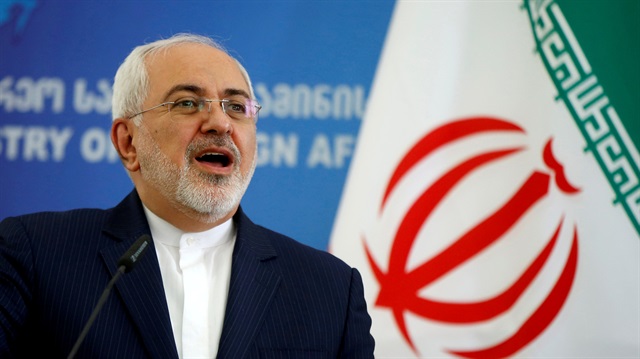
Iranian Foreign Minister Mohammad Javad Zarif
Iranian Foreign Minister Javad Zarif arrived in Damascus on Monday for talks ahead of a planned trilateral summit on war-torn Syria.
The top diplomat was welcomed by Syrian Deputy Foreign Minister Faisal Mekdad upon arrival at the airport.
The visit comes amid preparations by Syrian regime forces and allies to attack the northwestern Idlib province, the last major opposition stronghold in Syria.
“Al-Nusra and Hayat Tahrir al-Sham terrorist group must be cleaned out of Idlib,” Zarif said in statements.
According to Iran’s official IRNA news agency, Zarif will hold talks with Syrian President Bashar al-Assad and Foreign Minister Walid al-Muallem later in the day.
Israeli Defense Minister Avigdor Lieberman on Monday hinted that Israel could strike Iranian targets outside Syria.The Israeli Broadcasting Authority quoted Lieberman as saying: “We aren’t limiting ourselves to Syria. That should be clear.”Speaking at a conference in Jerusalem, the hardline defense minister did not elaborate on the nature of the Iranian targets that Israel might attack.In recent months, Israel has admitted to striking a number of Iranian targets inside Syrian territory.‘US is preparing to strike over 20 regime positions in Syria’UNRWA chief defends refugee criteria for millions of PalestiniansIsrael signals it could target Iranian military assets in IraqWorld-famous artists boycott Israeli music festivalIsraeli navy injures Palestinian during boat protest
Israel may strike Iran targets outside Syria: Lieberman
Located near the Turkish border, Idlib has been designated as a de-escalation zone where acts of aggression are expressly forbidden as part of the ongoing Astana process.
Nevertheless, for the past two months, the Idlib de-escalation zone has been the target of particular fierce airstrikes by Russia and Assad regime forces.
A tripartite summit is scheduled to be in Iranian capital on September 7 to discuss the situation of resolving the 7-year conflict in Syria.
The Iranian Foreign Ministry on Monday labeled an upcoming trilateral summit between Iran, Russia and Turkey on Syria as a “step toward peace, security and stability” in the war-torn country.The summit is scheduled to be held in Tehran on September 7 at the level of heads of state and foreign ministers as a follow-up to the Astana meeting held in Kazakhstan in mid-March.“It is not logical to imagine that the prolonged crisis in Syria would be resolved with a meeting but we believe that the only possible path to this situation is the political solution,” ministry spokesman Bahram Ghasemi said in his weekly press conference.The summit is also expected to address the situation in the northwestern Idlib province near Turkish border.In April, the leaders of the three countries, Recep Tayyip Erdogan, Vladimir Putin and Hassan Rouhani, met in Ankara to discuss means of resolving the 7-year conflict in Syria.The three mediator countries are acting as guarantors of a proposed cease-fire in Syria and have been trying to push peace talks since 2016 to resolve the Syrian conflict.Ghasemi said Iranian military advisers will remain in Syria at the request of the Syrian government to continue what he described as fighting “terrorism”.Iran and Shia group Hezbollah are strong allies of the Bashar al-Assad regime, whose forces have been fighting opposition groups in a deadly civil war since 2011.Since then, hundreds of thousands of people are believed to have been killed and millions more displaced by the conflict.
Syria tripartite summit ‘step to peace’: Iran
The summit, which will be held at the level of heads of state and foreign ministers, will be held as a follow-up to the Astana meeting held in Kazakhstan in mid-March.
Iran and Shia group Hezbollah are strong allies of the Bashar al-Assad regime, whose forces have been fighting opposition groups in a deadly civil war since 2011.
Since then, hundreds of thousands of people are believed to have been killed and millions more displaced by the conflict.
Syrian President Bashar al-Assad’s army is on high alert in anticipation of a potential U.S. attack.The U.S. is reportedly in preparation to launch strikes against more than 20 positions of Assad regime forces.On the other hand, Israel conducted a string of missile attacks against five of Assad’s military bases, including Mezzeh Military Airport, and the Syrian army’s 4th, 10th and 66th division early on Sunday morning. The strikes were fired from Israeli military aircrafts in Golan Heights.According to reports, Bashar al-Assad’s brother Maher Assad was wounded during the raids, and 25 Syrian army troops and 45 Shia militias were killed, including Iranian Revolutionary Guards General Marasad al-Mizani.US will first target major air basesSpeaking to Yeni Safak daily, Syrian army Colonel Abu Firas stated that the U.S. would first hit Assad’s eight major air bases, notably Tifur and Homs airport, in case of any possible Idlib attack.“Israel’s bombings were signal flares. The U.S. in waiting in ambush for a more comprehensive attack. The Syrian army is on offensive mode against a possible U.S. attack, and the joint air defense system of Russia-Syria is on red alert,” he said, adding that the U.S. was planning to strike over 20 points of the regime in Syria.Damascus has said that the U.S. is preparing to falsify a chemical attack to justify a military operation in Syria.U.S., British and French forces launched air strikes on Syria in response to a suspected poison gas attack that killed dozens of people in April.Idlib and areas surrounding it are the last major enclave held by groups opposed to Syrian President Bashar al-Assad, who is is preparing a phased offensive to regain the province.Syrian forces hide among civiliansHe said that following Russia’s intelligence warning, Syrian troops positioned in strategic bases in Homs, Damascus and Quneitra were being evacuated.Stressing that Assad’s forces disguise themselves as civilians, “They stay among civilians in the evenings and come back to their bases in the mornings,” said Firas.Constant vigilance at Iranian bases Forces were placed on high alert at nine large bases belonging to Iranian Shia militias and the Revolutionary Guards at Quneitra, Deir ez-Zor, Aleppo, Damascus and Homs.“Mezzeh was one of the most important points where the Iranian-developed Fajr missiles were positioned. Missile platforms and some Fajr rockets were destroyed on Sunday night. The Mezzeh base is being used as headquarters of Shia militias. Additionally, Fajr-3 and Fajr-5 missile platforms were deployed at the Mezzeh Airport.”“The Fajr-3 missiles have a range of 50 kilometers and Fajr-5 missile’s estimated range is 80 kilometers. Hence, these missiles have the capability to strike northern Israel. There are also huge underground tunnels between Mezzeh and the Presidential Palace. They were hiding a vast amount of ammunition and weapons there, but a great deal of the missiles and artillery have been destroyed during Israel’s attack.”Syria has been locked in a vicious civil war since early 2011 when the Assad regime cracked down on pro-democracy protests with unexpected ferocity.
‘US is preparing to strike over 20 regime positions in Syria’