

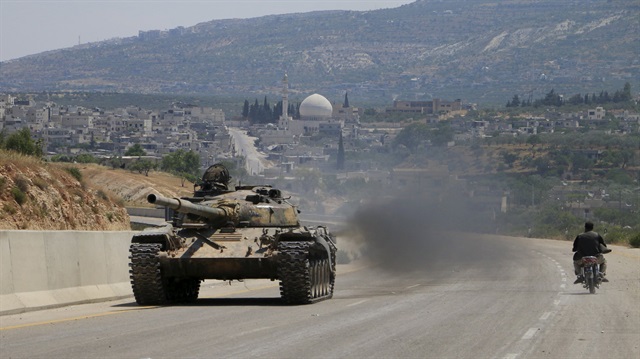
File photo
Opposition groups in Syria's northwestern Idlib announced on Saturday that they had begun withdrawing heavy weapons from the frontlines, conforming to the Turkey-Russia deal.
Naci Mustafa, a spokesman for the National Front for the Liberation of Syria affiliated with the Free Syria Army (FSA), told Anadolu Agency that the opposition groups began withdrawing their heavy weapons in line with the Sochi agreement in which Russia and Turkey agreed to set up a demilitarized zone.
Mustafa said the light weapons would remain and they would continue digging ditches as a measure against a possible attack by the Syrian regime.
"The removal of heavy weapons is being carried out with the coordination of Turkish authorities," he said.
Following a meeting in Sochi last month between Turkish President Recep Tayyip Erdogan and his Russian counterpart Vladimir Putin, the two countries agreed to establish a demilitarized zone in Idlib, Syria’s last opposition stronghold.
Ankara and Moscow also signed a memorandum of understanding calling for the “stabilization” of Idlib's de-escalation zone, in which acts of aggression are expressly prohibited.
Under the deal, opposition groups in Idlib will remain in areas in which they are already present, while Russia and Turkey will conduct joint patrols in the area with a view to preventing renewed fighting.
Syria has only just begun to emerge from a devastating conflict that began in 2011, when the Assad regime cracked down on demonstrators with unexpected ferocity.
At least five civilians were killed and 27 others were injured after a car bomb exploded in the northern Syrian city center of Azaz on Saturday.The large explosion, which occurred near a fuel center, sent up large pillars of smoke as fires engulfed the area. The wounded were rushed across the border to Turkey’s Kilis Public Hospital to receive treatment.Azaz is located 350 kilometers north of Damascus. It is just a few kilometers from the border with Turkey.Video: Car bomb kills three, injures 15 in Syria's Azaz
Car bomb kills five, injures 27 in Syria’s Azaz
As the conditional and temporary U.S. support for the YPG/PKK terror group in Syria has turned out to be permanent against Iran and Russia, Washington is moving into a strategic dead end in Syria.The U.S. tactic to work with the YPG/PKK against Daesh, which started during former President Barack Obama administration and continued in Donald Trump administration is putting Washington on a path of no return.Starting from 2014, the U.S. initially provided air support and then arms to the terror group, with the pretext of fighting Daesh.American officials claimed the support for the group was limited and conditional with the fight against Daesh and then Washington dispatched more than 2,000 troops to the region and established airports as well as military bases in the areas controlled by the YPG/PKK. - U.S. military bases in Syria According to local sources, the U.S. has established 13 operational military bases in the YPG/PKK controlled territories including Hasakah, Raqqah, Manbij, Ayn al-Arab (Kobani) and Tal-Abyad in Syria. The U.S. has established a military base near the largest oil field in al-Omar and Daesh's last fortress Hajjin town in eastern Deir ez-Zour province.Additionally, the construction of two more military bases in Qamishli started a few months ago. When completed, the U.S. will have maintained military presence in 18 locations in the country. In addition, the U.S. is said to have so far supplied YPG/PKK with more than 4,000 truckloads of arms and military materials. Besides, U.S. Special Operation Forces are providing the group with basic combat and internal and border security training. The US-led coalition has also established radar and missile defense systems in areas controlled by the YPG/PKK. - From anti-Daesh fight to strategic confrontation with Russia, Iran These build-ups of the U.S. indicate that it will not pull out of Syria so soon. U.S. officials including Defense Secretary Jim Mattis have been saying that American troops would stay in Syria until the conditions are set to prevent Daesh to regroup and UN-led Geneva process comes up with a political solution for the country.What is more, just recently White House National Security Advisor John Bolton, in parallel with the Trump administration's anti-Iran rhetoric, said the U.S. would not withdraw from the region “as long as Iranian troops are outside Iranian borders." It has been suggested by many for a long time that the U.S.'s arms and military build-ups in Syria and its aid to the YPG/PKK shifted from the fight against Daesh into a strategic confrontation against Iran and Russia. In recent weeks, Syria has become a battlefield between Iran and Israel. Israel repeatedly bombed the regime's bases which, it claims, are controlled by Iran. After the failure of the S-125 and S-200 air defense systems used by Bashar al-Assad regime against Israel and the downing of a Russian reconnaissance aircraft in the Mediterranean Sea, Russia deployed S-300 missile systems in support of the regime. The U.S. central command Commander Gen. Joseph Votel described Russia's move as a “needless escalation” of the conflict. In addition, Iran launched missiles on several targets in Syria last week, claiming to have links with the Ahwaz attack. The Pentagon has called the attacks "reckless, unsafe and escalatory” as they were not coordinated with the U.S. beforehand. Based on all these developments military experts point out that the U.S. has been dragged into a strategic dead end in Syria, where it intervened conditionally to fight against Daesh. - Occupation strategy loses in long-termTying its Syria strategy to a terror group like YPG/PKK in Syria might have some advantages for Washington in the short run, but it is argued that this approach will leave it alone in Syria in the long-term.Former ambassador James Jeffrey, the recently-appointed U.S. special representative for Syria, was among those who emphasized the handicaps in cooperating with YPG/PKK in the long-term.However, Washington insists on ignoring the warnings made in this regard, especially by Turkey.YPG/PKK’s actions such as displacing Arabs in the areas it has occupied and using violence against people who oppose to the terror group undermine the U.S. strategy.The intimidation by the YPG/PKK led to protests in predominantly Arab areas such as Raqqah, Manbij and Tal Abyad.The YPG/PKK's treatment of residents, who do not support the organization, was covered in reports of non-governmental and international organizations such as Human Rights Watch and Amnesty International, and it was highlighted that some of the YPG/PKK actions might even amount to war crimes.The U.S. officials constantly overlooked the questions about these reports, and disregard the discomfort the YPG/PKK imposes on residents of the areas it controls. - US losing TurkeyThe U.S. for its support to YPG/PKK has lost Turkey’s support in Syria to a significant extent.Even though some diplomatic steps Turkey has taken together with Russia and Iran are implemented to some extent, the U.S. has yet to implement Manbij deal with its NATO ally, which has led comments as Ankara’s goodwill towards Washington is running out.As the card the U.S. has against Russia and Iran is its own military force, losing Turkey due to its support with the YPG/PKK shows that the U.S.’s Syria policy would fizzle out. Just yesterday former Defense Secretary Chuck Hagel said in an interview: “It’s complete folly to think you’re going to threaten the Syrians or the Russians or the Iranians into anything because they hold more cards than we do.”Washington's conditional and limited partnership with the YPG/PKK, which is maturing increasingly permanent, is leading Washington to a long-term strategic impasse that is hard to return.
US headed toward strategic deadlock in Syria
The U.S. has yet to fulfill its promises given to Turkey about Manbij, Syria, with the YPG/PKK terror group surrounding the district center with trenches and embankments.After Turkey and the U.S. agreed this June to a roadmap agreement for removal of the YPG/PKK terror organization from Manbij, the terror group has to the contrary stepped up its presence and activities in the area, according to Anadolu Agency reporting. The terrorist group has completed the construction of trenches and embankments in areas surrounding the entire city center as if it has no intention of leaving.Highlighting problems with the agreement, Turkish presidential aide Ibrahim Kalin said on Wednesday: "Delaying tactics started becoming a growing problem. The Manbij roadmap should be implemented as soon as possible."Video: YPG/PKK dig ditches around Manbij in fear of Turkish forcesThe terror organization formed embankments at various depths in front of trenches to make up a series of lines stretching nearly 30 kilometers (18.06 miles).The trenches can be clearly seen from the sky in satellite photos taken by Anadolu Agency.The YPG/PKK terrorists also built tunnels linking trenches to use during possible combat.The terror group, using the Syrian Democratic Forces (SDF) label, organizes "defense of Manbij" meetings under the terror leadership from the PKK headquarters in Mt. Qandil, Iraq. Buildup next to areas liberated by TurkeyThe YPG is the Syrian branch of the terrorist PKK, whose 30-year terror campaign in Turkey has taken some 40,000 lives.Senior PKK/YPG terrorists train newly joined members of the terror group who escaped from Afrin -- liberated by Turkish-led forces this March -- to Manbij with U.S. support under the SDF umbrella.Turkey has long objected to U.S. support for the YPG/PKK.While the U.S. recognizes the PKK as a terrorist group, it has claimed the YPG is a “reliable ally” in the fight against Daesh, ignoring Turkey’s evidence that it is actually a PKK branch.The YPG/PKK terror group is also in the midst of a military buildup along Manbij's border with areas liberated by Turkey’s Operation Euphrates Shield in 2016-2017.The Turkish army first started patrolling on June 18 in Manbij with U.S. troops in line with a previously agreed roadmap for eliminating terrorists and stabilizing the area. So far the two armies have done 55 patrols in the region.The Manbij roadmap was first announced after a meeting in Washington between Turkish Foreign Minister Cavusoglu and U.S. Secretary of State Mike Pompeo.The deal focuses on the withdrawal of PKK-affiliated YPG terror group from the northern Syrian city and stability in the region.Turkey has said the presence of terrorist forces near its border constitute a threat, and has launched military operations and other efforts to rid the region of terrorists.U.S. military support for the YPG/PKK terrorist group in Manbij has strained ties between Ankara and Washington and has led to fears of military clashes between the two NATO allies, since there are roughly 2,000 U.S. troops in the city.
YPG/PKK terror group digging in around Manbij, Syria
Russia's deployment of the S-300 anti-aircraft defence system in Syria risks fuelling military escalation and hindering prospects for a political solution to the seven-year conflict, France's foreign ministry said on Friday.Moscow said on Tuesday it had delivered the surface-to-air missile system after the downing of a Russian spy plane by Syrian forces in September. Russia accused Israel of being indirectly responsible for that act because the Syrian forces had been firing at attacking Israel jets."France notes with concern the delivery by Russia of sophisticated anti-aircraft capabilities for the benefit of the Syrian regime," Foreign ministry spokeswoman Agnes von Der Muhll told reporters in an online briefing."Amid regional tensions, the delivery of such equipment by Russia contributes to maintaining the risk of military escalation and removing the prospect of a political settlement of the Syrian crisis," she said. India, Russia sign S-400 air defense system deal
Russia deployment of S-300 in Syria risks military escalation: France